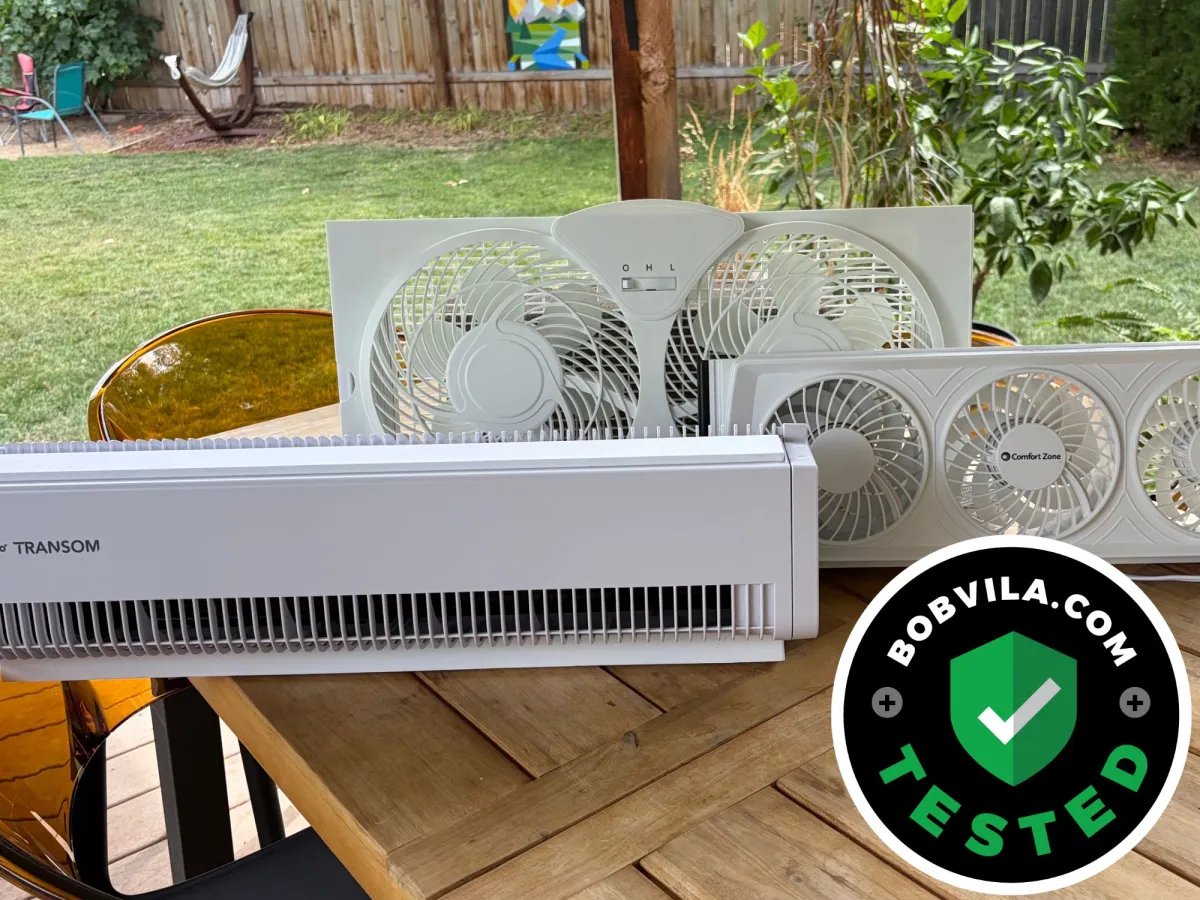
The 5 Best Window Fans for Affordable Home Cooling, Tested
When you’re trying to keep your home cool without sending your electric bill sky high, nothing beats a window fan. These devices mount to the bottom of a typical window frame and circulate air to bring in a breeze, consuming much less energy than an air conditioner. While hardly high-tech tools, the best cooling fans have a few features that suit them to specific functions, so it pays to be a discerning shopper.
To help you choose the right one, we tested 10 highly rated window fans, evaluating their ease of installation, airflow, and noise, among other factors. Based on our results, the Genesis A1 Window Fan earned our top award. Thanks to its accordion panels, it fits most window openings but also works as a freestanding fan via its included feet. We also like that it has an adjustable thermostat and reversible airflow.
Read on to learn what you should look for when choosing from among the best window fans, and how these criteria and our hands-on testing informed our top picks.
- BEST OVERALL: Genesis A1 Window Fan
↓ Jump to Review - BEST BANG FOR THE BUCK: Amazon Basics Twin Window Fan
↓ Jump to Review - BEST TWIN: Comfort Zone 9-Inch Reversible Twin Window Fan
↓ Jump to Review - BEST TRIPLE: Comfort Zone 3-Speed Triple Window Fan
↓ Jump to Review - BEST QUIET: Vornado Transom Window Air Circulator
↓ Jump to Review - BEST WHOLE HOUSE: Air King 20-Inch Whole-House Window Fan
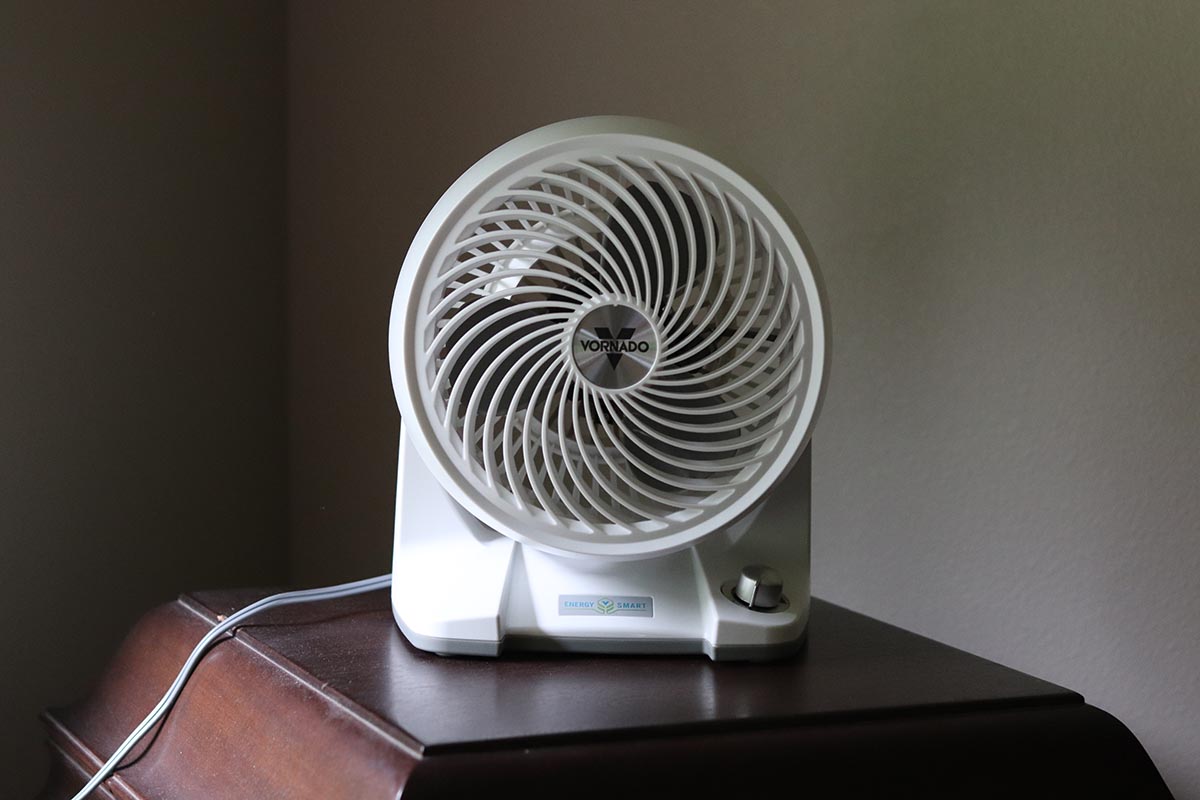
↓ Jump to Review - BEST COMPACT: Vornado Energy Smart Small Air Circulator Fan
↓ Jump to Review - BEST PORTABLE: Treva 10-Inch Portable Battery Powered Fin Fan
↓ Jump to Review
Best Window Fans at a Glance
Our Top Picks
The following list of eight of the best fans includes desk and floor fans as well as standard frame window fans. Each one is powerful enough to circulate ample air and has user-friendly controls that make it easy to operate.
Best Overall
Photo: Amazon
What We Like
- Thermostat or standard controls to suit users’ preferences
- Can function as a stand-alone or window fan
- Provides ample airflow
What We Don’t Like
- Materials feel cheap compared to similar window fans available
Product Specs
-
Max airflow:
706 CFM -
Size:
24 inches long by 12 inches tall by 4 inches deep -
Reversible:
Yes
Our Ratings
| Installation | 4/5 | Air Circulation | 4.5/5 | Noise | 3.5/5 | Cleanability | 4/5 | Value | 4.3/5 |
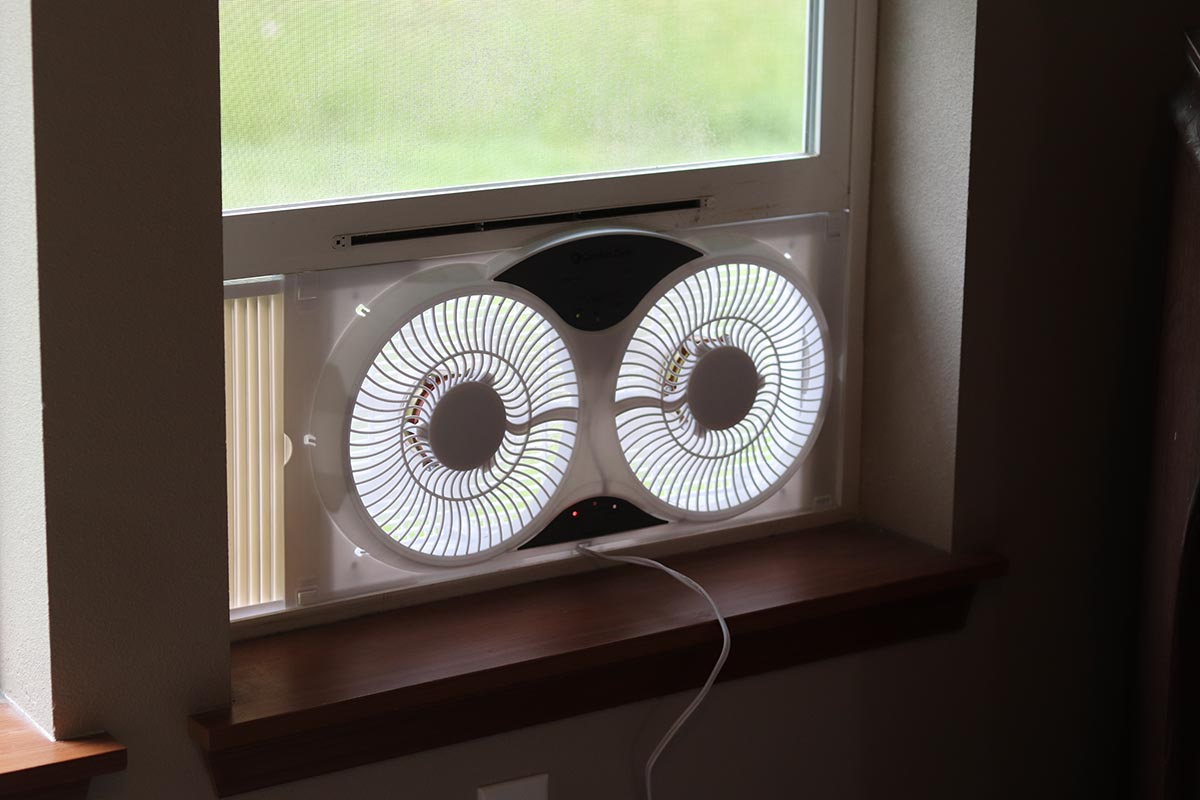
Loaded with features that make it easy to control, coupled with a design that allows it to be installed in a window or used as a freestanding fan, this dual window fan is one of the more versatile options on the market. Accordion panels on the sides help create a good fit. However, users should expect some wrestling as they try to expand the stiff panels while locking them in place from the top and bottom.
It also comes with feet, which can be attached to turn the fan into a freestanding model. The feet were easy to put on and take off during testing. There are three speed settings, and users can toggle the direction of each fan independently to intake or exhaust. This was the only fan we tested that allowed us to change the direction of each fan independently. It was a nice feature, though it probably would’ve worked better if we could have gotten a better seal with the window.
Users can set each fan to a specific speed or automate the fans using the thermostat temperature settings on the Genesis, which is a handy feature. One thing we didn’t like, however, was how cheap the materials felt. It seemed like if we dropped this fan, it would most definitely break.
What our tester says: “I liked leaving this fan on the automatic setting so I could set it and forget it. It provided good airflow and wasn’t too noisy unless it was on the highest setting.”—Stacey L. Nash, Product Reviews tester and writer
Get the Genesis window fan at Amazon or The Home Depot.
Best Bang For The Buck
Photo: Amazon
What We Like
- Easy to install and operate
- Comes with feet for conversion to freestanding
- Fits windows 25 to 32 inches wide
What We Don’t Like
- Can’t reverse flow without flipping the entire fan
Product Specs
-
Max airflow:
Not listed -
Size:
23.43 inches long by 12.6 inches tall by 5.35 inches deep -
Reversible:
Yes
Our Ratings
| Installation | 4.5/5 | Air Circulation | 4/5 | Noise | 3.8/5 | Cleanability | 4.5/5 | Value | 4.7/5 |
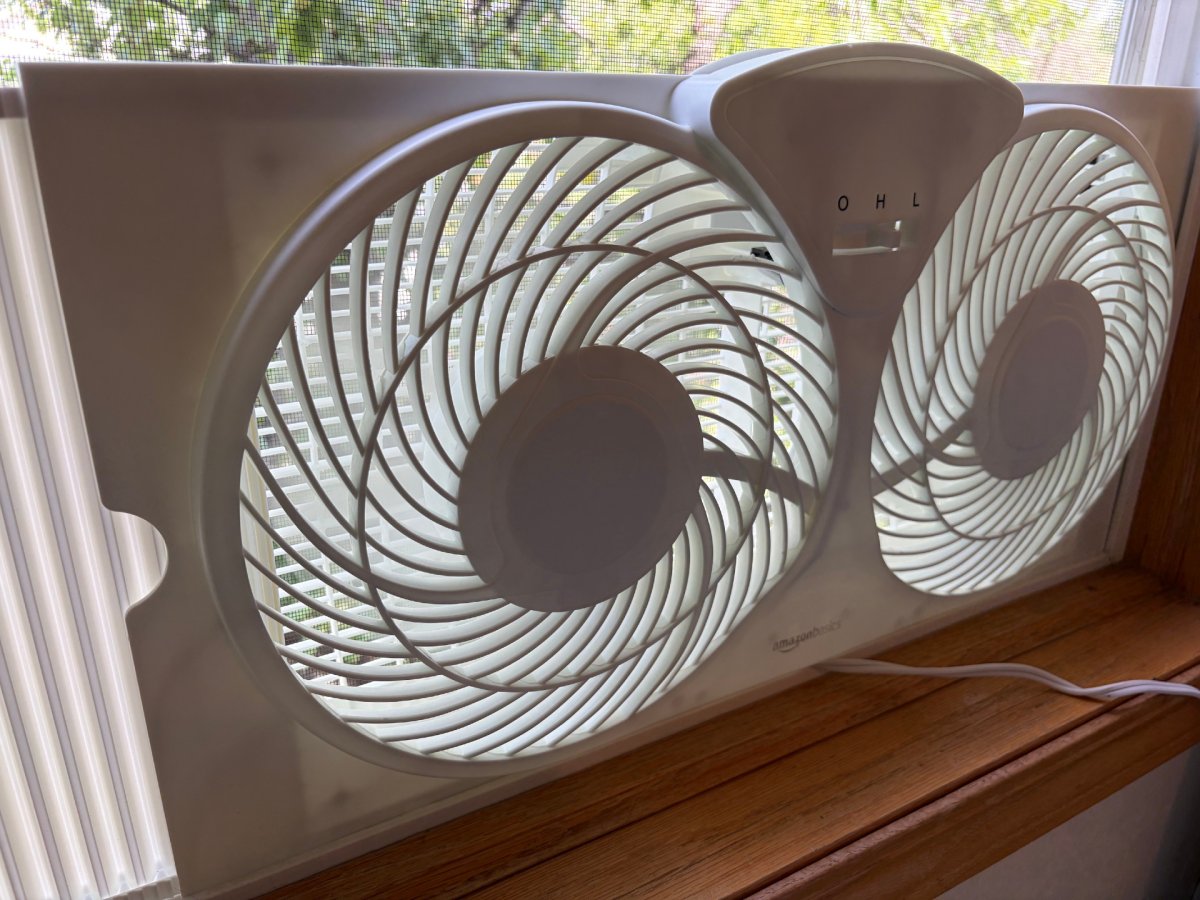
The Amazon Basics twin window fan is a straightforward, budget-friendly way to improve airflow in small- to medium-size spaces. Installation takes mere minutes thanks to side panels that expand from 25 to 32 inches wide, and the manual controls make it very easy to operate. The dual-fan design can be used for intake or exhaust depending on which way you install it, and there are two speed settings for adjusting airflow.
Although this is a value-driven double window fan, it still has a copper motor that’s built for continuous operation without excess noise. The body and blades are plastic, which is pretty typical for a window fan, but it’s light on extras—there’s no thermostat or way to reverse airflow without flipping the entire thing. What you do get is a set of feet that let you swap it from a window fan to a freestanding one, plus a built-in handle for moving it from room to room.
Get the Amazon Basics window fan at Amazon.
Best Twin
Photo: Аmazon
What We Like
- Functions as stand-alone or installed window fan
- Settings can be adjusted via the remote control
- Easy to install
- Reversible window fan with multiple settings
What We Don’t Like
- Not as powerful as other window fans available
- Remote control didn’t work as well as expected
Product Specs
-
Max airflow:
431 CFM -
Size:
23.5 to 37 inches long (adjustable) by 11.9 inches tall by 4.75 inches deep -
Reversible:
Yes
Our Ratings
| Installation | 5/5 | Air Circulation | 3.5/5 | Noise | 3.5/5 | Cleanability | 4/5 | Value | 2.7/5 |
With its simple controls, this twin window fan from Comfort Zone is one of the easiest to operate. The fan’s control panel, which sits conveniently between the two fans at the top and bottom of the unit, consists of an off button and an on button that also sets the fan to one of three speed settings. We also appreciated that this fan came with bug screens. None of the other window fans with a similar design did.
Controls at the bottom of the fan make it easy to set the fans to exhaust, intake, or circulate, which runs the two fans in opposite directions. Thanks to its reversibility, it could even be used as a bathroom window exhaust fan. With detachable feet and lockable accordion panels that extend from the side, this fan can be set up as either a stand-alone fan that rests on a windowsill or a fan that fits tightly between the sash and jamb of windows between 23.5 inches and 37 inches wide. We installed the Comfort Zone in under 5 minutes. We found the accordion panels were easier to adjust than on some of the other models we tried.
However, while the manufacturer reports this fan at 431 CFM, it didn’t feel nearly as powerful as most of the other fans we tested. And it came with a remote, but it didn’t work. Honestly, though, the controls are so easy to use that no remote is necessary.
Get the Comfort Zone twin window fan at Amazon.
Best Triple
Photo: Amazon
What We Like
- Can run 1, 2, or all 3 fans at once
- Built-in adjustable thermostat
- Installs horizontally or vertically
Product Specs
-
Max airflow:
432 CFM -
Size:
25 to 36.7 inches long (adjustable) by 8 inches tall by 3 inches deep -
Reversible:
No
Our Ratings
| Installation | 4/5 | Air Circulation | 4/5 | Noise | 3.8/5 | Cleanability | 4/5 | Value | 4.7/5 |
Rather than two large fan units, the Comfort Zone triple window fan features three smaller ones, which gives it a more streamlined look without sacrificing airflow. While marketed as having three speed settings, what that really means is that you can choose to run one, two, or all three of those fans at once, which is useful for adjusting airflow based on room size or ventilation needs. This low-profile window fan also has a built-in analog thermostat that turns whichever fans you have selected off or on based on room temperature. You can install it either horizontally or vertically, and it has locking expanders to allow for a tight fit so it runs without rattling.
In terms of performance, this triple fan delivers impressive air movement for its size, and we found it effective for quickly cycling stale air or pulling in a cool breeze. Since it isn’t reversible, however, it’s an intake-only option. We also didn’t find the manual thermostat dial all that useful since there’s no way to know what temperature any given position corresponds to. Still, since fans are more about moving air than dropping temperature (unless it’s cooler outdoors than in), that didn’t make much of a difference in how we used it.
Get the Comfort Zone triple window fan at Amazon.
Best Quiet
Photo: Amazon
What We Like
- Only 46 decibels on its highest speed
- Low-profile design preserves view
- Digital touchpanel plus a remote control
- Feels even more powerful than its CFM rating
What We Don’t Like
- Can be hard to install with a screen
- Horizontal only
Product Specs
-
Max airflow:
1,315 CFM -
Size:
26 inches long by 7.16 inches tall by 5.73 inches deep -
Reversible:
Yes
Our Ratings
| Installation | 4.5/5 | Air Circulation | 4.3/5 | Noise | 4.5/5 | Cleanability | 3.5/5 | Value | 4.3/5 |
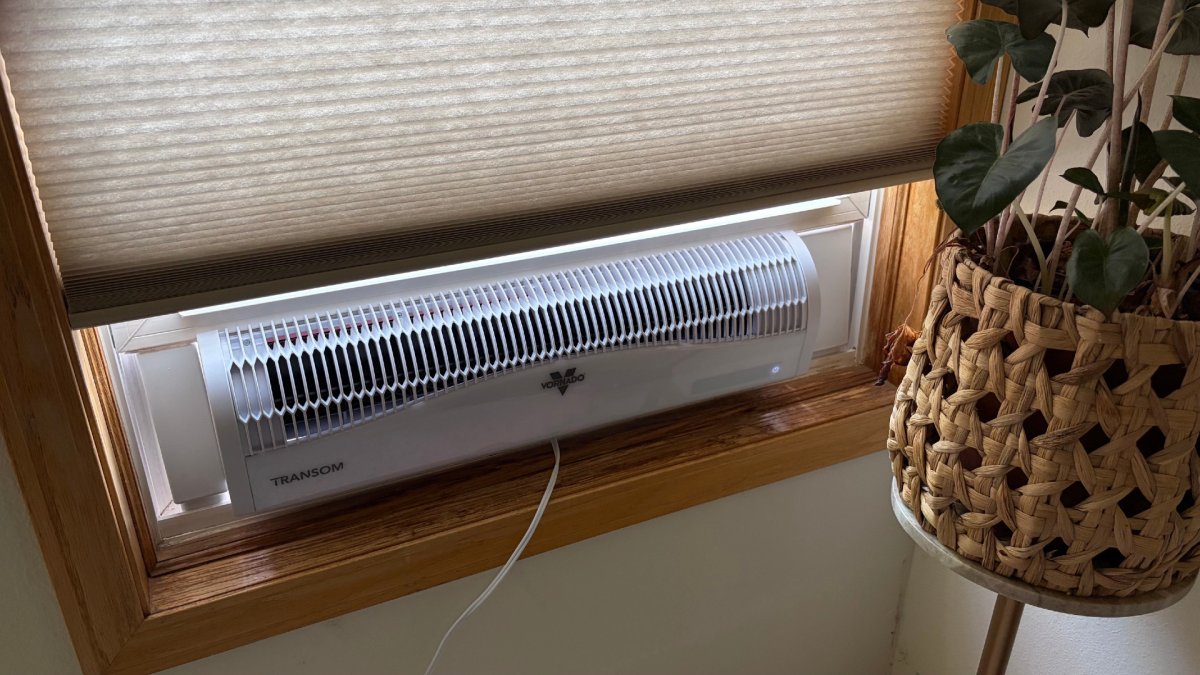
If you’re after a more refined—and noticeably quieter—window fan, the Vornado Transom air circulator is the model for you. Its 1,315 CFM of airflow comes from a low-profile package that won’t get in the way of your view, and the included Soft-fit panels ensure a secure seal (even if you have to take your screen off to get it set). While it’s a window fan with remote functionality, the digital touchpanel is also incredibly easy to use.
Although I ended up lucking out, this Vornado almost didn’t fit in my window with the screen on. That ultimately would’ve been fine given the extra installation materials Vornado includes, but I’m glad I didn’t have to choose between enjoying a good breeze and ensuring bugs stay out. In terms of noise, it was quieter than almost every model on this list, ranging from 40 decibels on the lowest of its four speeds to only 46 on the highest. It’s also easy to reverse with just the touch of a button, and the temperature-sensing controls add a level of convenience that more basic models lack.
Get the Vornado Transom window fan (various colors) at Amazon, Ace Hardware, Walmart, Best Buy, or Vornado.
Best Whole House
Photo: Amazon
What We Like
- Powerful window fan; suitable for large living spaces
- Durable metal construction will last for years
- Fits standard window sizes
- Comes with multiple useful speed settings
What We Don’t Like
- No remote control; must be adjusted manually
- Large size won’t suit very small windows
Product Specs
-
Max airflow:
3,560 CFM -
Size:
26.75 inches long by 26.25 inches tall by 11.25 inches deep -
Reversible:
Yes
Our Ratings
| Installation | 3/5 | Air Circulation | 5/5 | Noise | 2.5/5 | Cleanability | 4.5/5 | Value | 4.7/5 |
When your entire home feels like a sauna, flood it with cool air from floor to ceiling with this powerful fan. The Air King fits windows between 27 and 38 inches wide and at low-, medium-, or high-speed settings, and it delivers an airflow of 2,510, 3,120, or 3,560 CFM. On its highest setting, the Air King can cool up to 1,310 square feet.
We can attest to the power of this high CFM window fan. During testing, there was an unfortunate accident on the stove that left behind some seriously unpleasant odors. We turned on this fan’s exhaust and the house was cleared of odors within 10 minutes. It’s heavy and loud, but it’s undeniably powerful.
There’s no remote control with this model, but it’s reversible. We didn’t love the installation process. It comes with a guide and sliding panels to fit it to the window, and it must be screwed into place. Two people are needed to install this behemoth.
What our tester says: “I tested this fan in my 2,318-square-foot home, and could feel cool air moving in almost every room, going beyond the advertised 1,310 square feet.”—Stacey L. Nash, Product Reviews tester and writer
Get the Air King window fan on Amazon or Walmart.
Best Compact
Photo: Walmart
What We Like
- Compact and lightweight construction
- Ample output for its size
- Variable airflow adjustment
What We Don’t Like
- Loud on the highest speed
Product Specs
-
Max airflow:
358 CFM -
Size:
9.65 inches long by 11.3 inches tall by 7 inches deep -
Reversible:
No
Our Ratings
| Installation | 5/5 | Air Circulation | 5/5 | Noise | 3.5/5 | Cleanability | 3.5/5 | Value | 5/5 |
With its compact size, this powerful Vornado window fan is a nice alternative to a traditional window fan. It measures just 11 inches high and just under 10 inches wide but packs a punch thanks to its design. Its spiral-shaped grate and powerful brushless motor allow it to move air up to 75 feet.
This small window fan became a favorite during testing. It has a variable speed dial that adjusts the airflow. It can go from whisper-quiet to a wind-blowing tornado and everything in between. A powerful motor creates far more airflow than one might expect from its size. The Vornado can also tilt upward or downward, making it easy to direct airflow. Plus, it’s small and lightweight (only 3.5 pounds), so it can be carried from room to room.
Get the Vornado Energy Smart window fan at Walmart.
Best Portable
Photo: Amazon
What We Like
- Compact fan suitable for desks or windows
- Runs off batteries or AC power
- Quiet operation, even on highest setting
- Freestanding design can be moved where needed
What We Don’t Like
- No reversible airflow
- Less powerful than standard window fans
Product Specs
-
Max airflow:
Not listed -
Size:
12 inches long by 12.9 inches tall by 3.8 inches deep -
Reversible:
No
Our Ratings
| Installation | 5/5 | Air Circulation | 3/5 | Noise | 4.5/5 | Cleanability | 4.5/5 | Value | 3.5/5 |
Though this desk fan may not be a traditional window fan, its slim design and square shape make it a great option for those looking for relief from the summer heat on a budget. Its 10-inch blade isn’t quite as powerful as those on higher-priced small window fans. However, during testing, we found that this box fan for window use moved enough air to provide cooling relief on a hot day in a small room or within 10 feet when outside. It also offers the advantage of versatile power options, operating off AC power or six D batteries.
However, batteries aren’t exactly cheap these days, and relying on the battery too much could get pricey. We ran this fan for 4 days straight on the six D batteries, which is a pretty good life. Batteries also make it super quiet.
Since it’s a cordless window fan, the Fin Fan is suitable for camping as well as home use. This narrow window fan measures 12 inches wide, 13 inches high, 4 inches deep, and it weighs just over 2 pounds, which makes it ideal for moving from room to room or even taking on the road. We moved it around the house from an office to the bathroom to outside and back to the office, which became its home. It also has a convenient port for charging a smartphone. We tested the charger, and it wasn’t fast, but it’s handy in a pinch.
Get the Treva window fan on Amazon or Walmart.
How We Tested the Best Window Fans
| Products tested | 10 |
| Time spent testing | 50+ hours |
| Tests performed | 7 |
| Price range | $30 to $275 |
In testing, we considered each fan’s ease of installation, airflow/cooling ability, noise, and extra features:
- Airflow/cooling: The CFM rating can be deceptive when it comes to actual airflow. Since a fan’s design and motor affect how effective they actually feel, we noted our test room’s temperature before and after testing.
- Noise levels: We tested noise levels by carrying on conversations and watching television while the fans ran to see how disruptive they were.
- Extra features: We evaluated extra features like a remote control, built-in thermostat, extension panels, and feet, factoring in how much they benefited the fans’ usability.
Our Testing Scores
What to Consider When Choosing a Window Fan
As with all types of fans, certain features are more important than others for ensuring optimal cooling performance. Prioritize the following when choosing the best window fan for your space.
Size/Dimensions
Since a window fan is intended to fit inside a window, it should not be larger than the window’s dimensions. For this reason, most standard window fans can fit windows about 26 inches to 38 inches wide.
When shopping for a window fan, make sure to choose a model that is just small enough to fit the dimensions of the window when open, as this will ensure that there aren’t large gaps around it that can allow warm air to enter the room or grant access to bugs if the window lacks a screen. Many window fans have sliding guards on the sides that cover these gaps to prevent drafts from around the fan while also keeping bugs and rain out. If you’d like to position a fan into a slider window, be sure to purchase a vertical window fan, as most fans are made to fit standard single- or double-hung windows.
Airflow
The airflow of a fan, an indicator of its cooling power, measures the velocity at which air enters or escapes a space. Airflow will be indicated on the fan manufacturer’s website and on the fan packaging in CFM.
While it may seem advantageous to buy a fan with the highest CFM available, it can be a waste of energy to use a unit with a stronger airflow than what is warranted for the room. It’s more prudent to buy a fan with an airflow sufficient to cool the space where it will be installed. In general, figure about 1 CFM per square foot of space, plus an extra 50 CFM.
Most window fans have both an intake function (to draw in and circulate air from the outdoors) and an exhaust function (to force out indoor air or odors). Reversibility refers to the mechanism that changes airflow direction. There are manually reversible and electrically reversible fans.
Manually reversible fans require the user to physically remove the unit from the window, flip it, and reinstall it to reverse airflow. Electrically reversible fans allow the user to change airflow direction with the push of a button or the flip of a switch, a major convenience with intake and exhaust functions at various times on any given day. For example, the intake function is useful while sleeping to draw in cool nighttime air, while using the exhaust function by day expels hotter air.
Number of Internal Fans
- One-fan units house one large centralized internal fan that enables air circulation. Because one-fan units bill themselves as “whole-house” fans to cool the entire home, they tend to deliver a stronger airflow (more on that below). That said, their large single fan makes them bulkier and less efficient overall; thus, it’s slower to cool an individual room.
- Two-fan (or “twin”) units feature two small side-by-side internal fans. They’re more compact, and while they offer a slightly lower airflow on average, two fans work more efficiently to cool a room faster. Bonus: In a two-fan unit with electrical reversibility and independent control of the fans via two intake/exhaust switches, one fan can perform intake while the other set performs exhaust, thereby maximizing cooling efficiency and indoor comfort.
Noise Level
Most window fans generate between 40 and 80 decibels (dB), depending on how close one is to the fan. Standard window fans produce similar noise levels to floor fans, while desk fans with smaller blades are quieter, operating at less than 40 dB. If a fan is too noisy, the user can make it quieter simply by running the fan on a medium- or low-speed setting. Keep in mind that many manufacturers won’t list the fan’s decibels, so read reviews if you’re in search of a quiet window fan.
Controls and Convenience
Many window fans come with some convenient extras, and certain models tend to look better in specific spaces.
Control panel
Window fans generally have a control panel on the front to turn the unit on and off, switch between intake/exhaust modes, adjust airspeed and temperature, and tilt or angle the blades. Some models include a digital thermostat as well.
Remote Control
Some models come with a remote control for common functions so that there’s no need to get up to operate it manually. This is a great bonus for those with limited mobility. It’s also convenient when the fan sits in an overly large room, or if most of the seating is positioned far from the window.
Portability
Window fans designed to be portable usually have a lightweight build and may come with a handle and collapsible legs. Some are battery-powered for even more flexible usage.
Installation and Maintenance
Most window fans are easy to install and maintain. Desk fans and tower fans can stand on their own, eliminating the need for an installation that requires drilling holes and driving in screws.
Most window fans fit between the sash and sill of the window and must be fastened to the window frame with screws to hold it firmly in place while it operates. Models that come with guides can help make sure that the screws are installed correctly. Other fans are designed so that the window sits on top of the unit, holding it in place. Most window fans have panels that extend from the sides to close off the gaps in the window opening on either side of the fan.
Energy Efficiency
Because they’re generally much more efficient than central air conditioning, window fans can be a smart way to slash your electric bill—especially when used to move cool outdoor air in at night or to push hot indoor air out during the day. The easiest way to achieve this is with a model with reversible airflow, multiple speed settings, and a thermostat or timer. It’s also a good idea to make sure there are no gaps around the frame during installation, as that will reduce air leakage and help keep cooled air inside the room.
FAQs
Attic fans, per their name, are installed in the attic through the ceiling or an exterior wall of the home. The fans work by removing hot air from the attic while sucking in cooler air through the home’s soffits. A window fan, as the name suggests, fits into the window of a home, removing hot air or circulating cooler air to reduce the room’s temperature.
Yes, window fans can help reduce the temperature in a room by exhausting hot air or bringing in cool air.
Yes, window fans can potentially let bugs in if there’s no screen behind them or if you leave gaps around the sides during installation. Most models come with extendable panels or extra foam to ensure a snug fit.
While a fan with a higher CFM rating can be desirable, for a window fan to be effective, it should generally move 1 CFM for every square foot of space, plus an extra 50 CFM. For example, a 200-square-foot room would call for at least 250 CFM.
Exhaust is usually best if your goal is to push warm indoor air out, especially on hot days or when cooking. Intake works better when the outdoor air is cooler than the room, like in the evening or at night.
To clean a fan, start by unplugging the fan and removing the protective grate if possible. (Check the manufacturer’s instructions because not all grates are removable.) Use a vacuum hose with a dusting brush to clean off the fan blades, then wipe them down with a damp cloth and reattach the grate.
Yes, window fans can make a room feel cooler without using much electricity, making them worthwhile if you’re looking for a low-cost alternative to running air conditioning.
The best place for a window fan depends on whether you need to exhaust hot air from your home or bring cool air in. To draw in cool air, place the fan in a window on the coolest side of your house and face it inward. To expel warm air, position the fan facing outward in the hottest area of your home.
No. Most window fans use between 50 and 100 watts of electricity, which is a fraction of what a small air conditioner consumes.
Meet the Testers
Michelle Larson has been a writer and editor for more than 10 years in the fields of health, business, and the home. As a lifelong fan of sleeping in a cool room, she’s tested her fair share of ways to beat the heat without cranking the AC.
Stacey L. Nash has written about home and garden products, home design and decor, and general indoor and outdoor home improvement for more than 5 years. She’s passionate about research and hands-on testing to find the products that add true value to homeownership and daily life.
Additional research provided by Tony Carrick and Manasa Reddigari.

After Testing 20 Air Purifiers, We Found One That Does Something the Rest Can’t