Read the Odyssey! | American Enterprise Institute
The opportunities for IMAX are not abundant in the Aegean Sea, which explains why I have not yet seen Christopher Nolan’s latest film. Marvel as I may at the sharp differences in opinion found in the dozens of pre- and post-release commentaries, including by three of my colleagues at AEI, I am in no position to weigh in on its successes and failures.
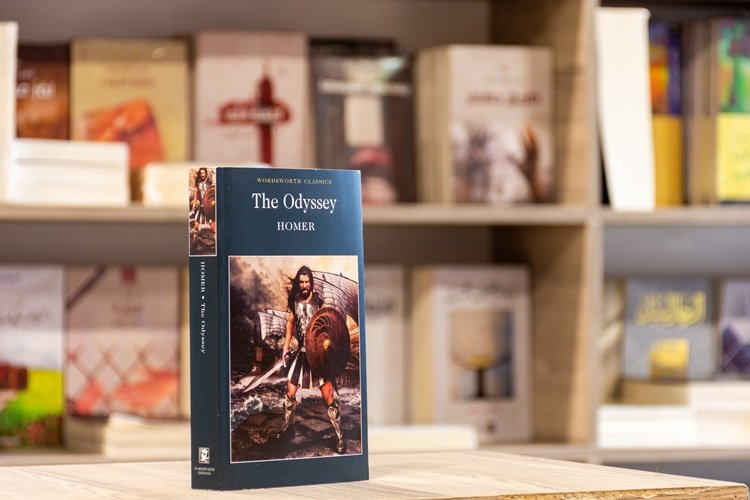
Still, the Odyssey is on my mind, not least because I just gave a lecture about it aboard a vessel far nicer than Odysseus’ raft, and I recommend that people take time this “Odyssey summer” to pick up the epic poem. Whatever you think of the characters played by Anne (Hathaway) and Zendaya, wouldn’t it be nice if you also had a view of the literary personae from Antinoos to Zeus? Or—since the Greek gamut is not from A to Z but rather from Alpha to Omega—all the way to Ōkeanos, “Ocean,” the Titan whom Odysseus and his men encounter when they reach the edge of the living world?
If you have not read the Odyssey, or have not read it recently, you should—and the Iliad, too. Obviously I will be delighted if you read them in Greek. In the original Greek, one might say, except that Homer almost certainly did not exist but is the name given to the roughly eighth-century B.C. product of an oral tradition that stretches back to Proto-Indo-European times, some 5500 or 6000 years ago. If you wish to learn Ancient Greek, arguably the best instruction in the country is to be found at Ralston College in Savannah; there are also immersive summer programs, among which the Greek Institute at the City University of New York stands out for its rigor. I can’t promise that learning Greek will change your life, though it did substantially shape mine, thanks in no small part to the pedagogical genius of Richard Garner, whose intensive course at Yale was probably the single most extraordinary class I ever took on any subject.
But if you prefer to read Homer in translation, you can do so in Latvian, Mandarin, and dozens of other tongues. In English alone, there have been over a hundred translations since George Chapman’s (made famous by Keats) and Thomas Hobbes’s (yes, that Hobbes) in the seventeenth century and Alexander Pope’s in the eighteenth. More recent ones that you may have been assigned in high school or college include Robert Fitzgerald’s (Odyssey 1961, Iliad 1974), Richmond Lattimore’s (Iliad 1951, Odyssey 1965), and Robert Fagles’s (Iliad 1990, Odyssey 1996). Astonishingly, there have been over fifteen English translations each of the Iliad and the Odyssey just since 2000.
The most controversial translations of our time are by Emily Wilson, who has stoked further controversy now by criticizing Nolan’s film. To the chagrin of many, I wrote a positive review of Wilson’s 2023 Iliad and also appreciate the contentious translation in her 2017 Odyssey of the poem’s opening adjective, polytropon, as “complicated.” That said, as I wrote in AEIdeas at the start of January, Daniel Mendelsohn’s 2025 translation of the Odyssey is the one I currently recommend. I have chosen it for the AEI reading group I’m leading this fall.
When I recommended Mendelsohn’s, I did not know that yet another translation of the Odyssey had come out in December: Michael Solot’s for the Society of Classical Poets (SCP), which is advertised as “Not Your Grandfather’s Odyssey.” (Neither Wilson’s translation nor Mendelsohn’s is your grandfather’s Odyssey either, but never mind.) Solot’s language is lively; Aedan Kennedy’s pen-and-ink illustrations will make the book appealing to people of all ages, including your grandchildren; and the SCP has released an edition with a substantial commentary that provides an unobtrusive enhancement for those who want it. I have seen a couple of positive reviews, but Solot’s translation appears to have gotten lost amid the Nolan hype, which is a pity.
There is no such thing as a definitive translation. Even when a clear “original” exists, every translator necessarily put a special stamp on his or her work. This is why, although I of course have my likes and dislikes, I am rarely exercised over the licenses that serious-minded translators take. It may well be that your grandfather’s Homer should be different from my grandfather’s—and from your grandchild’s and mine. The importance of the Iliad and the Odyssey is reflected in the multiplicity of options, and many more translations are sure to appear in the decades and centuries ahead.
This is something to be celebrated. And so, almost regardless of its quality, is the appearance of a film that is making everyone talk about a work from thousands of years ago. But, please, do more than talk about it. In one translation or another, also read it.