Raising Capital: Fidelis Capital on Breaking Away
Fidelis Capital added its 13th partner in July. The move is part of a team-building process, through which co-founder and CEO Rick Simonetti said Fidelis gains large, wirehouse capabilities with a boutique touch.
The reference to bank-based wealth management is not a throwaway line for Simonetti or his other partners. The nearly $3 billion registered investment advisor is composed solely of advisors or specialists who have left bank practices such as Wells Fargo and Bank of America Private Wealth.
That fact, according to Simonetti, makes Fidelis a unique player because the large bank know-how is there, but with a team unburdened by the need to sell specific products or adhere to blanket compliance procedures.
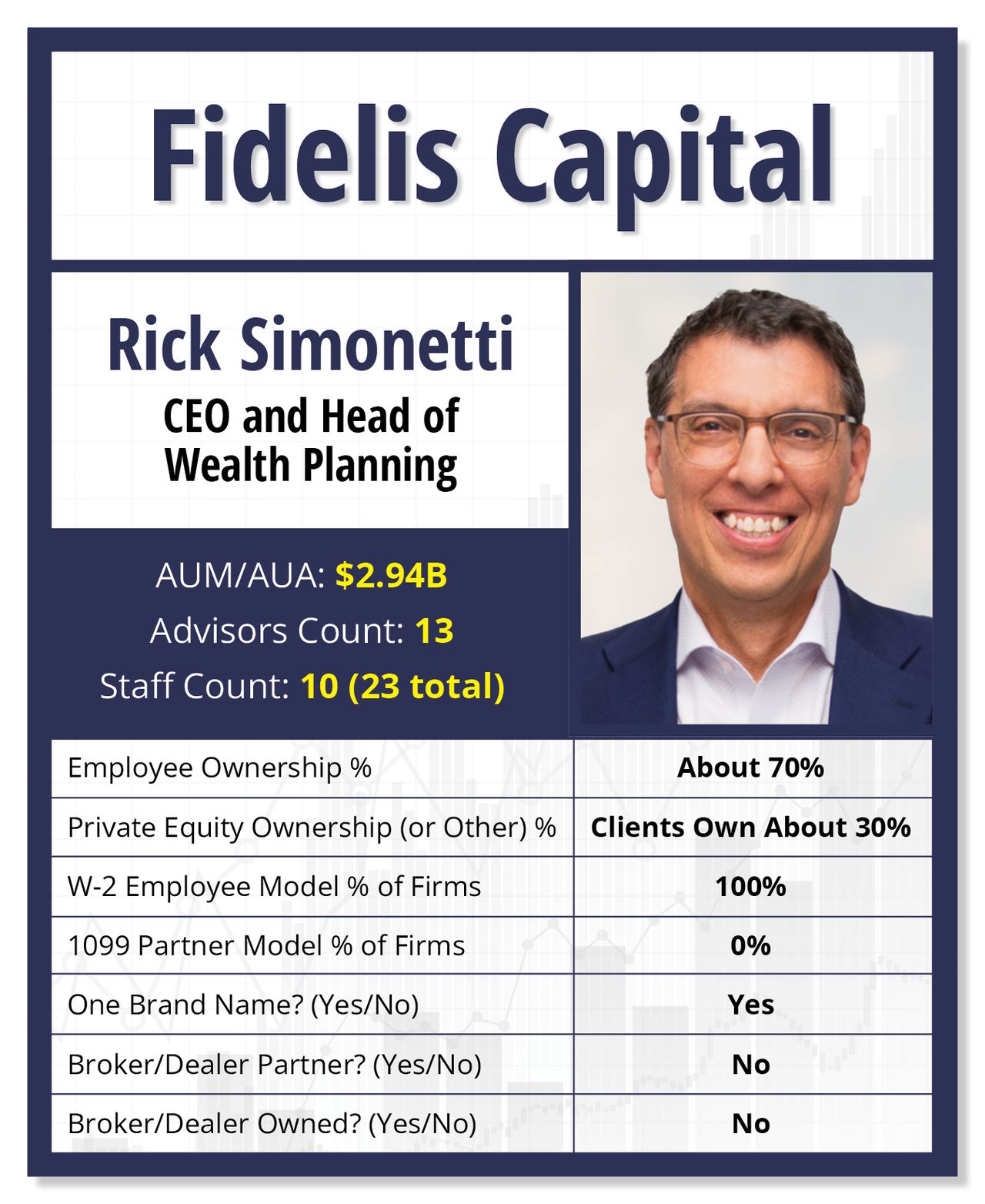
It’s also a driver of Fidelis’ capital table structure: Simonetti and a few advisors hold about 70% of ownership, and the firm’s clients own the remaining 30%. New partners are given “phantom” interest, which provides paydays tied to firm growth but not actual ownership.
Wealth Management recently talked with Simonetti to unpack the firm’s structure, offerings and succession plan.
The following has been edited for length and clarity.
Wealth Management: What prompted you to leave a successful career at Wells Fargo to start Fidelis Capital?
Rick Simonetti: I was 22 years at Wells Fargo. I ran their national planning team and one quarter of the country for private wealth management. At about the same time our firm decided to make big strategic shifts about how they were serving clients, the opportunity to build something ourselves became even easier—and that has continued.
The same thing that happened to us was happening with a team from Bank of America Private Bank in Dallas. It just so happens that I worked with the brother of the guy in Dallas, and we connected.
We started our firm after looking at other firms and talking to everyone. Each of us could have gotten a big check, but we chose a different path. We actually chose to write checks. That in and of itself tells you our level of commitment.
WM: What transpired from that move?
RS: What we decided to do was come together for almost a full year before we launched, checking off the things that we knew families in this space and organizations in this space needed and were now really unable to get at the big institutions.
In August of 2022, we launched in Dallas and Tampa. Since then, we’ve grown by adding a Bank of America Private Bank team in Washington, D.C., the global head of fixed income from Bank of America Merrill Lynch up in Greenwich, Conn., and Doug Rothermich out in St. Louis, who formerly headed all of wealth planning for TIAA.
You get this incredible pool of talent, and you serve clients really well. That’s how you get from zero to almost $3 billion of assets in four years without necessarily a huge initial book move. Our belief was: build it, execute, serve in a way that differentiates you, and you will meet more people. More than half of our business today is people we didn’t know when we launched, and that to us says we hit the mark.
WM: There’s obviously more money on the table now in the RIA market—bigger checks being written. What do you find is drawing advisors to Fidelis? Is it similar to what drew you?
RS: The people who joined us and who we didn’t know for a long time found us and sought us out. But a lot of the people who’ve joined us have known at least one member of our founding partner team—there are five of us—for decades. Their driver is passion, which will result in success. Their driver is not money.
Philosophically, if somebody calls up and says, “What’s your grid and how much are you paying?” That’s just not going to go too far. It’s about saying, “Hey, I’ve got a family with a massive amount of need, and it’s not getting served. How can you help me serve this family well?” Financial success comes as a result of that—that’s the outcome. All you’re doing when you take that check is deferring the stress, because at some point that money either performs or it doesn’t.
WM: You position yourselves as an outsourced family office. For a $3 billion firm, how are you pulling off all those adjacent wealth services that clients might have found at larger institutional entities?
RS: We pull it off because, first of all, we’re willing to dig in where most of the bigger institutions won’t even allow their advisors to go. You can’t go talk about income taxes with your client at those places—if they see that in an email, they’re going to flag you. You’re out of bounds.
We say: give us your tax returns, give us your trust documents, let us look at them, let us understand them, let us explain how they work to you.
Second, we do have enough talent internally to go there. My specialties are income tax and estate tax planning. We’ve got two former practicing trust, estate and tax attorneys. I mentioned the specialty in alts, the specialty in fixed income and the specialty in equities. When we come together on behalf of a client and take the time to look at their situation, we almost immediately—and in every case we’ve done so—identify areas that need adjustment or a shift. In some cases, we’ve done that before they become a client.
Everybody says they’re a planning-based firm. Everybody says they’re team-based. The fact is, we meet twice a week as an entire company in each office. We go over every single task about what’s on our plate for every single client. We meet twice a month as a planning committee—five members of that committee, two former practicing trust and estate and tax attorneys, two 20-year-plus trust officers and me. We talk about situations: What are you seeing? What are you experiencing? What are the challenges? What questions are you being asked?
We’ve helped clients with things there’s no chance we could have helped them with at Wells, Bank of America or any other big institution.
WM: In terms of ownership, do new partners like Herb Achey buy in?
RS: We are somewhat uniquely structured. We built ourselves as what’s called an opportunity zone business, and what that means is the ownership structure has to maintain that structure for a period of time. We tend to create the ability for a back-end benefit that is almost like a phantom interest in the company, as opposed to an actual current equity interest.
We believe that if a team member joins us and they build a book—a series of five, six, seven clients that they’re serving and that they’ve introduced to our firm—then not only should we compensate them now for that, but we should compensate them for the value that they are leaving that firm with years from now when they depart. We do that in the form of some sort of structure that allows us to calculate something that’s a value to them. That’s really what ends up attracting people, from a financial perspective, to join the firm.
In terms of our actual equity ownership, that’s pretty solid for a while. Something that’s unique is that we are, in fact, partially client-owned. We weren’t originally, but we had a little bit of a disconnect or misalignment with our original investors—not that they’re bad or good, just misaligned. We went to a couple of clients and said, “Hey, would you be interested?” They said, “Sure,” and we were able to structure ourselves so that we are completely and totally aligned with every owner of the company.
WM: When you structured it this way, did you have the idea of phantom equity in mind already?
RS: Yeah. The reality is that someone who’s worked at a private bank today tends to get paid well now, but tends to get paid nothing when they leave. We know how that works. There are lots of people very interested in attracting talent from that space, and you really have to understand how people in that world think. Everyone in our firm worked in a private bank—all 23 of us. We all speak that language. We get it. We know the language of that relationship.
WM: Have you talked to any minority investors or private equity? Are there any plans in that direction for capital?
RS: I could pull out my inbox and show you plenty of those conversations. But as we think about what we’ve built, one element I didn’t highlight is that we’ve built ourselves for succession as well. Every portfolio manager has their successor already in place. They’re already working with the families that they will ultimately step into and serve.
The next step is planning. If you’re a planner out there and you want to join a planning team of this caliber, we’d love to talk. We’re going to build that out more on the planning front.
We believe the ownership of our firm should probably transition to those who are inheriting the legacy that we’ve built. That’s our current focus. As a group of five founding partners, we believe we’ll be able to get enough financial reward out of that structure to be able to really live this out in the long run and then watch it grow into something even more special as we pass it off many years from now.