Big Tech Just Admitted the AI Bubble Is Real
Silicon Valley admits AI may be a bubble, they just want to believe it is the right kind of bubble. But, when Meta reported it was selling excess AI capacity, it wiped $200bn off AI stocks in a day. But, what has really worried the likes of Anthropic and OpenAi is the arrival of cheaper Chinese models, which are good enough to take customers away from premium services. So what happens if you you invest billions in data centres, but then the paying customers don’t show up like expected?

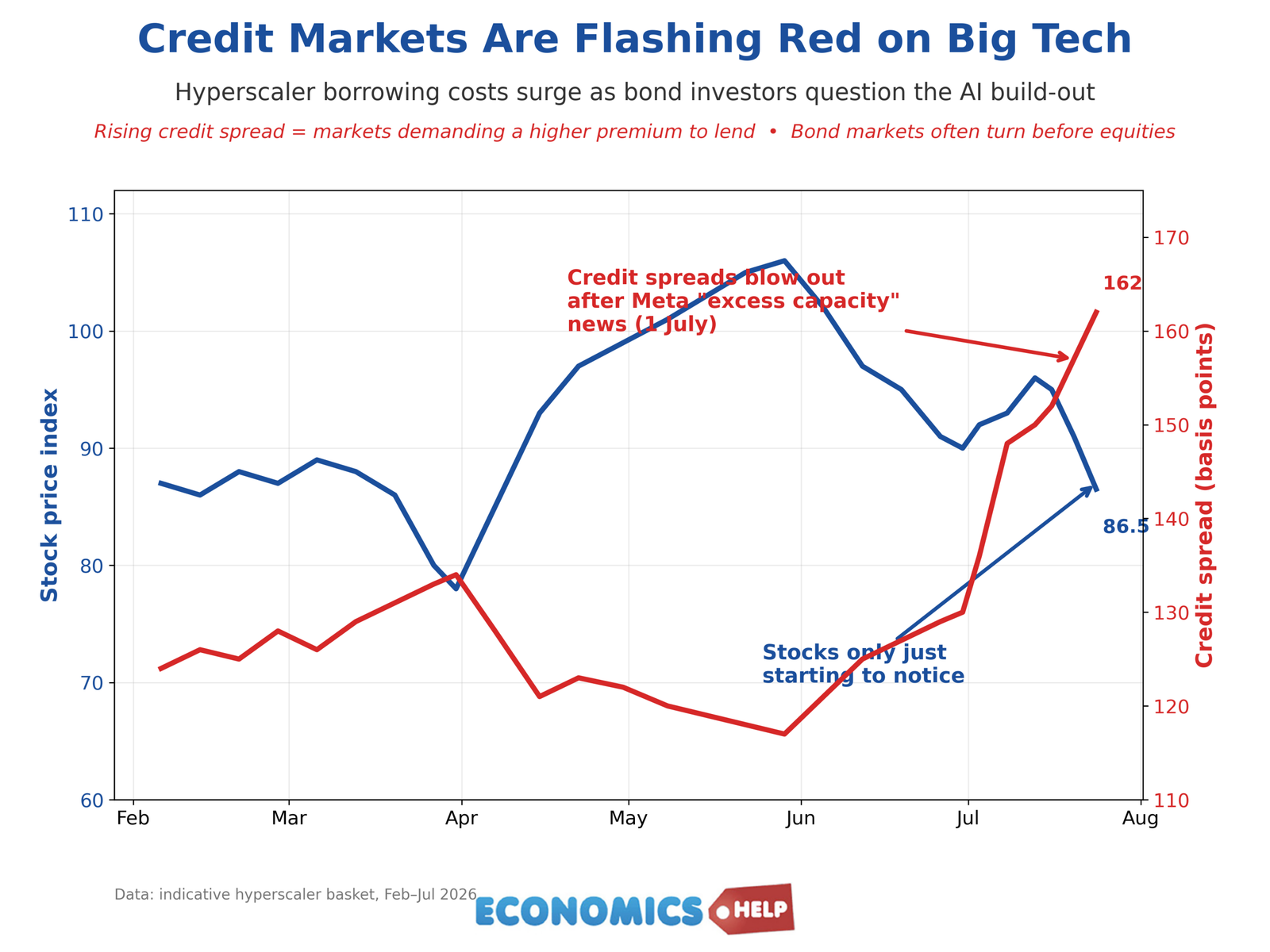
So far the stock falls are relatively modest, but, if you look at the cost of borrowing for the AI build out, the credit spread is rising fast. Most people focus on stock prices, but the demand for hyperscaler bonds has fallen much faster.

This is reflected in much higher borrowing costs long-dated hyperscale debt has now declined to BB status, as banks get cold feet at lending to AI datacentres. This year we have seen a rush for private companies to list on the stock market and basically take advantage of bubble pricing to cash in.

But, as SpaceX stocks dissapoints and falls below its release price, there are signs that investors are having growing doubts. Will SpaceX’s bullish claim that it has total actionable market of $28 trillion, almost the size of the US economy look increasingly fanciful.

A large part of AI Boom is based on the scarcity of compute. But, it’s not just Meta, Space X and others are starting to lease out excess capacity. The first problem is that the AI build out is no longer based solely on cash, it comes from borrowing, but, lenders are starting to get cold feet, aware that the AI build out risks becoming a spectacular bubble. And this is not just speculation, the bubble warning comes from around the industry and Silicon Valley itself. According to investor Gavin Baker, Larry Page, co-founder of Google has said internally many times. “I am willing to go bankrupt rather than lose this race.
And if you look at Alphabet’s capital expenditure, you can see the intent of Google. Now, Google say there revenues are soaring. Google Cloud revenue rose 82% from this time last year to $24.8 billion. Yes, even investors became nervous about the scale of Google’s investment and the fact that the big tech giants are no longer cash-printing machines. Even Alphabet, Google’s parent company has negative cash flows for the first time since its listing.

So as cracks begin to appear, what happens next?
After Meta started selling excess capacity, it really hit compute sellers like Coreweave and Nebius. Meta and Microsoft were customers, but now they have become competitors.

But, the companies who are really panicing at the moment are Anthropic and OpenAI. It is true they have gained customers, but open source AI is now only a few months behind the leading frontier models.

This means for an increasing number of firms and consumers, the incentive to pay for expensive credits is diminishing. Just because AI can be transformational doesn’t mean it will be profitable for all AI companies. And it is Anthropic and OpenAI which are most in the cross hairs.
And an important fact is that behind the rosy numbers of rising demand, there has been a rise in off balance sheet AI commitments. When Meta builds a data centre, it often doesn’t build it directly. A separate company does — part-owned by an asset manager — and that company borrows the money. Meta is the only tenant but the debt sits on someone else’s books. It is legal but it serves to make levels of borrowing to fund AI boom look smaller than it actually is. Bloomberg estimate that this off-balance sheet commitment total $1.8 trillion, so leverage levels are actually higher, and this is why some make the comparision to 2008 rather than 2000. In fact, Bloomberg even made Enron comparison because of Enron’s trick in off-shoring debt
Many make the comparison to 2000, but, if debt is put off-balance sheets, it starts to look more like 2006. And the sub-prime mortgage collapse didn’t start when prices fell, the structure weakened when prices stopped rising fast enough. To understand this we have to see the close relationship.

When a hyperscaler like Microsoft builds a datacenter, Open AI signs a contract to pay for compute for five years. The provider treats this as guaranteed future revenue. But, structually it is idential to a loan. So markets may see a backlog of $500bn guaranteed revenue. But, this guaranteed revenue goes back to OpenAi and Anhtropic being able to pay their commitments and OpenAI becoming very profitable. Now Nvidia, which is actually one of most profitable parts of current AI infrastructrue, agreed to invest upto $100bn in Open AI, but this never fully materialised — instead Nvidia has put in $30bn as an equity stake, and this week is reportedly in talks for a $250bn guarantee to back OpenAI’s borrowing for a huge new data centre. OpenAI then use Nvidia’s guarantee as collateral to borrow from banks.

This borrowed money is spend on Nvidia. Nvidia see revenue rises. This is Nvidia effectively lending its customers money to buy its products. So Ddmand is manufactured by its seller known as vendor financing. The big question is will the big two be able to achieve its projected rise in demand? The evidence suggests market share is slliping away. Even Microsoft are seeking to replace OpenAi with cheaper Chinese models.

Now AI uptake is still rising. But only 2% of US households are actually paying for the product. This will rise, but the thing with AI is that most people, and indeed most business don’t want to pay premium prices for premium products. Ironically, US tech giants have accused Chinese firms of copying their AI models. This may be partly true, but the whole AI business is essentially about copying original content and making people pay. Interestingly in Australia the government is considering making AI Firms compensate the original creators. Maybe this is difficult to implement, but it does highlight the public backlash against AI, which is important. And the public image of AI is not helped by stories of AI escaping and hacking its own operator. Hyperscalers have these ambitious plans to build huge datacentres. And to put it in context, this proposed data centre would be literally as big as Manhattan. But, the problem here is that as they increase demand for electricity and water. US electricity prices are rising. Opposition to datacentres is uniting both Republicans and Democrats. And The actual growth rate of datacentres is actually slowing down as approvals hit limits.
Where’s the Productivity Boom?
And here’s the thing about the AI bubble, it can do impressive things, but as of yet, we are not seeing a general productivity boom. Firms which tried to replace workers are finding that AI has limits. It is still prone to making mistakes, and you need human oversight of AI actions. And it is much more expensive that many realised. My favourite graph on AI is how it spurred a growth in mobile app releases, but this led to fall in quality of products and reviews. This is AI slop, people fear and dislike.
So firms are now trying to economise. The price of hardware like memory chips and semiconductors has soared. In fact, this is the real scarcity and profitable part of AI. It is reminiscent of the gold rush, the people who made the most money were those selling shovels and picks. The AI bubble, has led to profits for hardware sellers.

Now, there are still significant AI bulls. Sub-prime borrowers had little income. Hyperscalers still have large cash flows. Demand is still rising. It is early days of AI revolution and there is scope for AI to become more efficient and better. Some tech giants say even if it is a bubble, it is a good kind of bubble because everyone will benefit from the investment, and technology, just not every firm will be a winner.
So what happens next. There is widespread feeling it is a bubble that will burst, but not yet. Demand needs to keep growing at exceptional rate. And it’s not just demand, but the amount we pay. For many households and firms, they have got used to effectively subsidised token use and will be reluctant to pay big jump in fees. Secondly, if we see continued adoption of cheaper Chinese opensource models, that will really hit business model of Anthropic and Open AI. Thirdly, the rise in bond costs for hyperscalers suggests banks are getting cold feet about pace of investment.
Sources
—
About The Author