Imagine a UK industry that generated £23 billion in export revenue, contributed £63 billion to the economy, and provided nearly 1 million jobs. You might think it would be touted as a great success story, perhaps even encouraged. But, British universities are in crisis, 24 universities could face insolvency or closure within 12 months. Government cuts, market reforms and a decline in visas for foreign students have left a gaping hole, causing a wave of cost cutting, job losses and declining export revenue. Is this the end of the road for British universities?
University Expansion

Since the 1990s, there was a massive expansion of university education. Student numbers soared as school children were told that this was the route to success. But the problem is that as numbers soared, government funding per pupil was cut. Education was left to the market and students increasingly paid higher fees. From £1,000 in 2000 to £9,500 today. But, whilst the cost of university rises, the graduate premium has fallen. The Sunday Times report a premium of 30% has fallen to 16% in 2025 if you include loan repayments. Recent graduates have struggled to gain employment in a competitive environment with AI infiltrating entry level jobs. There has also been a widespread backlash against universities. The British press see it as a fair game, universities overtaken by woke, teaching useless humanity degrees when what we really need is a good old honest trades like electricians and plumbers. And faced with harsh economic reality of student, students are pulling back. Why spend three years at university when you graduate with huge debt and struggle to recover the cost?
Success Story

Firstly, universities were a great British success story. Education exports are worth around £32 billion a year and are expected to rise. The UK has four of the top 10 universities in the world, and world class research, which has played a critical role in the developing of technology from AI to biotech research. Whilst the British tend to have a negative view of the economy. British universities had a global appeal and attracted a range of international students. And this was the first problem, given that universities needed to be more self-funded, the whole university eco-system became dependent on non-UK students paying £20-£50,000 to cross-subsidise UK students and also research and teaching. Universities increasingly resembled an export business. Which was ironically quite beneficial for the wider economy, since most of our manufacturing export industries were in decline. The boom years saw new buildings, more admin staff, higher management salaries and universities planned for perpetual growth. But, when net migration figures hit 900,000, the government panicked and cut student visas and fewer dependents were allowed. This was combined with demographic falls in the number of Chinese students, and increased competition from other countries. The fall in overseas students is the primary cause of the immediate financial crisis, which has seen a wave of redundancies, cut backs in research and causes closed.
Waste of money?
With universities in crisis, many respond by saying we are wasting our money? Kemi Badenoch Conservative leader says that New Labour’s 50 per cent target for school leavers was achieved by “creating loads of useless courses” And the fall in the graduate wage premium might support her hypothesis. But, when the US and other countries expanded higher education, the graduate wage premium actually increased.
 Source FT
Higher supply of graduates led to even higher wages. And this was the logic of the UK expansion in Higher education, it would lead to higher skilled economy, higher productivity, a richer economy and improved tax revenue. So what has gone wrong in the UK? Is it simply a matter of too many graduates? The evidence from this table suggests it could be something else.
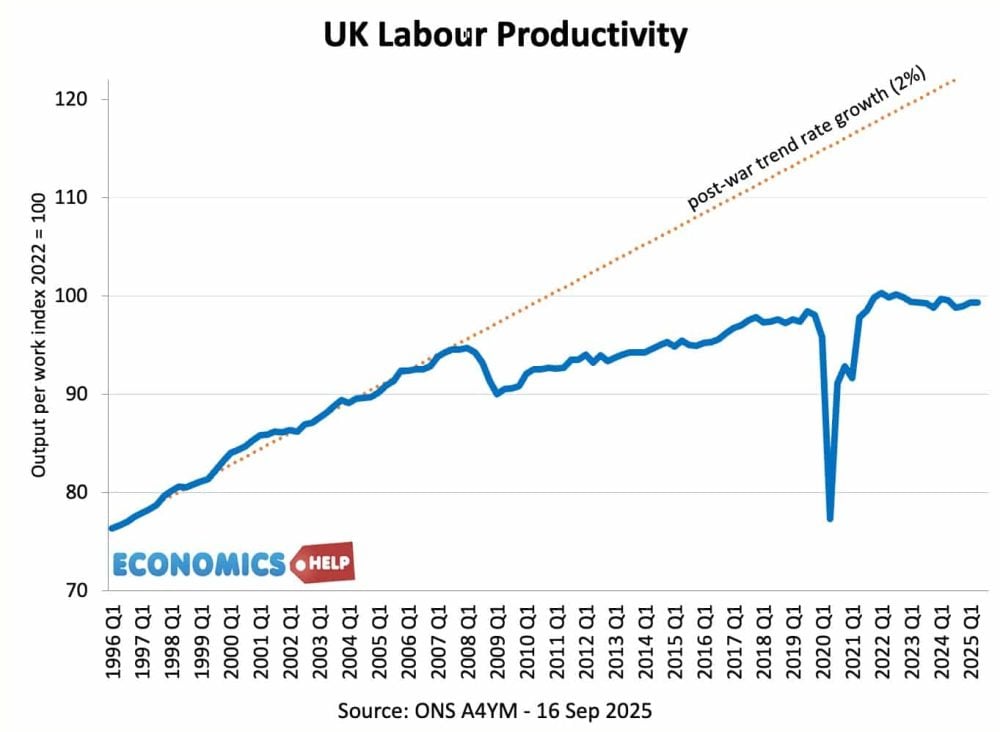
The real problem was that UK higher education expanded during a period of stagnant productivity and stagnant wages. So although there were more graduates, the UK did not create sufficient high skilled jobs. But cutting student numbers doesn’t address this underlying issue.

Also the graduate wage premium has become more mixed. The UK economy is ever more reliant on London – a place where the graduate wage premium was maintained. The only problem is cost of living in London.

Some universities like LSE, oxford and Cambridge have much bigger wages than former polytechnics. Also, certain subjects like medicine economics, yeah and maths give much bigger wage premium is still significant.

So with an economic degree from Oxford I should probably be earning more than the pittance I get from a few YouTube videos.
UK/EU Divergence
But the point is there is a large divergence in degrees. An OECD working paper found the UK had the lowest share of graduates working in graduate jobs. Also a major difference with Europe is that UK degrees tend to emphasise the subject above all else. In Europe, there is much greater emphasis on a more rounded degree which combines academic study with work placements given actual experience. UK Universities are actually involved in apprenticeships, but this could be expanded to give a more rounded degree, with greater practical experience and more flexibility. Something essential in an AI economy, where the actual skills employers need is changing rapidly.
Benefits University?
But can we judge the benefits of education purely by the market value of degrees. There is a good case to argue that although university research might not be profitable, it generates significant externalities for the rest of the economy. UK universities played a key role in the research in to LLM, it was just a shame the research was bought up by US tech giants who made the money from it.

London economic argues the UK’s higher education sector has benefits which are underestimated by conventional measures. This includes the benefits of research, benefits to productivity, impact on the exchequer of higher salaries and taxes and the benefits of greater knowledge. They argue that for every £1 of publicly funded income, there is an £11.6bn of economic benefit.
However, whilst the university sector might have external benefits to the economy and in fact play a key role in the local economies of university towns, universities do have an image problem. With tight public finances universities have fallen to the bottom of the pile. If a steel works threatened the loss of 500 jobs, the government would probably bail it out. But, if a university closed threatening job losses and the devastation of a university town, I can’t see a government doing anything.
The problem is that something has to give, universities have seen their cash cow of foreign students been taken away. Domestic students now think twice and the university sector may struggle to support so many universities. In a competitive market, it will be universities perceived to have lower rank and prestige which could be forced to close or merge.
Hard Choices
There are two questions. What proportion of school leavers should go to university and how should universities be funded?
To the first question, I do feel that many schools became unthinking conveyor belts for university, even if it was not necessarily in the best interest of their students. Again it comes back to the competitive nature of education. Schools want to climb league tables and you climb league tables by getting people into university. But are we doing less academic students a favour by making them spend three years, when they might be better off taking more vocational qualifications and missing out on the student debt and three years of studying.
Lower number of students would enable a rethink of funding. Rather than scrapping by, we give higher per-student funding, and enable an overhaul of the current model of very high student debt, which holds back a whole generation. In the current system, there is danger of universities become the preserve of children with wealthy parents.
But, also whilst there may need to be a cut back in student numbers and some types of degree, with low economic value, it is important to bear in mind a few factors. The UK has a comparative advantage in education, it doesn’t have one in manufacturing. I think many politicians would rather put on a high viz jacket and visit a steel factory than visit UK research labs. A steel worker is seen as a proper job. But, you have to focus on what you are relatively good at, rather than trying to subsidise an industry that is uncompetitive. And the truth is manufacturing jobs are increasingly graduate level. Modern manufacturing is very capital intensive. You are more likely to have a graduate overseeing systems than the hard physical labour of the past. In the short-term with net migration falling rapidly, it is time to rethink the lucrative overseas market and allow more foreign students, the UK could do with the revenue.
Related
Sources
https://www.ft.com/content/649d3c64-b8e5-4979-9f0c-9aebd43642e2
https://ifs.org.uk/articles/degrees-make-you-rich-and-ones-dont
https://qmucu.org/qmul-transformation/uk-he-shrinking/
About The Author
