Why Japan’s Debt Crisis Is America’s Problem
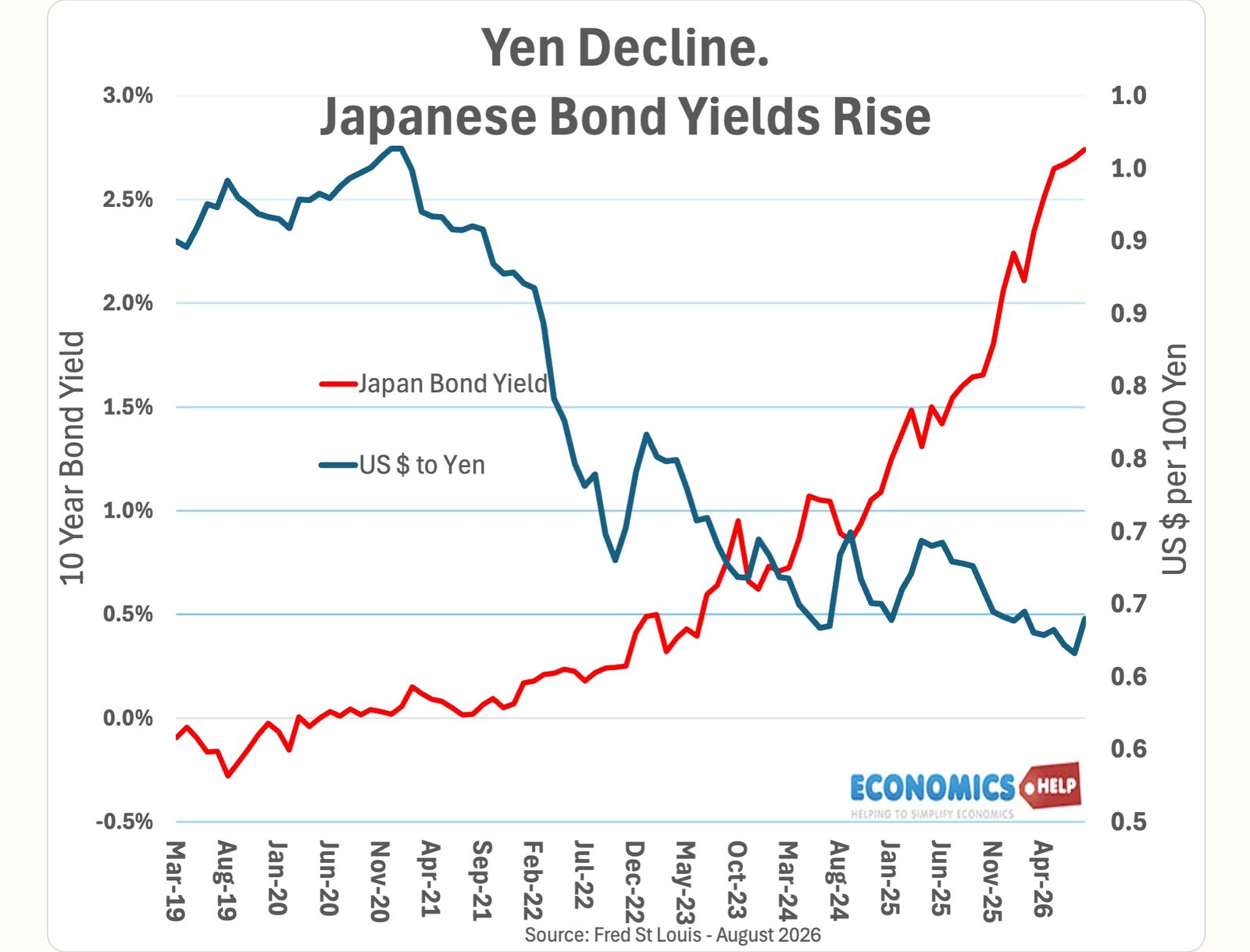
 Japan is the land of the rising sun, but the Yen has been falling and the only thing going up is Japanese bond yields. But why does this matter for the global economy? Well, the other part of the equation is this Japan’s gross debt at 249% of GDP, the highest in the world.
Recently, the US did something it hadn’t done for 28 years, it joined Japan to intervene in Currency markets and buy Yen. The official line was solidarity with a good ally. But no-one really believes it was an outbreak of solidarity. The real reason is the US Treasury is worried about what could happen next.
Problems of falling Yen for US
Firstly, a falling Yen causes problems for the US. As the Yen and other Asian countries fall, US exporters are less competitive, but the real story is that a falling Yen means the Japanese may be forced to unilaterally intervene. Sell US Treasuries to be able to buy Yen and shore up the value of the currency. A strong dollar isn’t all bad, it helps reduce import prices and inflation. But, this benefit is not enough to offset the bigger about a falling Yen.

For many years, the interest on Japanese debt was close to zero so for a long time, this high debt didn’t really matter it was really cheap borrowed. But, in recent years, Japan has seen higher inflation and bond yields have risen as a result. Above is a long-dated 40 year bond yield showing a steep climb. This does two things. Firstly, it increases the cost of Japanese debt, and secondly it encourages Japanese to sell US Treasuries and bring money back to Japan to buy Japanese debt which now give a better return. And it is this that has got the US Treasury worried.

Japan is the largest foreign holder of Treasuries $1.2 trillion. 13% of foreign held debt. As Japanese yields rise, it has encouraged selling of US bonds. T D economics suggest sustained selling of US Treasuries could add up to 50bp to US 10 year yields.

And this explains why the US Treasury is in near panic mode. US 10-year yields hit an 18-month high of 4.75% last week — and the 30-year is near its highest since 2007. US bond yields are rising because of inflationary pressures from Iran, a rising US budget deficit. But, the main point is given all these pressures on US bonds, the US don’t want to see any more rise in bond yields. Because US debt interest payments are already set to soar. So when the US suddenly appears to be helping Japan. It is really seeking to protect its own borrowing costs.

And the thing is although US bond yields are rising, Japanese bond yield are rising faster. This shows the premium of US yields over Japanese. In late 2023 the gap was wide — a big incentive to hold dollars. As that gap narrows, the incentive reverses.

But the curious thing is that despite rapid rise in Japanese bond yields, the Japanese Yen has been falling against the dollar. Usually higher bond yields cause stronger currency. But this is not happening. One explanation is that because Japanese debt is so high, the Japanese Central Bank is artificially caping Japanese bond yields via bond purchases.

If you look at debt levels and bond yields. You could argue, Japanese bond yields should be closer to 7%, rather than 4%. So with artificially low Japanese bond yields, Japanese investors are still investing abroad, which weakens the Yen. So can you solve this by propping up the Yen through government intervention?
Difficulty of Intervention
Firstly, governments have a lot of foreign exchange reserves but it is small share of overall market. The US sold Euros to buy Yen, perhaps reluctant to sell own dollar reserves. There was a short-term bounce in the Yen. But can it be maintained? One argument put forward by Robin Brooks is that the Yen is arguably still overvalued. Bond yields are suppressed by the Bank of Japan. So with domestic returns too low, there will be a persistent capital outflows. Why buy Japanese debt at 4%, when there is risk premium for having 249% debt levels. So no matter how much Yen Central Banks buy, it doesn’t stop the tendency for capital flight as Japanese investors want alternatives to low rate, high risk Japanese bonds.
Now, if you really want to protect the Yen, the obvious solution is to increase Japanese interest rates from their current lows. But Japan doesn’t want this because it would make debt interest rate payments really high. Already, Japanese debt interest payments are expected to double from 10 trillion Yen to 21 trillion by 2029. Add in bond redemptions and total debt servicing hits ¥41 trillion — around 30% of all government spending, that’s more than Japan spends on social security. But this forecast assumes yields stay low. If yields doubled to 6 or 7%, the arithmetic breaks down.
But the problem for the US, is that whilst it is worried about Yen weakness, it doesn’t want a solution of higher Japanese interest rates either. If Japan increased interest rates and stopped intervening, some claim Japanese bond yields could rise to 7%. Then people would sell US treasuries and buy Japanese bonds. Higher Japanese yields would cause higher US bond yields. This is a really big issue because of the Yen Carry trade. Basically, people borrowed in Yen at 0% interest rates and invested in dollars. If Japanese rates rose to US levels, the Yen trade would collapse and there would be a massive liquidity shock. Investors would have to sell US stocks, pay back their loans and capital would flood back to Japan and away from US. So this is the trap. The only durable fix for the yen is higher Japanese interest rates — and higher Japanese interest rates are exactly what would do most damage to the US Treasury market. Bessent can’t have both.

Now, there are a few things to point out. Firstly, Japanese net debt is lower than gross debt. This is because Japan holds overseas financial assets which earn interest. Japan could sell these to pay down gross debt. That would relieve the pressure on Japan’s fiscal situation and the Yen.
Also, two evaluation points 88% of Japanese debt is held domestically, so although the headline figure of 249% is very high, it is not quite as extreme as first glance. Also, not everyone agrees yen is overvalued, if you look using purchasing power parity, the Yen is perhaps undervalued, and Japan is running a large current account surplus, the weak yen has been good for Japanese exports.

The problem for the US though, is that you can’t solve this problem of rising US bond yields by intervening in currency markets, the problem is much deeper than that. Long-term projections of debt are a big issue. Up to now, the US has benefitted from decades of high demand for US assets and this has enabled the US to run large deficits at relatively low cost. However, it’s not just Japan thinking twice about saving in dollars. And it’s not just Japan. China has been steadily diversifying out of dollars into gold. In a crisis, demand for Treasuries is supposed to rise. In this one, it hasn’t
Kevin Warsh has had a baptism of fire. Inflation is still running above target, which normally means higher rates. But it’s no longer just about inflation — it’s about interest payments on a growing debt. And as the US is finding out, what happens in the Japanese bond market doesn’t stay there.
So the US is stuck. It can’t let the yen fall, and it can’t afford the one thing that would stop it falling (higher interest rates). For thirty years Japan’s debt was somebody else’s problem. It isn’t any more.
# Sources (HTML)
About The Author