Which Tax Strategies Are Actually Worth Your Time? A Physician’s Effort-Adjusted Guide

 |
 |
<!–
At my CPA firm, I have this conversation almost every week. A physician comes in for a tax-planning meeting, excited about a strategy. They’re convinced this is the move to make. Then, we run the math and realize they may be chasing $3,000 of savings while adding 50 hours of work, documentation requirements, and audit exposure to their life.
This is when my job switches from being their tax strategist to just a strategist.
Physicians often evaluate tax savings like they’re still residents. When you made $50,000 per year, $3,000 was meaningful to your finances. Now as an attending, it may be the equivalent to the pay of one shift.
The trap is looking only at the tax savings. I know every April that a six-figure annual tax bill hurts, but if the work, complexity, cash commitment, or audit risk exceeds the benefit, the strategy may be a bad trade. With the limited amount of time that physicians have, they need to focus on doing the right moves for their situation.
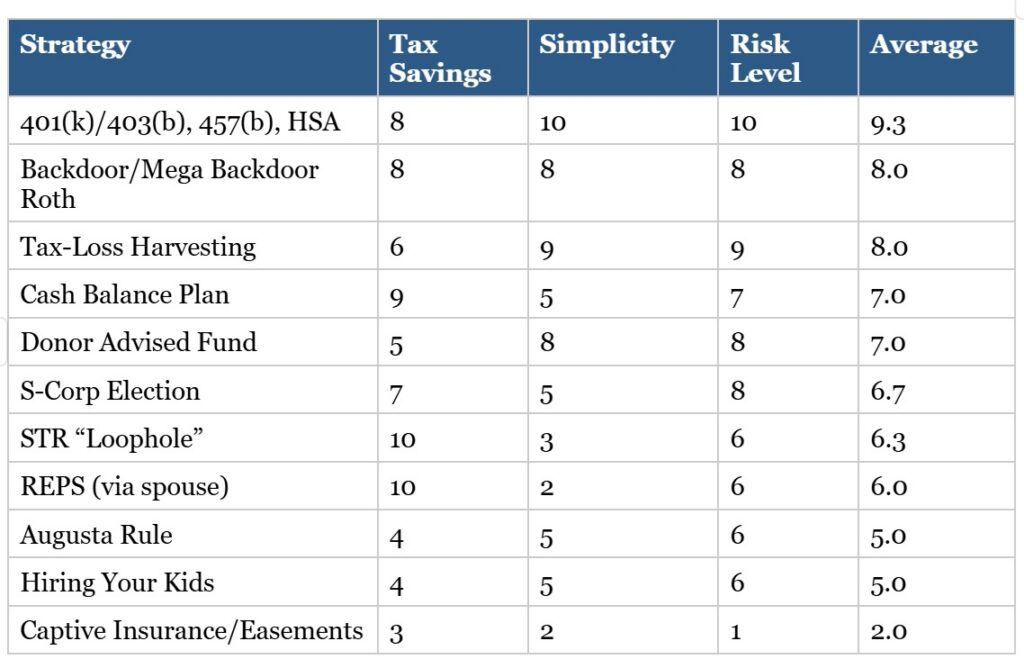
This guide is a framework for judging many popular tax strategies by their effort-adjusted return to help you determine if a tax strategy is right for you. The scores are 1 to 10, with 10 always being most favorable in the following categories:
- Tax savings: How much tax benefit the strategy can realistically create.
- Simplicity: How easy it is to implement and maintain.
- Risk level: My interpretation of IRS, documentation, and compliance risk for the strategy.
- Average: A rough overall score, but the component scores matter more than the final number.
Before we get started, please note that while I’m a CPA, I’m not your CPA. Work with your own advisor, ideally a CPA who focuses on physicians, before implementing anything.
The Quick Wins
Big savings, almost no effort, and low IRS risk. These are easy winners for most physicians.
401(k)/403(b), 457(b), and HSA
Tax Savings 8 | Simplicity 10 | Risk Level 10 → Average 9.3
- What is it? Tax-advantaged retirement and health accounts
- Who is it for? Most W-2 physicians and practice owners. HSAs require an eligible High Deductible Health Plan.
- Why do it and how does it work? Money goes in pre-tax, grows for decades, and lowers taxable income. A governmental 457(b) is usually attractive.
- Why not? The money is less flexible once it’s put in, and traditional contributions are usually tax-deferred, not permanent tax elimination. A non-governmental 457(b) requires more caution because of employer-creditor risk and distribution restrictions.
- Potential savings: Thousands per year now—and far more over a career from decades of tax-advantaged growth. Roth options may be available for residents and for those currently in lower-income tax brackets.
Backdoor Roth IRA and Mega Backdoor Roth 401(k)
Tax Savings 8 | Simplicity 8 | Risk Level 8 → Average 8.0
- What is it? Two ways high earners can get money into Roth accounts despite income limits: a Backdoor Roth IRA through a nondeductible IRA contribution and conversion, and a Mega Backdoor Roth through after-tax 401(k) contributions if the plan allows it.
- Who is it for? High-income earners over the direct Roth IRA income limits. The Mega Backdoor Roth only applies if your 401(k) plan specifically allows after-tax contributions and Roth conversions or in-service distributions.
- Why do it and how does it work? The regular Backdoor Roth is usually a simple annual IRA contribution and Roth conversion. The Mega Backdoor Roth can move much larger amounts into a Roth through an employer plan. Neither is usually a current-year deduction; the value is decades of tax-free growth.
- Why not? The Backdoor Roth can be tripped up by the pro-rata rule if you have pre-tax IRA money. The Mega Backdoor Roth depends entirely on your plan document, and practice-owner plans must also consider staff costs and nondiscrimination testing.
- Potential savings: No current-year deduction but potentially six figures of tax-free growth over a career.
Tax-Loss Harvesting
Tax Savings 6 | Simplicity 9 | Risk Level 9 → Average 8.0
- What is it? Tax-loss harvesting is selling investments at a loss to offset gains and then reinvesting in a not-substantially-identical investment or waiting long enough to avoid the wash-sale rules.
- Who is it for? Anyone with a taxable brokerage account.
- Why do it and how does it work? It turns normal market volatility into losses you can use against current and future gains, plus up to $3,000 against ordinary income each year.
- Why not? The wash-sale rules can trip you up if you’re careless. It is mostly tax deferral, not permanent tax savings.
- Potential savings: Usually a few hundred to a few thousand dollars a year—more in volatile markets and larger taxable portfolios.
More information here:
Worth It If You Qualify
These can save real money, sometimes life-changing money, but they require the right facts: eligibility, documentation, cash flow, compliance, and audit tolerance. The question is not whether the strategy works. The question is whether it works for your situation.
S-Corp Election
Tax Savings 7 | Simplicity 5 | Risk Level 8 → Average 6.7
- What is it? Electing S-Corp status allows you to split business income into a salary plus distributions.
- Who is it for? 1099 contractors and practice owners with solid, stable profits. This is my No. 1 request from locum docs. I usually want to see at least $50,000-$75,000 of stable profit before even discussing an S-Corp.
- Why do it and how does it work? You pay yourself a reasonable salary and take the remaining profit as distributions. Salary is subject to payroll tax; distributions generally avoid payroll taxes.
- Why not? As a physician, your reasonable salary may already exceed the Social Security wage base, shrinking the savings to only the 2.9% Medicare portion. You also add payroll filings, an 1120-S tax return, bookkeeping, reasonable-comp documentation, and another layer of compliance.
- Potential savings: Often $2,000-$10,000+ per year for the right 1099 physician or practice owner, but it can be negative if compliance costs outweigh payroll-tax savings.
The Short-Term Rental Loophole
Tax Savings 10 | Simplicity 3 | Risk Level 6 → Average 6.3
- What is it? Owning and operating a short-term rental in a way that can make losses non-passive if the average guest stay and material participation rules are met.
- Who is it for? A high earner or dual-high-income couple willing to run a short-term rental as a business. Unlike REPS, a full-time physician can make this one work.
- Why do it and how does it work? If the average guest stay is seven days or less and you materially participate, losses may offset W-2 or 1099 income.
- Why not? You have to buy a real investment and run a miniature hotel. If a property manager does most of the work, you maintain poor logs, the average stay drifts above seven days, or you make a mediocre deal only for tax savings, any of those can wreck the strategy. A tax deduction is not a long-term investment strategy.
- Potential savings: $20,000-$100,000+ in Year 1 on the right property, but the real estate must stand on its own as an investment.
Real Estate Professional Status (REPS)
Tax Savings 10 | Simplicity 2 | Risk Level 6 → Average 6.0
- What is it? Qualifying as a real estate professional so rental losses offset ordinary income.
- Who is it for? Usually the couple where one spouse earns a large income and the other spouse genuinely runs the real estate. A full-time physician almost never qualifies alone.
- Why do it and how does it work? The bar is more than 750 hours in real property trades or businesses and more than half of your personal-service working time. The non-practicing spouse logs and documents those hours while the physician keeps practicing. You will also need material participation in the rental activity.
- Why not? If you are a full-time physician trying to claim REPS yourself, that is one of the brightest audit flags in the code. If audited, it is a very hard case to defend. You also need new depreciation or real economic losses to keep generating large annual offsets.
- Potential savings: Potentially six figures when large usable losses are created through real estate activity and depreciation, but the documentation burden needs to be taken seriously.
 |
 |
<!–
Worth It in the Right Situation
These are not bad strategies. But they are bad when forced onto the wrong facts. Used correctly, they can work well. Used because someone on the internet said they were clever, they usually disappoint.
Cash Balance/Defined Benefit Plan
Tax Savings 9 | Simplicity 5 | Risk Level 7 → Average 7.0
- What is it? A defined benefit plan layered on top of your 401(k) that allows very large pre-tax contributions.
- Who is it for? Practice owners or certain high-income 1099 earners with stable, high income; few or no employees; and the willingness and ability to make required annual contributions.
- Why do it and how does it work? A properly designed cash balance plan lets the right physician put well into the six figures away pre-tax in a single year. For a high-income owner with no staff, it can be the single biggest deduction available.
- Why not? Younger physicians, variable-income owners, and employee-heavy practices should be cautious. It can build wealth but starve available cash for living expenses.
- Potential savings: Often $50,000-$100,000+ in current-year deductions for the high-income owner with few employees.
Donor Advised Fund (DAF)
Tax Savings 5 | Simplicity 8 | Risk Level 8 → Average 7.0
- What is it? A DAF is a charitable account you fund for a deduction now and then grant out to charities over time.
- Who is it for? Physicians who are already charitable and hold appreciated taxable investments.
- Why do it and how does it work? Bunch several years of giving into one high-income year, deduct it now, and donate appreciated shares to avoid capital gains. Then grant the money to charities over time.
- Why not? If you were not already going to give the money away, you are giving away a dollar to save up to 37 cents federally. The tax benefit is strongest when bunching gifts helps you itemize or when you donate appreciated assets.
- Potential savings: Potentially thousands or tens of thousands if you already planned to give.
The Augusta Rule
Tax Savings 4 | Simplicity 5 | Risk Level 6 → Average 5.0
- What is it? Renting your home to your own business for up to 14 days a year and collecting the rent tax-free.
- Who is it for? 1099 contractors and practice owners with real business meetings and a defensible fair-market rental rate.
- Why do it and how does it work? Your business pays documented fair-market rent for legitimate business use of your home, and the rent can be tax-free if you stay within the 14-day limit.
- Why not? In many cases, you are spending a Saturday on agendas, minutes, comparable rental rates, and documentation to save a few hundred dollars.
- Potential savings: Usually a few hundred to a few thousand dollars. Be skeptical of big numbers as most homes don’t have amenities and services that are comparable to the Four Seasons.
Hiring Your Kids
Tax Savings 4 | Simplicity 5 | Risk Level 6 → Average 5.0
- What is it? Putting your children on the payroll for genuine work in your business.
- Who is it for? Practice owners and 1099 contractors with real tasks that a child of that age could reasonably complete.
- Why do it and how does it work? Wages for real work shift income to your child’s lower bracket, and that may fund a Roth IRA.
- Why not? A 3-year-old cannot be a $13,000 marketing consultant for an anesthesiologist. I always ask clients whether they would pay their neighbor’s kid the same amount for the same work. If they can say yes with a straight face, then we can typically look into this strategy further. Entity type also matters. Wages from an S-Corp are not treated the same as wages from a parent-owned sole proprietorship.
- Potential savings: $3,000-$6,000 per year per child if the wages are real, reasonable, documented, and actually paid.
Red Flags: Captive Insurance, Conservation Easements, and Other Exotic Structures
Tax Savings 3 | Simplicity 2 | Risk Level 1 → Average 2.0
- What is it? Complex structures (micro-captive insurance companies, syndicated easements) that are marketed as large deductions.
- Who is it for? Almost no physician who is being pitched one primarily for tax savings.
- Why do it and how does it work? Legitimate captives start with a genuine insurance need, not a promised deduction. If the tax deduction is the main selling point, that is your warning sign.
- Why not? The IRS lists abusive micro-captives and syndicated conservation easements on its Dirty Dozen. The fees are large and the audit risk is high, and penalties can dwarf the promised benefit.
- Potential savings: Large on paper, often destroyed by fees, penalties, audit costs, and bad facts.
More information here:
The Scorecard
The average score is only a rough judgment. The right score can change by person, and the component scores matter more than the final number when reviewing it for your personal situation.
Rapid Fire: A Few More for Business Owners
Here are some other quick hits for locum docs and practice owners.
- Home office: Take it if you genuinely run a business from a dedicated, exclusive-use space. W-2 physicians do not get a federal home-office deduction.
- Spouse on payroll: Useful if your spouse genuinely works in the business and compensation is reasonable. Paper titles do not count.
- Accountable plan: If you run an S-Corp, this is how you reimburse legitimate business expenses tax-free. Boring, useful, and often missed.
- QBI deduction: Huge when available, but physicians are a specified service trade or business and may be phased out at a high income.
- Vehicle in the business: Real if you actually drive for the business and keep a mileage log. Commuting is not business mileage.
The Real Takeaway
For physicians who can often earn more by working a few more hours instead of adding complexity, a tax strategy is only as good as its effort-adjusted return. The best strategy is not always the biggest deduction. It is the one that improves your after-tax position without becoming another job. The right advisor should protect your time as aggressively as your tax dollars.
Which of these tax strategies have you used? Have they worked out as well as you hoped? Which of the strategies would not be worth your time?
[EDITOR’S NOTE: Many thanks to Taxstra PLLC and Bryan Martin, one of our Platinum Level (contributing $8,000+) Sponsors for the WCI Medical School Scholarship, for helping physicians secure the best tax strategies. This is the first of our three scholarship-sponsored posts for 2026. Thank you for supporting those who support this site and especially the scholarship. All proceeds go to the scholarship winners.]
The post Which Tax Strategies Are Actually Worth Your Time? A Physician’s Effort-Adjusted Guide appeared first on The White Coat Investor – Investing & Personal Finance for Doctors.
 |
 |
<!–