What It Feels Like to Lose Money

 |
 |
<!–
While updating my investment spreadsheet at the end of 2025, I saw a little note I had added to the spreadsheet 18 years prior. It looks like this:
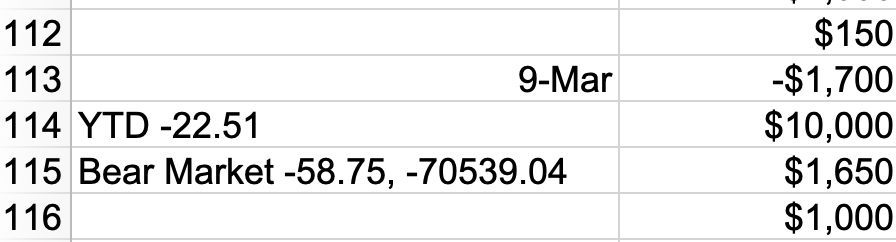
Let me interpret this for you. That “9-Mar” means I put in this note on March 9, 2009. Those who didn’t live through it as an investor may not realize that March 9, 2009, was the bottom of the bear market associated with the Global Financial Crisis of 2008-2009. I calculated at that point that our retirement portfolio was down 22.51% year to date. This is after taking a shellacking in 2008. In fact, from peak to trough, the portfolio was down 58.75% at that time. I calculated the actual dollar loss, too. We had lost $70,539.04 since the last market peak.
Now, maybe $70,000 doesn’t feel like very much money to you. Truthfully, it no longer feels like very much money to me. But in 2009, it felt like A LOT of money. My military physician income that year was only about $120,000, and that was pretty much our entire household income (although I did a little moonlighting every now and then). We started saving for retirement in 2004. The total amount of money we put toward retirement from 2004-2008 was < $134,000. Five years’ worth of savings.
At the beginning of 2008, we had $97,000 in our retirement portfolio. At the beginning of 2009, that amount was just under $104,000. Obviously, investments didn’t do too well in 2008, but the ongoing contributions for 2008 totaled up to a little more than we had lost. When you think of it that way, losing $70,000 from peak to trough was the majority of our life savings. Since our house had fallen in value from 2006 to 2009, it was a huge chunk of our net worth, as you can see below:
- 2004: $432
- 2005: $17,084
- 2006: $68,816
- 2007: $141,337
- 2008: $206,630
- 2009: $324,206
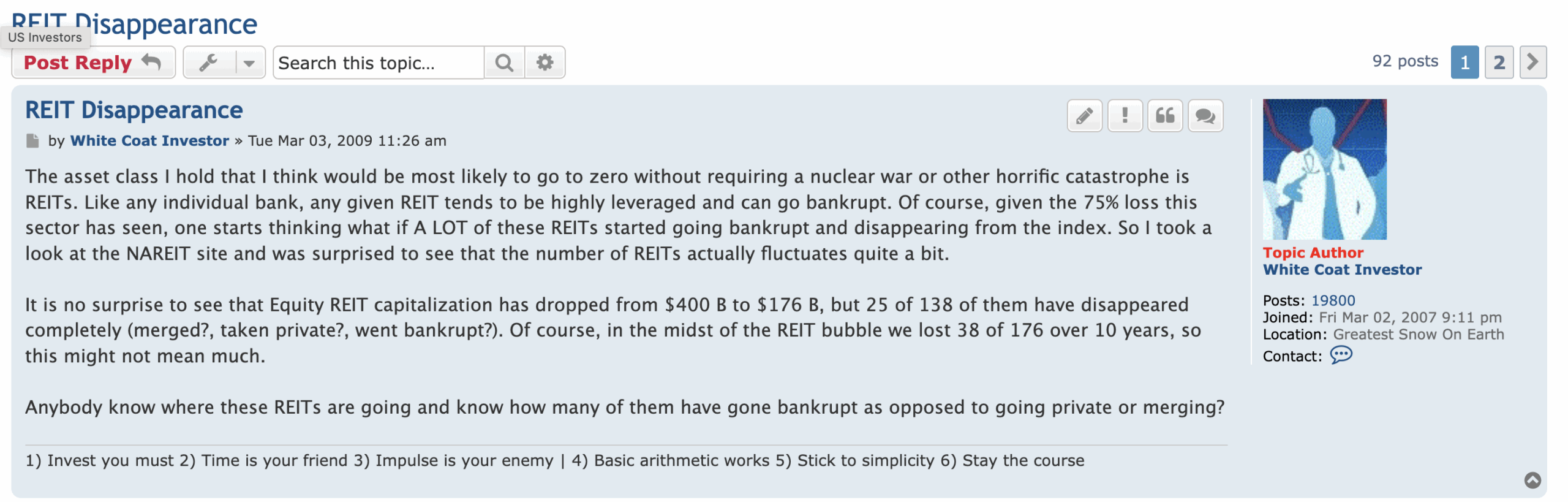
Yeah, $70,000 was a lot of money. It was money we didn’t spend on trips. It was money we didn’t spend on a kitchen renovation. It was money I didn’t spend on a car (I was driving something I bought for $1,850 as a first-year attending). And it was psychologically painful to lose. Overall, we were down 58%, but at least one of my asset classes (US Public REITs) was down 78% peak to trough. I had posted this on the Bogleheads forum six days earlier:
We Stayed the Course, Though
This was still more than two years before we started WCI (the name and image on the account have since been changed). Our portfolio stock-to-bond mix was 75/25 at the time, and that seemed just about right to me, given how I was feeling about what I owned. Don’t beat me up too badly; my spreadsheet says that we not only didn’t panic-sell, but that we continued to invest throughout this bear market:
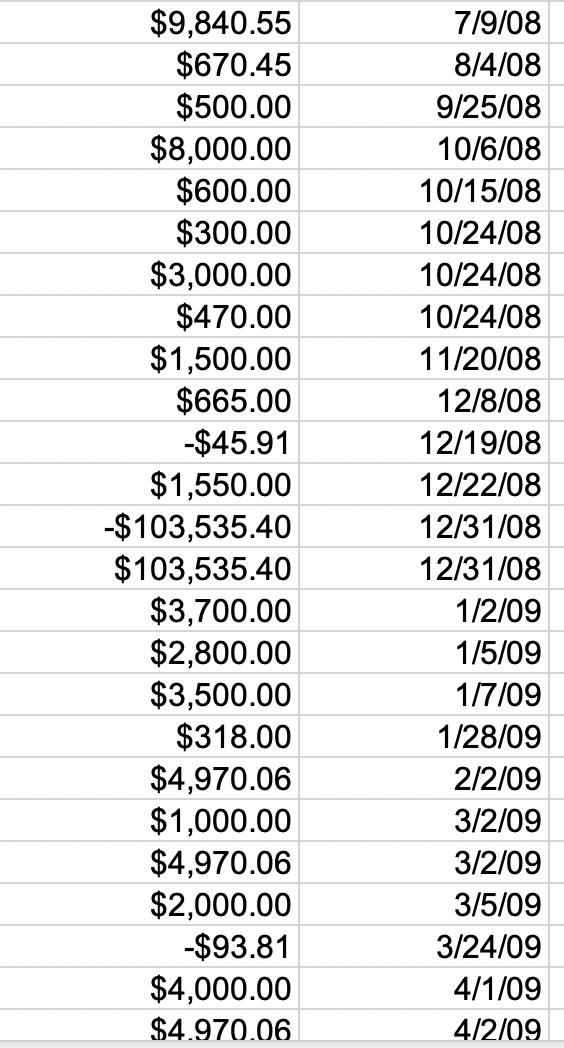
See all those positive numbers on the left? Those were investments we made, effectively “buying low” during that bear. With our portfolio at 75/25, we certainly weren’t wishing at that time that we had been more aggressive. We were just thrilled to have been smart enough to have invested at least some of our money into very safe bonds instead of stocks and real estate.
What’s my point in sharing all this ancient history? My point is this: 2008-2009 was my first bear market as an investor, and it was also the biggest. Nothing since—not 2011, December 2018, March 2020, or 2022—can compare. The drops from those other bear markets were smaller, and the recoveries were faster. I’m already half a century old. If I can barely remember the last nasty bear market, perhaps half of investors have never really experienced one. Heck, half the people on Wall Street haven’t invested in one.
Far too many investors lack the experience of really losing a big chunk of money they used to own. That’s why they talk about borrowing money at 6% or even 8% so they can invest. That’s why they talk about not needing to own bonds at all. That’s why they say you don’t even need an emergency fund. That’s why they talk about risk tolerance as if it were an academic or mental thing rather than a behavioral or even visceral thing.
I confess I don’t watch the markets closely. Part of that is simply because I know day-to-day movements don’t matter. But part of it is that market movements now seem downright boring. How can anyone think it’s interesting to see the market go up 1% in a day after living through 2008 when markets and actually investments I owned went up or down 5%-10% a day for weeks? Yes, it was very interesting to watch. We all seriously worried that we were going to lose the money we had in money market funds, for crying out loud. Now? Not so interesting.
More information here:
 |
 |
<!–
Listen to Experienced Investors
Some investors are even older than me. They might be worth listening to. Two of them are Bill Bernstein and Ed McQuarrie, both of whom wrote an article a few months ago titled “Beware Empty Memory Banks” that said:
“Nowhere is today’s zeitgeist better captured than in a recent Economist piece entitled ‘Investing like the ultra-rich is easier than ever,’ which describes a highly leveraged strategy espoused by Barry Nalebuff and Ian Ayres in their 2010 book “Lifecycle Investing.” The star of the Economist piece is a pseudonymous “Mr. Street,” who has embraced the Nalebuff/Ayres strategy. While 200% equity was difficult to manage when they wrote the book in 2010, Mr. Street can now execute it with cheap margin loans from the likes of Interactive Brokers.
Trouble is, while the Economist piece focused on how inexpensive margin loans made leveraged investing so much easier, it buried the lede: Mr. Street, it turns out, is in his early 30s.
Need we say the quiet part out loud? Mr. Street, poor baby, has never personally experienced a long-term bear market as an established investor, and his memory banks are devoid of the damage wrought by the Grim Reaper of equity risk. Let’s be generous and assume he’s read his market history and knows that stocks can lose money—sometimes, a lot—and take months, if not years, to recover. There’s a difference, though, between being told that markets can fall by more than 50% and having it burned into your memory banks by seeing your net worth halved in real time as the economy careens towards the precipice.”
More information here:
- Why ‘You Don’t Lose Money Until You Sell’ Is Bunk
- The 15 Questions You Need to Answer to Build Your Investment Portfolio
My Crystal Ball Is Still Cloudy
I have no idea when we’re going to hit our next “real” bear market. But I do know we will hit one. Stocks are not on a “permanently high plateau,” and it’s not “different this time.” Setting your asset allocation is a lot like playing the old game show The Price is Right, where you try to guess the price of a consumer item as closely as you can without going over. If you go over, you lose. In investing, if you slightly underestimate your risk tolerance, it’s no big deal. But if you slightly overestimate your risk tolerance and end up panic-selling in a nasty bear, especially late in your career, you’re looking at a financial catastrophe.
Naturally, the only risk tolerance that matters is your risk tolerance after you’ve lost a ton of money and it appears you’re going to lose a ton more. If you have never been in a situation like that, it’s probably best to set that old stock-to-bond ratio at a level that you are 110% sure you can tolerate—even in the Great Depression after you’ve lost your job, had your home and investment properties foreclosed on, and watched 90% of your stock portfolio evaporate. You can adjust it upward once you’ve learned from experience just how much you can tolerate.
I know I can tolerate a 58% loss and not panic-sell. Do you?
What do you think? Have you lost real money? How did it feel? What did you do?
The post What It Feels Like to Lose Money appeared first on The White Coat Investor – Investing & Personal Finance for Doctors.
 |
 |
<!–