After announcing a cease-fire deal in June, the conflict in the Middle East is back on, with strikes resuming and U.S. President Donald Trump reimposing a naval blockade. On July 13, oilprice.com reported that oil prices jumped “more than 8%” after Trump announced the blockade.
Aside from the immediate price jump, Trump’s stance on the Strait of Hormuz and the seemingly inevitable oil price hikes the instability will cause is likely to have a trickle-down effect on Social Security benefits next year. Recipients are likely to see the largest cost-of-living adjustment (COLA) in recent years. Though that’s not necessarily good news.

Image source: The White House.
The connection between rising prices and the annual COLA
The annual COLA is based on the CPI-W, an inflation measure that tracks the cost of goods and services such as housing, food, and energy (including oil). Not all CPI-W data is relevant, though; only the figures from the third quarter (July, August, and September) are included in the Social Security COLA calculation.
It’s a three-step process:
- Average the third quarter CPI-W data.
- Compare this year’s average to last year’s third-quarter average.
- The next year’s COLA is the percentage increase (if the average is lower, there is no COLA).
With the blockade resuming and oil prices rising right now — during a month that will be used to calculate next year’s COLA — there’s a good chance the CPI-W average will lead to a higher-than-usual COLA in 2027. Higher oil prices are reflected at the gas pump, but they also drive up the costs of groceries and retail goods because of the transportation that is required.
A 3.8% bump?
President Trump’s stance on Iran has flip-flopped plenty of times, so there’s no reason to believe this time will be any different. Previously, however, the U.S. government has been able to tap the U.S.’s reserves to keep oil prices relatively stable, but it’s now reported that the reserves are at their lowest levels since 1983.
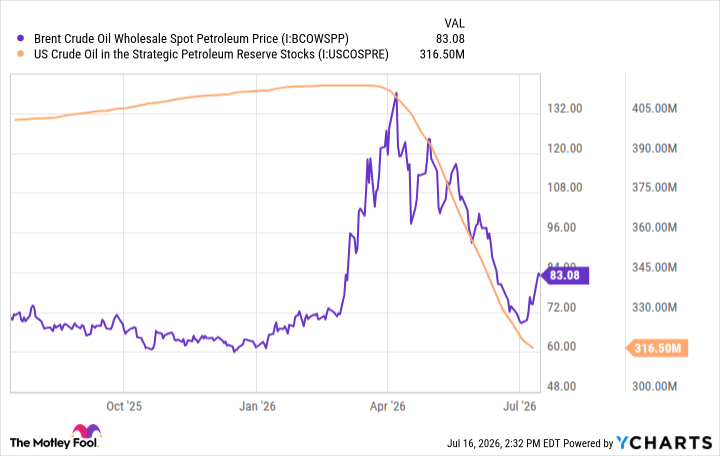
Brent Crude Oil Wholesale Spot Petroleum Price data by YCharts
The COLA this year was 2.8%, but 2027’s is on pace to be at least a percentage point higher at the current rate of inflation, according to trusted advocacy group The Senior Citizens League. A 3.8% COLA would be the third-highest in the past decade.
- 2026: 2.8%
- 2025: 2.5%
- 2024: 3.2%
- 2023: 8.7%
- 2022: 5.9%
- 2021: 1.3%
- 2020: 1.6%
- 2019: 2.8%
- 2018: 2%
- 2017: 0.3%
While a higher COLA sounds good it, of course, is the result of inflation. So if things cost more that means a larger Social Security check won’t necessarily buy more.
Any estimates for the 2027 COLA are just that: estimates. We won’t know an official figure until CPI-W data is in for the whole third quarter and the Social Security Administration makes the announcement, which is expected on Oct. 14.
The annual COLA is more of a reactive measure, so it doesn’t necessarily help seniors deal with the inflation they’re experiencing now and may continue to experience. However, it does help retirees keep some of their purchasing power going forward.