Buying a diversified portfolio of many different stocks is often a good choice for long-term investors. But what if you could (almost literally) buy “all the stocks in the world”? A popular Vanguard exchange-traded fund (ETF) lets you do just that.
The Vanguard Total World Stock ETF (VT +1.23%) is one of the simplest, lowest-cost ways to buy thousands of stocks from the U.S. and other countries. This ETF holds more than 10,000 stocks. It could be a good choice for investors who want international diversification while still owning a large percentage of U.S. stocks.
Let’s look at this Vanguard ETF and see if it could be a good choice for your portfolio.

Image source: Getty Images.
Vanguard Total World Stock ETF (VT): 10,048 stocks, 18 years of 8.87% annualized returns
The Vanguard Total World Stock ETF offers an impressive array of U.S. and international stocks. Its portfolio includes 10,048 stocks from 40 countries across developed and emerging markets. This ETF tracks the performance of the FTSE Global All Cap index, so it includes large-, mid-, and small-cap stocks.
Simply put: This fund might not technically own “all the stocks in the world,” but it’s close enough for most investors. And it charges an ultra-low expense ratio of 0.06%.
The Vanguard Total World Stock ETF has an 18-year track record of solid performance. Since the fund’s inception in June 2008, it has delivered average annual returns of 8.87%. More recently, it’s delivered a year-to-date return of 10.41%, and over the past five years, it’s delivered average annual returns of about 10.9%.

Vanguard International Equity Index Funds – Vanguard Total World Stock ETF
Today’s Change
(1.23%) $1.90
Current Price
$156.19
Key Data Points
AUM
$97B
Dividend Yield
1.59%
Expense Ratio
0.06%
Top Holdings
NVDA
4.00%
AAPL
3.59%
MSFT
2.38%
What stocks are in this fund? The fund’s top 10 stock holdings are all tech names, mostly from the U.S. The top five holdings are Nvidia (4.0% of the fund), Apple (3.6%), Alphabet (3.2% combining Class A and Class C shares), Microsoft (2.4%), and Amazon (2.0%).
The only non-U.S. stock in the ETF’s top 10 holdings is Taiwan Semiconductor Manufacturing, which ranks sixth with 1.6% of the fund. The top regions represented in this worldwide ETF are North America (64.9% of the fund), Europe (13.7%), and the Pacific (11.1%), with 10% of the fund allocated to emerging markets.
Why buy the Vanguard Total World Stock ETF — or not
This is an impressive ETF. Many investors might not know that you can buy more than 10,000 stocks all in one fund. The Vanguard Total World Stock ETF offers a low-cost way to just “set it and forget it” with investing in what might be the most-diversified stock portfolio possible. For internationally minded investors who want to own shares of companies in other countries and the U.S. market, this could be a good choice.
But be aware of the risks. For the past 10 years, the Vanguard Total World Stock ETF has underperformed the U.S. stock market. The Vanguard Total Stock Market ETF (VTI +0.96%) (which owns thousands of U.S.-only stocks) has delivered a 290% total return, while the Vanguard Total International Stock ETF (VXUS +1.78%) (which holds thousands of global stocks outside the U.S.) has delivered 145%. The Vanguard Total World Stock ETF has delivered returns that fall right in the middle of those two funds, with a 10-year total return of about 220%.
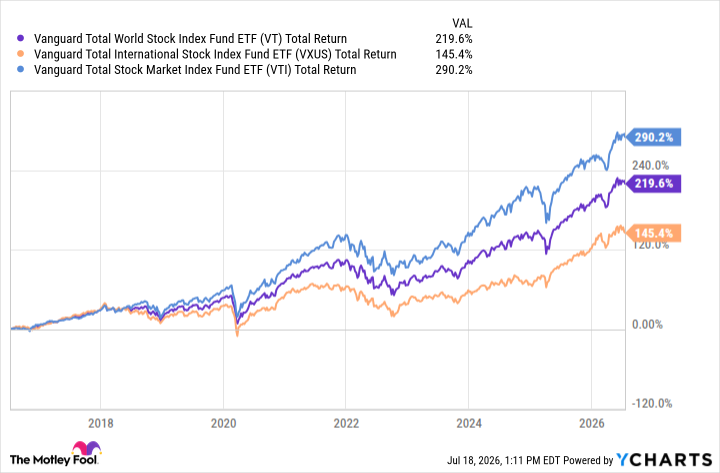
VT Total Return Level data by YCharts
Some U.S. investors might question whether this fund offers too much global diversification. The fund’s portfolio is about 62% U.S. stocks by weight. Many Americans might prefer to own a higher percentage of U.S. stocks than that. If an allocation of 38% international stocks feels a little too high for your goals, you might want to investigate other ways to buy international ETFs.
Ben Gran has positions in Vanguard Total International Stock ETF and Vanguard Total Stock Market ETF. The Motley Fool has positions in and recommends Alphabet, Amazon, Apple, Microsoft, Nvidia, and Taiwan Semiconductor Manufacturing. The Motley Fool has a disclosure policy.