Using Personalized Lifespan Estimation For Retirement
There’s a long-standing aphorism amongst financial planners about the difficulty in doing retirement planning: if the client could just tell me the precise date they will die, I’d make them the perfect retirement plan. Yet the reality is that no one knows when they are going to pass away; while life insurance companies may be remarkably effective at estimating life expectancies for whole populations based on the law of large numbers, any individual client is a sample size of one. Which means most advisors simply plug in a “reasonably conservative” assumption to their retirement planning software, and plan from there.
In this guest post, Dr. K. Jeremy Ko of ShoreUp Retirement Solutions explores the dynamics of how advisors typically estimate a retiring client’s lifespan, and the potential impact of developing more customized estimates of life expectancy, to better estimate how much clients need to save for retirement, can safely spend in retirement, or time the onset of their Social Security benefits.
The starting point is to recognize how common it is for most advisors to simply use a standardized conservative life expectancy assumption, with one recent analysis finding that nearly 90% of advisors simply use the default age-90 or age-95 assumption already built into their financial planning software. Even though the reality is that different demographics – from income to education to race – have materially different life expectancies, varying in many cases by 10-15+ years. Which means at the least, advisors would benefit by looking to more client-demographics-specific actuarial tables than just the standard population average.
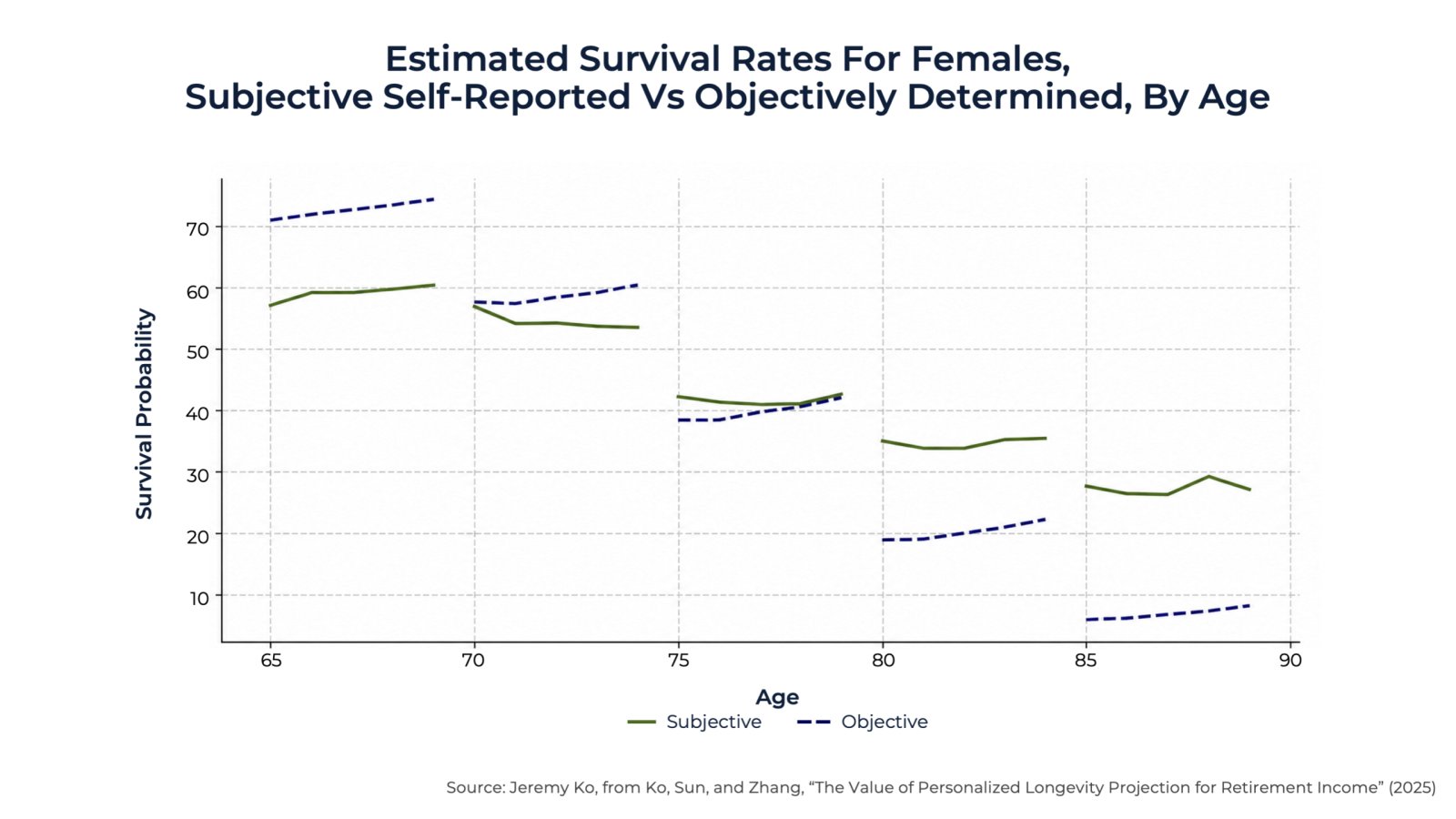
At the same time, while many advisors may prefer to ask clients what their own preference is for a life expectancy assumption, research finds that consumers also systematically misjudge their own life expectancy, with a so-called “flatness bias” that younger individuals tend to underestimate life expectancy (i.e., they don’t realize how long they may really live in retirement), while older individuals tend to overestimate life expectancy (i.e., they don’t realize how short their remaining years may be). Which is especially problematic because these client misperceptions will systematically tilt planning recommendations towards more aggressive, rather than more conservative, assumptions early in retirement.
So what’s the alternative? Using an emerging set of technology tools – from the Society of Actuaries calculator, to the University of Connecticut’s Goldenson Center of Actuarial Science, or the public version of Northwestern Mutual’s Lifespan Calculator – to craft more client-specific recommendations that take into account their individual income, educational, and health factors. Two otherwise similar clients can vary by as many as 20 years in life expectancy just on the basis of a select number of key health and other demographic factors, enough to very materially impact planning recommendations that might otherwise be overlooked if not discussed.
Another benefit of the emerging crop of technology tools is that it can make the conversations with clients easier, as advisors can either walk through the questionnaire with clients together, or offer them the opportunity to do it on their own (if the clients are otherwise uncomfortable to talk about specific family or health factors that may impact their longevity) and simply use the results from the software output itself. Recognizing that because advisors still have a conservative tilt – no one wants to see a client run out of money by underestimating life expectancy – advisors may still default to more conservative longevity estimates (such as a 90th percentile lifespan instead of using the 50th percentile median).
Ultimately, though, the key point is simply to recognize that lifespan in retirement can vary, quite significantly, based on individual health, demographic, and other factors. Merely using a broad-based conservative assumption about clients’ life expectancy – such as assuming all clients may live to age 90 or 95 – can still result in undue conservatism for clients who really aren’t in good health, and with recent medical advances may actually underestimate the life expectancy of the healthiest clients. In the end, no life expectancy tool can perfectly predict how long a client will live, but the more life expectancy assumptions are adapted to the individual client and their retirement recommendations, the more accurate the recommendations can be, even if they will never be perfect.
 |
And if you want to go deeper on this topic, hear directly from the author on the Financial Advisor Technician podcast . |