Trump’s Latest Tariffs Hit With New Lawsuit by 25 States
A group of 25 states filed a lawsuit challenging President Donald Trump’s new global tariffs that went into effect last month, adding to similar complaints by small businesses who claim the levies are illegal.
New York, California, Illinois and other states filed the complaint Aug. 3 in the US Court of International Trade, setting up a now-familiar clash with separate coalitions of states and small businesses locked in a fight with the Trump administration over a third round of tariffs.
The lawsuits accuse Trump and US officials of unlawfully using Section 301 of the Trade Act of 1974 to replace earlier tariffs that were either struck down by the US Supreme Court or expired. The government’s stated reason for imposing the levies — concerns about goods produced with forced labor — is pretextual and invalid, they said.
“After losing at the Supreme Court, the administration is once again trying to illegally raise taxes on families and businesses with a new round of tariffs,” New York Attorney General Letitia James said in a statement. “No matter how the administration tries to justify it, the law and our Constitution are clear that the president does not have the power to impose sweeping tariffs on whatever countries he wants.”
Under the new tariffs, the administration is collecting 10% to 12.5% duties on imports from most major trading partners. The move under Section 301 followed a US probe into the alleged failure of about 60 economies to prevent forced labor in their supply chains to the detriment of American workers.
The states allege the administration is improperly invoking provisions of the trade law and that the new duties are operating “as an implementation of the president’s broad tariff policy rather than the kind of tailored measure authorized under Section 301.”
A White House spokesperson didn’t immediately respond to a request for comment.
Trump is rebuilding a tariff wall that was struck down in February when the Supreme Court ruled his global levies, issued under the International Emergency Economic Powers Act, or IEEPA, were illegal.
The president then imposed 10% global tariffs, under Section 122 of the Trade Act. Those were ruled illegal by a trade court, but they were allowed to stay in effect during an appeal. The Section 122 tariffs expired last month.
Section 301 allows the US Trade Representative, under the direction of the president, to impose tariffs in response to other nations’ trade measures it deems discriminatory to American businesses or in violation of US rights under international trade agreements.
Janet Whittaker, senior counsel at the law firm Clifford Chance in Washington, said the core of the lawsuits is that the stated reasoning behind the tariffs is pretextual and not a legitimate effort to address forced labor concerns. Even so, she said, the new lawsuits may face “stronger headwinds” than the challenges to Trump’s earlier tariffs.
“Unlike both IEEPA and Section 122, Section 301 has an established history as a tariff authority and requires the administration to undertake a multi-step notice, consultation, and investigative process before it can act,” Whittaker said. “In contrast with IEEPA, the Section 301 authority to impose tariffs is clear.”
A key question facing the Court of International Trade will be how much deference to give the Trump administration’s investigative findings, said Whittaker, who isn’t involved in the cases.
In one of the earlier suits by a pair of small businesses — spice importer Burlap and Barrel Inc. and watch retailer Collective Horology LLC — their lawyers alleged the new tariffs failed to reflect the “country-specific inquiry” that Congress expected when it adopted Section 301. They filed the case as a proposed class action suit covering all importers of record who will pay the new tariffs.
The businesses argued that the trade representative failed to explain “how each economy’s particular practices burden or restrict United States commerce, rather than relying on generalized assertions regarding the effects of forced labor and forced-labor inputs in global supply chains.”
The latest litigation comes as the administration continues to face fallout from the IEEPA tariffs. In the months since the Supreme Court invalidated those tariffs, customs authorities have had to contend with refund demands from thousands of businesses that paid the roughly $166 billion in levies collected.
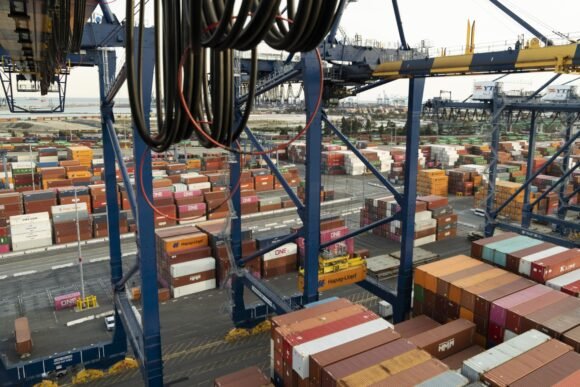
Photo: Operations at the Port of Los Angeles. Lauren Justice/Bloomberg
Copyright 2026 Bloomberg.
Topics
Lawsuits
Legislation
Interested in Lawsuits?
Get automatic alerts for this topic.