This year has seen its fair share of major leadership transitions. After more than half a century at the helm, Berkshire Hathaway‘s Warren Buffett retired as CEO on Dec. 31. Similarly, Adobe‘s chief of 18 years, Shantanu Narayen, announced in March that he planned to step down once a new CEO is appointed.
But perhaps the biggest surprise of all was the April 20 announcement that Apple (AAPL -0.05%) CEO Tim Cook, who’s held the top position since August 2011, would step down on Sept. 1 and turn the proverbial keys over to John Ternus. Although Cook is staying aboard as the executive chairman of Apple’s board, the company’s day-to-day operations and its innovative trajectory will now be charted by Ternus.
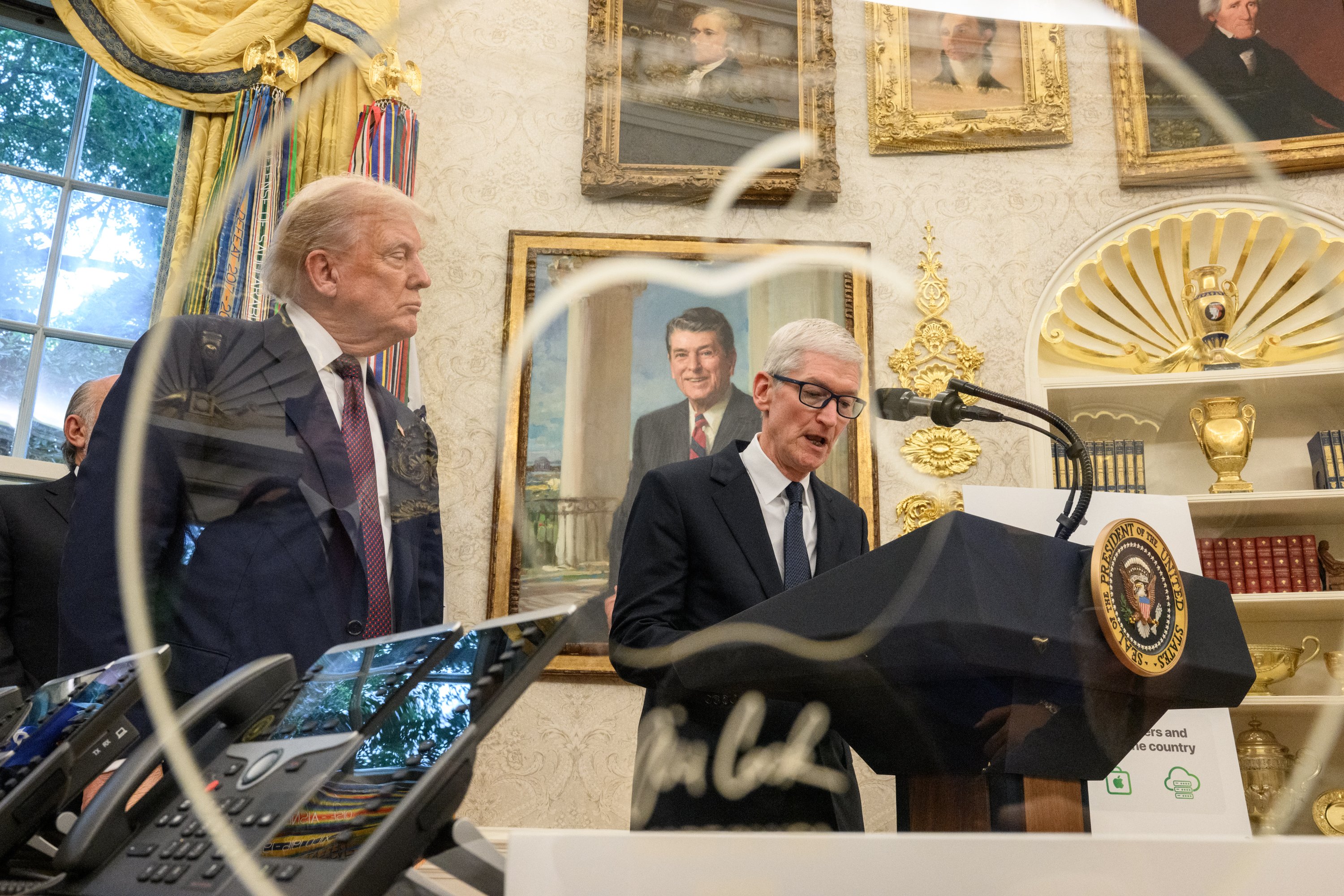
Apple’s now-former CEO delivering remarks at the White House. Image source: Official White House Photo by Daniel Torok.
Since Cook was appointed CEO, Apple shares have soared by more than 2,700%, including dividends. While some investors will attribute these outsize gains to Cook overseeing iPhone innovation, a pivot to high-margin subscription services, and the launch of Apple’s generative artificial intelligence (AI) system, Apple Intelligence, his legacy should be defined by the nearly $879 billion investment he oversaw that had nothing to do with AI.
Apple’s now-former CEO bet big on his company
As of the closing bell on Aug. 28, $879 billion was greater than the market cap of all but 12 S&P 500 companies, one of which is Apple. In other words, Cook could have used this capital to purchase all but 11 other companies in the benchmark S&P 500.
Instead, Tim Cook and Apple’s board have spent $878.5 billion since the start of 2013 purchasing their most prized asset: shares of Apple:
- 2013: $22.95 billion in buybacks
- 2014: $45 billion
- 2015: $35.253 billion
- 2016: $29.722 billion
- 2017: $32.9 billion
- 2018: $72.738 billion
- 2019: $66.897 billion
- 2020: $72.358 billion
- 2021: $85.971 billion
- 2022: $89.402 billion
- 2023: $77.55 billion
- 2024: $94.949 billion
- 2025: $90.711 billion
- 2026: $62.094 billion (through the fiscal third quarter)
During Cook’s tenure as CEO, he oversaw a 44.5% reduction in Apple’s outstanding share count.
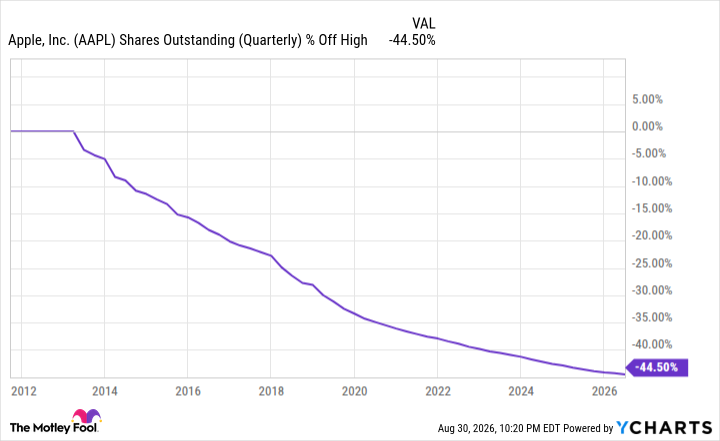
AAPL Shares Outstanding (Quarterly) data by YCharts.
To say this aggressive buyback program had a positive impact on Apple’s stock or its bottom line would be an understatement. For companies with steady or growing net income, a decline in the number of shares outstanding can increase earnings per share, making it more attractive to fundamentally focused value investors.
A little over a month ago, Apple shares hit an all-time high, with the company’s price-to-earnings (P/E) ratio tipping the scales at nearly 40. Without these aggressive share repurchases, Apple’s P/E ratio would have been historically high.

Today’s Change
(-0.05%) $-0.17
Current Price
$324.96
Key Data Points
Market Cap
Day’s Range
$323.53 – $328.40
52wk Range
$225.95 – $344.57
Volume
96.1K
Avg Vol
54.6M
Gross Margin
48.65%
Dividend Yield
0.33%
You’ll also note that Apple’s buybacks really stepped up in 2018, once President Donald Trump’s Tax Cuts and Jobs Act (TCJA) took effect. The TCJA permanently lowered the peak marginal corporate income tax rate from 35% to 21% (the lowest level since 1939). With market leaders like Apple retaining more of their income, share repurchases became a priority.
With Cook staying on as executive chair of Apple’s board and the company generating boatloads of operating cash flow, buybacks should remain a staple, even with Ternus now steering the ship.
Sean Williams has no position in any of the stocks mentioned. The Motley Fool has positions in and recommends Adobe, Apple, and Berkshire Hathaway. The Motley Fool recommends the following options: long January 2028 $330 calls on Adobe and short January 2028 $340 calls on Adobe. The Motley Fool has a disclosure policy.