
 |
 |
<!–
You’ve heard the phrase “More money, more problems” before. But you probably didn’t believe it. Well, it’s always been true. The problems that come with more money are often good problems to have, of course, but they’re problems nonetheless.
We spend a lot of time here at WCI trying to help doctors and other high-income professionals solve these “champagne problems.” However, the biggest problem high earners have is the same one as everyone else: they spend all their money. Don’t believe me? Take a look at this chart from the Goldman Sachs Retirement Survey and Insights 2025.
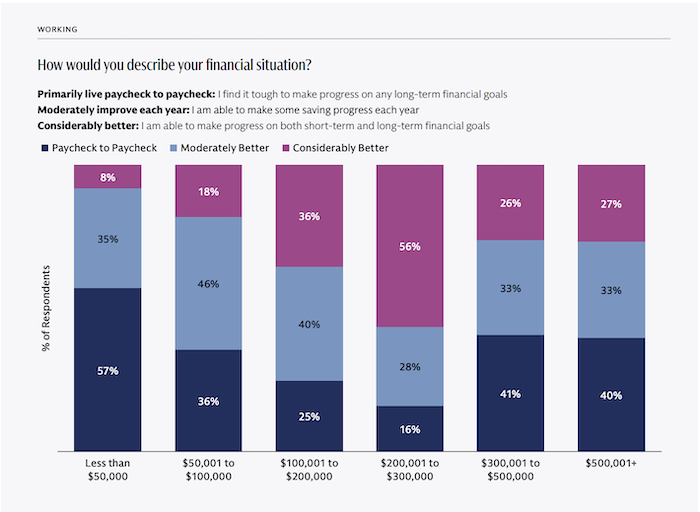
There are two interesting findings on this chart. You probably identified the second one very quickly, and don’t worry, we’re going to get to that soon. Let’s start with the first one, though. The lower dark blue bars in the chart represent the percentage of people of various income levels who spend all their money. They live “paycheck to paycheck.” If the next paycheck doesn’t arrive for whatever reason, they’re in financial straits.
You might have heard the statistic that 37% of Americans can’t come up with $400 in an emergency. That means basically the same thing as living paycheck to paycheck. You probably always thought those Americans were poor. Not necessarily. As the chart shows, 16%-57% of survey takers are living paycheck to paycheck (57%!) But even 16% is pretty ridiculous. Why would you spend all your money every month, month after month, for years? How could that possibly strike you as an intelligent way to manage that income? How much thought does it take to realize that pathway doesn’t lead anywhere you want to go? Not very much.
Why 25% of Doctors Do Not Retire as Millionaires
You’ve probably heard us here at WCI mention that 25% of doctors in their 60s are not millionaires, and in fact, 11%-12% of them don’t even have a net worth of $500,000. That statistic comes from a net worth survey done by Medscape every year. Here’s one version of it:
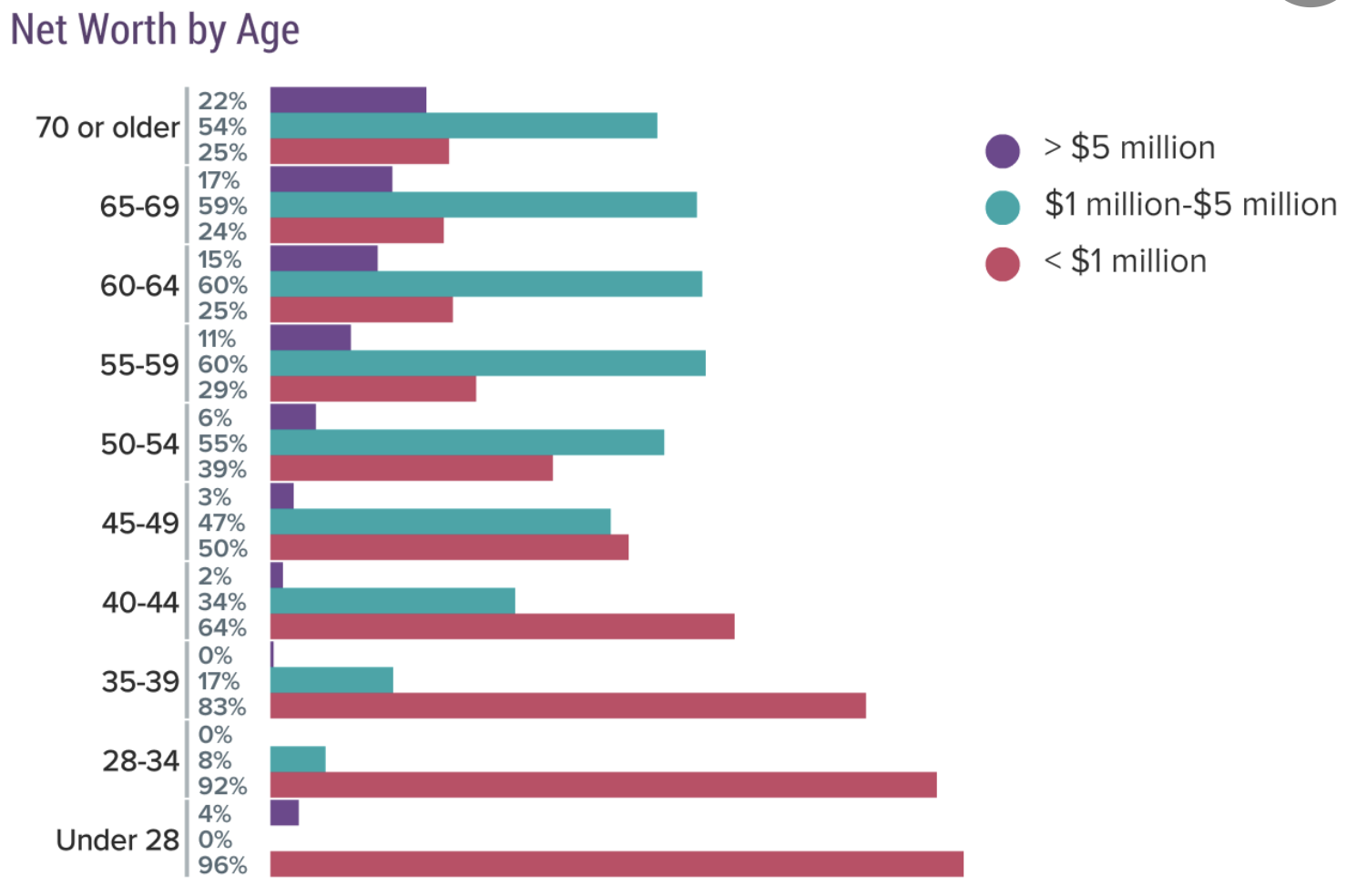
That chart looks about the same every year. How does that happen? Let’s go back to that first chart above from the Goldman-Sachs survey. You’ll see an unexpected pattern. No surprise that as income rises, fewer and fewer people live paycheck to paycheck. As you go from a sub-$50,000 income to a $200,000-$300,000 income, that percentage drops from 57% to 16%, as expected. But then something wild happens. When income hits $300,000, the number goes up again. In fact, it TRIPLES to 40%! That means 40% of those making $300,000+ are living paycheck to paycheck! That’s bonkers!
Who are these people? Many of them are doctors. The average physician income is $386,000, squarely in that $300,000-$500,000 category where the percentage of people living paycheck to paycheck is higher than it is for people making 1/4 as much money.
More information here:
- 10 Reasons Doctors Spend Too Much Money
- Life Got Really Expensive (We’re Spending Twice as Much as I Thought)
- Doctors Need to Budget, Too (with a Few Examples)
 |
 |
<!–
How Do You Live Paycheck to Paycheck on $300,000+?
Once you pick your jaw up off the floor at these statistics, let’s start thinking about how this can possibly occur. Med students laugh when I tell them that if they can’t live on $200,000, they have a spending problem, not an earning problem. Attending physicians don’t think that’s funny at all. That’s because 40% of them are having trouble living on twice that much.
Sure, a lot more of their money is going to taxes. Typically, 20%-33% of the income of an attending physician goes to taxes. But they still have far more money after tax than a lower earner. It’s not just our tax system that is progressive, though. Also included are:
- Social Security benefits
- Healthcare costs
- Higher education costs
- Licensing fees and more
Between taxes and these other progressive costs, we can account for some of the reasons higher earners are more frequently living paycheck to paycheck. But I don’t think that explains all of it. The remaining portion is likely explained by simply living bigger lifestyles because they think they can. Well, they can’t. If you’re spending it all, you’re living way too high on the hog. (Incidentally, that phrase comes from the fact that the best cuts of pork come from muscle located above the level of the stomach.) Doctors (and their families and their friends) and other high earners think they should be able to afford more than they really can. So, they watch their money less. And all of a sudden, their savings rate becomes functionally zero. They’re living paycheck to paycheck.
Surely you’ve seen it. Once a year or so, something comes up in the payroll process, and paychecks get delayed a day or two. You have a colleague or two or four that starts sweating when it does. Now you know why.
The older I get, the less of an optimizer and the more of a satisficer I become. Get the big things right, and the small things no longer matter. You know what one of the big things is? Your savings rate (the amount saved for retirement divided by the total earned). Calculate it once a year. If it’s zero, you’ve got a real problem. Less than around 20%? You’re probably not going to like what that means by late career. If you’re at 20%, you’re not even close to paycheck to paycheck. Save 20% for the first five years of your career, and you can lose your paycheck for two years without going broke. Do it for 25-30 years, and you’ll never have to work again.
Whether you’re a doc with a net worth of under $1 million in your 60s is almost entirely within your control—just like whether you live paycheck to paycheck on $300,000+ per year.
What do you think? Why do higher earners spend a higher percentage of their income? Have you personally run into this problem?
The post Think More Income Will Solve Your Financial Problems? Maybe Not appeared first on The White Coat Investor – Investing & Personal Finance for Doctors.
 |
 |
<!–