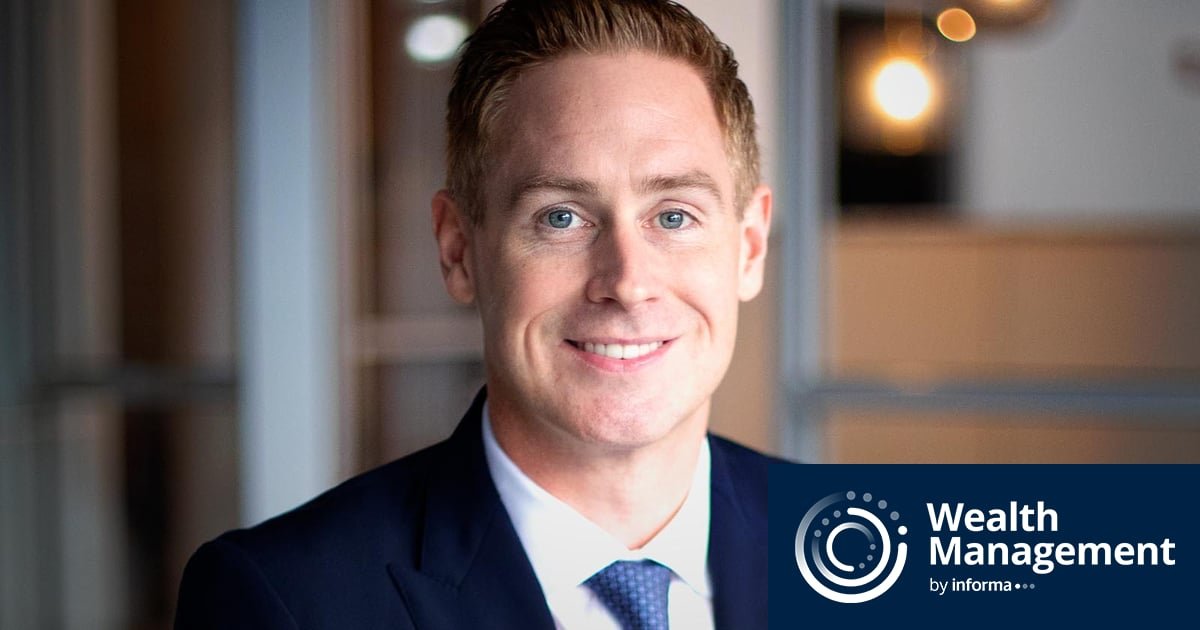
Q&A: Corient CEO MacAlpine on the RIA as a ‘Service Partnership’
Kurt McAlpine, CEO of Miami-based Corient, attributes the firm’s more than doubling its clients’ assets since the start of this year to a few factors. But the most critical, in his view, is a bet he made when the Corient brand launched in 2020: that an RIA should be run similarly to other professional services firms, such as legal or accounting practices, complete with partners.
This model, in his view, eliminates internal competition among advisors for clients and assets and creates a culture of providing the client with whatever they need, no matter who provides it.
MacAlpine has taken the model so far as to maintain a single profit-and-loss statement across the entire organization, with no “chargebacks” to specific teams. That P&L now encompasses an RIA focused on upper-high-net-worth clients across the U.S., Canada and Europe, with more than 300 partners, about 3,000 employees and more than $556 billion in client assets.
Wealth Management spoke to MacAlpine about this model on the heels of another deal announced Wednesday: an agreement to acquire Summit Trail Advisors for $21 billion.
The following has been edited for length and clarity.
Wealth Management: How did the conversation with Summit Trail get started? What drew you to them and them to you?
Kurt MacAlpine: They have an incredible business. By wealth management standards, they have great scale with over $21 billion of assets, a phenomenal client base, and, probably most importantly, incredible people in the organization who have done great things for clients over a long period of time.
In terms of what they liked about us, when I launched Corient in 2020, we put in place a unique structure from a wealth management perspective. The whole industry is oriented toward wealth managers having individual advisors or very small advisor teams that operate in silos and derive economics directly from those underlying clients.
From our standpoint, clients are clients of the firm. We collaborate across the firm to serve clients together, so they aren’t limited to one or two advisors that onboarded them to the firm for their source of expertise. Clients get access to the full weight of the capabilities of the 3,000 people who work here globally.
[Summit Trail] was really drawn to this very differentiated way of working, which is very novel in wealth management. Think of it as a professional services partnership—like a law firm or an accounting firm. I come from management consulting. It’s very different from the independent contractor, sole practitioner model in wealth management. I attribute a lot of our success to having that structure because it just filled a very meaningful void in the marketplace.
Second was the services. They were serving very affluent clients with a broad set of services, but the service offering that we have for ultra-high-net-worth clients is unique in the industry. We have traditional wealth advisory, traditional and alternative investment management, global financial planning capabilities, global wealth transfer capabilities, global tax capabilities, global trust capabilities, a global family office with built-in outsourced CFO, customized reporting, concierge lending, we manage complex residential real estate projects, we have an aviation business where we own aircraft on behalf of clients around the world, and we have art management. That capability set is very unique, and they have the clientele that would benefit from it as well.
The third piece was the global footprint. We’re certainly the only global independent wealth manager in the space, and how we’re global—through one unified partnership, through one global compensation model, through one global P&L—allows us to serve global families in a way that banks and other institutions that are in multiple jurisdictions just can’t do.
WM: Summit Trail launched as part of Dynasty Financial Partners, which has been successful partly by emphasizing independence with a strong support platform. Were there concerns from Summit Trail about being moved into a more centralized model?
KM: The reason I launched Corient was that I felt the entire wealth management industry was built on a fundamentally flawed structure. Advisors are, for the most part, essentially independent contractors sharing somebody’s brand, somebody’s technology, somebody’s office space. Inside of these advisory firms, advisors can compete with one another for new clients. They can literally take clients from one another inside of the same firm, which creates a tremendous amount of isolation, not collaboration.
Secondly, to the extent that any of these firms have family office services or other services that extend beyond what the advisors do, they act as a cost center to the advisors, which creates friction from an adoption standpoint for clients.
The third piece: the whole advisory industry is oriented toward advisors making money by doing two things—generating revenue and commissions from their clients, and then hoarding those revenues and commissions to themselves. Because if you generate a lot of revenue and commissions and you share it with 70 people, or 20 people, or five people, you make a lot less than if you keep it for yourself.
My view was, if your advisors have tension with one another, your advisors and front office have tension, and your advisors and middle and back office have tension because people that support the advisors are paid on different metrics—the clients are the big loser. The clients’ experience with any one of those firms that operate that way is marginalized down to the individual that onboarded them to the firm. It’s a suboptimal experience, and certainly not giving them access to the best of any organization.
I think the second big loser is actually the employees, because the employees are effectively independents working on a platform. They’re not working in a company with a culture and financial alignment across the organization, with career development and opportunities.
WM: Do you get questions from advisors about whether your model will return to the wirehouse days?
KM: We’re nothing like a wirehouse on any dimension. Our whole view is that we want to be the best in the world at serving ultra-high-net-worth clients. We believe that we can do that by having the expertise of 3,000 people shared to serve those clients directly and indirectly.
We have one compensation plan globally. Everybody’s paid the same way. I have zero exceptions. I run one P&L firm-wide, and I do absolutely no chargebacks. The reason for that is I want to make sure all of those resources and sources of expertise flow to clients directly without any sort of friction.
I launched the business in April of 2020 with $50 billion of assets. Today, we’re at $550 billion and continuing to grow. I attribute much of that success to the underlying structural piece. It’s because we tend to be somebody’s first choice who believes we can do more working together to serve clients, or we’re somebody’s last choice if they say, “I’m just looking for the next commission grid.” It’s just not our model.
WM: Why do you think now is the time to have an independent wealth management firm that is global—in the U.K., Europe, Canada, the U.S.? We haven’t really seen this before, and there are as of now only a few other large RIAs active in this market.
KM: There are a tremendous number of trends that would support the need for global advice. More wealth is being created today more than ever. It’s being created faster than ever. It’s more concentrated than ever. It’s changing hands faster than we’ve ever seen, and it’s globalizing faster than ever. The notion of this wealth being global creates an inherent amount of underlying complexity that magnifies the need for financial advice.
With that being said, I believe outside of Corient, there aren’t any other truly global wealth managers that exist. Banks operate in other jurisdictions, but my view would be they are absolutely multi-jurisdictional. Being multi-jurisdictional and being global are not the same thing.
Multi-jurisdictional would mean that you have local silos, local P&Ls, local compensation plans. Just take the bank model as an example. Let’s say you’re a billion-dollar client at a bank that has a global footprint, and you have assets in four different countries, and you’re going to consolidate all of your assets here in the United States.
What happens in practice is three regional P&Ls from that client go to zero, three advisors serving those clients see their pay go to zero because there’s no revenue, and one advisor in the U.S. quadruples the assets that they manage and becomes the ultimate beneficiary. That set of circumstances does not set people up well for collaboration because it’s zero-sum.
In our model, when we have a client across four jurisdictions that wants to consolidate assets, every single person here who’s a partner is in the same equity. So, if a client picks up and says, “I’m consolidating all of my assets in Florida or New York,” it doesn’t matter. Every single person who was part of the team before is equally relevant to the team going forward. There’s no incremental compensation for the person where the assets are being domiciled, and there’s no negative compensation or consequences for the people who are serving the family. It’s effectively business as usual.
WM: What made you decide to go for both U.K.-based firms Stonehage Fleming and Stanhope Capital Group at the same time, as opposed to building more slowly?
KM: When we went global, we bought the largest and the second-largest independent ultra-high-net-worth wealth managers on the same day. That was important because when you’re going global, I think the mistake that a lot of folks make is that they establish a presence in multiple jurisdictions but don’t actually build any relevant scale. In our industry, all your scale comes locally. We wanted the scale to overwhelm the complexity so you can actually do amazing things for clients as opposed to being burdened by the complexity.
We did these two acquisitions, and now that we have the local scale, the multi-jurisdictional capabilities, and the partnership, we’ve announced two more acquisitions in Europe: an $11 billion business and a $5 billion business—one in Geneva, one in Paris. I think there’s more to come for us.
Strategically, we built it brick by brick, market by market in the U.S., because the U.S. lends itself to that—one regulator, one language, four primary time zones. Internationally, it’s harder to do. You need the scale and the multi-jurisdictional capabilities to start, and then you can start to go market by market, which is what we’ve started to do.
WM: What happens to CI Financial now in Canada? Is there a way that maybe Corient becomes the key flagship brand?
KM: CI and Corient are actually separate companies. CI Financial is a Canadian asset manager and a Canadian wealth manager focused effectively on the mass affluent or broader clientele. Corient is a global, ultra-high-net-worth-focused wealth manager.
Corient is in Canada serving ultra-high-net-worth families. CI Financial has a wealth business serving a different segment. So they actually serve different segments with a different structure and a different value proposition. They’re not really competitors per se. They’re just playing very distinct segments of the market.
WM: How is it working with Mubadala Capital on these deals? You seem to be very well capitalized and able to pull these off. Are they at the table with you?
KM: They’ve been amazing. We’ve more than doubled the size of the firm since January, and they’ve been incredible partners as part of the journey. They believed and saw the potential of the business, hence the desire to partner with us to take the company private.
We’re very uniquely positioned here as well because this is permanent strategic capital. Our industry, as you know, is rife with private equity, which by definition is temporary capital. If you’re taking a forever time horizon to build a business, it’s very different than a two-to-four-year time horizon. I feel very privileged to have partnered with them, and the work that we’ve been able to do together with their support has been great. I think there’s a lot more to come.
From my standpoint, a permanent strategic capital partner is the absolute best capital partner because you’re totally aligned on building this business forever. Corient is technically a freestanding private partnership owned and operated by the partners with a great institutional partner and shareholder. That’s very different than dealing with finding a new sponsor every 24 to 36 months. You think about and run the business differently, and I feel like we’re very privileged to have a partner like them to do it.