Perigon: Building a Tech Stack Through Partnerships
What sets Perigon apart isn’t a single tool in our stack; it’s an openness to innovate. We stay curious about how our technology serves both our clients and our employees, and we’re constantly asking how it could be better. That mindset leads us to the right partners, keeps us reaching for better ways to grow, and it’s the reason I’m building what we call our Growth Hub. It’s also the foundation of how we think about technology: partner for scale, build for differentiation.
We choose partners, not individual features. A platform may be missing a capability today, but strong partners keep investing and improving alongside us, so we don’t have to rebuild our stack every time a new feature hits the market. We look for partners who are collaborative, invested in our growth, and capable of supporting the complexity that comes with scale. That’s why Salesforce, Google Workspace, Box and Slack have each been with us for more than a decade. The point isn’t that our stack never changes; it’s that the right partners change with us, so we don’t have to replace them.
When a firm is smaller, almost any tool can do the job. At more than $11 billion in assets and over 160 employees, the questions change: Can the platform handle increasingly complex permissions? Does it integrate cleanly with the rest of our environment? Can it deliver the security and reliability an enterprise needs?
Our stack also reflects one of Perigon’s core values: empowering advisors. We standardize where consistency, integration and control matter most and preserve advisor choice where the work is personal, like financial planning and investment management.
Underneath all of it is the layer we’re investing in most deliberately: our data. It’s the connective tissue that makes real automation, AI and business intelligence possible. We partner where established platforms give us scale; we build where we can create genuine differentiation. Organic growth is where we’ve chosen to build.
In-house Organic Growth Tool: Growth Hub
That build and my core focus at Perigon, is the Growth Hub: a proprietary, in-house organic-growth platform that connects digital strategy, marketing, business development and data- and AI-enabled insights into a single growth engine. More than any single tool, it represents where our technology strategy is heading: an integrated, scalable environment that helps advisors attract new clients, deepen relationships and grow their practices, without having to become technology operators themselves. By architecting, developing and owning the platform ourselves, we capture the growth it drives along with the proprietary insights and IP that come with it.
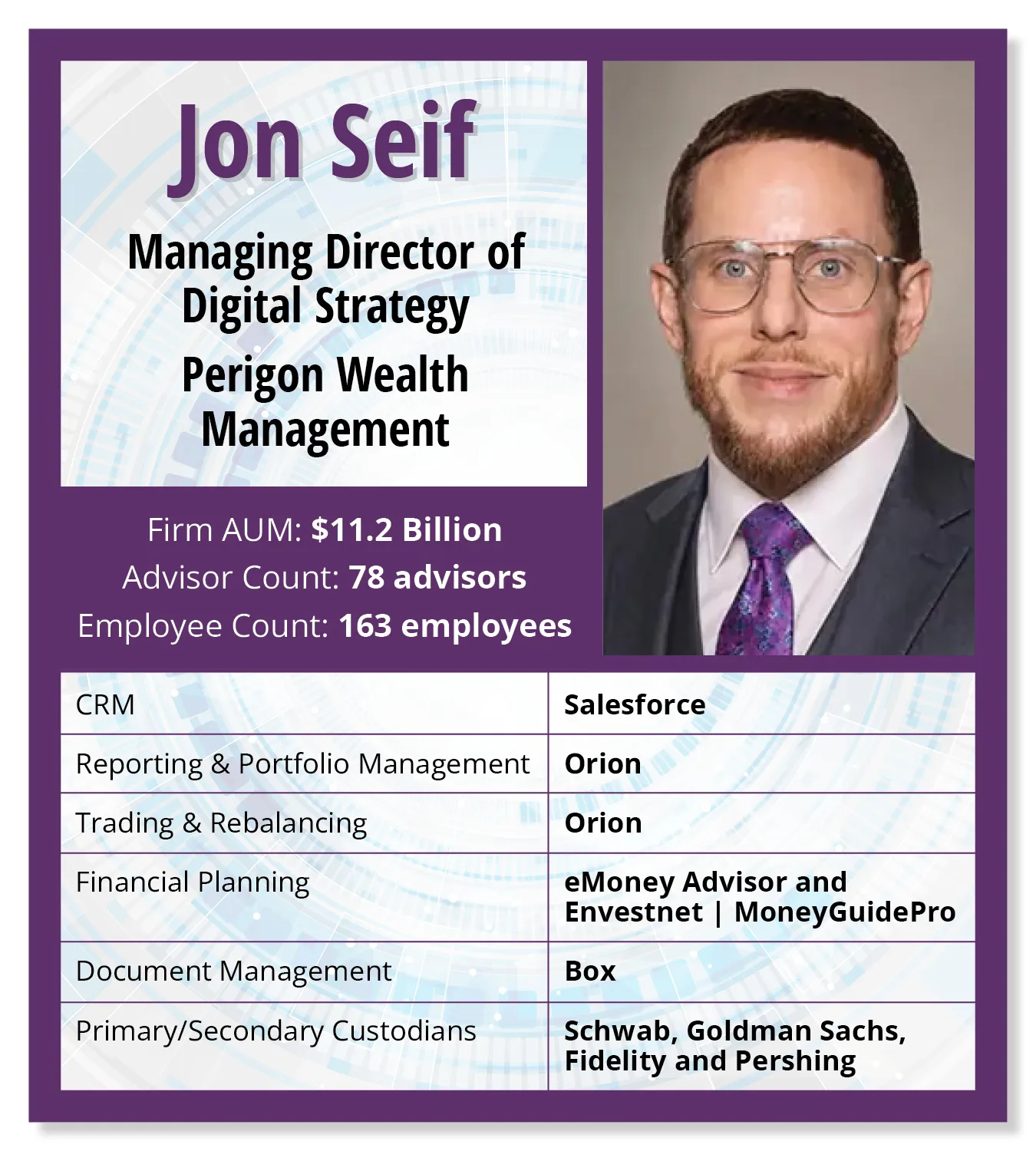
CRM: Salesforce
Salesforce is one of our longest-standing technology partnerships. At our size, a CRM must do far more than store contact information. We need an enterprise-grade platform that can grow with us and adapt to how our teams actually operate.
Its configurability, reporting capabilities and dashboards are central to our day-to-day workflows. Its integration with Slack also allows us to bring relevant CRM workflows and insights into the environment where our teams already collaborate.
Reporting, Portfolio Management, Trading & Rebalancing: Orion
We use Orion across reporting, portfolio management, trading and rebalancing. It is a good example of our approach to platform consolidation and integration.
A comprehensive platform that performs the essential functions well and connects cleanly with the rest of our environment is generally more valuable than a collection of highly specialized point solutions that create fragmentation. Once a platform satisfies the large majority of our requirements, a narrow amount of additional functionality rarely justifies the operational, integration and governance costs of adding another system.
Financial Planning: eMoney and Envestnet | MoneyGuidePro
Planning is where advisor choice matters most, so rather than mandate a single platform, we let each advisor use what fits their practice, which, for most, means eMoney or MoneyGuidePro. We’d happily adopt something better the moment it shows up, but the category hasn’t seen a major leap in a while, so for now we optimize for advisor preference.
Document Management: Box
Box integrates well with the rest of our environment and has kept pace with our evolving security and collaboration needs, which is why it’s stuck around for years.
Custodians: Schwab, Goldman Sachs, Fidelity, Pershing
We’re deliberately multi-custodial, working with Schwab, Fidelity, Pershing, Goldman Sachs and others through an open-architecture model. Think of the custodian as the harness that runs much of a firm’s day-to-day operations; keeping several relationships lets our advisors play to each provider’s strengths instead of being boxed in by the limits of any single one. And we’re watching the newer platforms being built for the next generation of clients, because that’s where a lot of tomorrow’s wealth will want to be served.
Artificial Intelligence: Slack Assistant
Our view on AI is somewhat contrarian. The market is fixated on the shiny object, but AI is only as good as the data foundation underneath it. It’s most useful when it works close to the user and inside the systems where the firm’s knowledge already lives. A simple example is the Slack-based assistant we use for meeting prep, which is genuinely useful because the context is right there. That’s why we’ve prioritized strengthening our data foundation first, and why we’re building our own AI-enabled growth tooling on top of it, rather than rushing to bolt on the latest AI startup and then unwinding the contract six months later when it doesn’t deliver. Many firms will discover that purchasing an AI tool is the easy part. Creating the data architecture, governance and adoption necessary to generate sustained value is the hard part, but it’s also where they’ll find the ROI they’re searching for.
Operational Technology: BILL and Paylocity
Our operational backbone also includes systems like BILL and Paylocity, along with our accounting, compliance and administrative platforms. This layer is a big part of what Perigon offers a growing advisory firm. The same software that helps a small firm get started often becomes a constraint as it grows, and the costs, compliance load and operational demands pile up. Our platform lets advisors work inside an established infrastructure instead of building and managing that entire layer themselves. Ultimately, every part of this stack serves something we care deeply about: empowering our advisors to do their best work for clients.
As told to senior reporter Alex Ortolani and edited for length and clarity. The views and opinions are not representative of the views of Wealth Management.
Want to tell us what’s in your wealthstack? Contact Alex Ortolani at [email protected].