Our Odyssey Summer Beyond Christopher Nolan | American Enterprise Institute
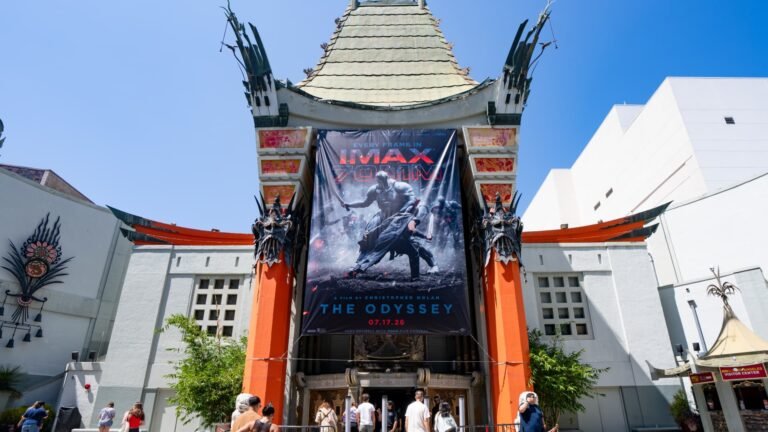
Yesterday, I exhorted everyone to read the Odyssey and not just watch Christopher Nolan’s film, which I had to confess to not yet having seen myself. I suggested learning Ancient Greek to do so but also provided comments on translations, of which there are an extraordinary number.
Today, I want to say something about adaptations, which are more numerous still. One of the reasons the Odyssey is a so-called Great Book is that it has influenced, often in substantial ways, thousands of works from antiquity to the present: poems, novels, paintings, operas, films, video games, and more. Without the Odyssey, we wouldn’t have Vergil’s Aeneid, James Joyce’s Ulysses, J. M. W. Turner’s Ulysses Deriding Polyphemus, Gabriel Fauré’s Pénélope, the Coen Brothers’ O Brother, Where Art Thou?, or the new game Hades II. Without the Odyssey, Derek Walcott, Margaret Atwood, and Alice Oswald could not respectively have written Omeros, The Penelopiad, and Nobody. And, of course, a shaggy Matt Damon—very much a somebody but playing a character who famously tells the Cyclops that his name is Nobody—wouldn’t be bound to the mast of a ship.
But there is much more to our Odyssey summer than Nolan, and I take this opportunity to recommend three new takes on the Odyssey and ancient epic generally: a novel, a book of American cultural musings on the poem as we celebrate our country’s Semiquincentennial, and a fascinating new scholarly article, written for a popular audience, about Homeric geography.
First, the new novel. At the end of March, the Canadian writer Yann Martel came out with Son of Nobody. Martel is best known for Life of Pi, which won the 2002 Man Booker Prize and was commercially very successful but is not a story I have ever warmed to. Martel’s latest work presents the translated fragments of an epic (the Psoad) about a real nobody of a soldier in the Trojan War called Psoas and, in the form of massive footnotes, a self-referential and increasingly unhinged commentary by the nobody Canadian graduate student who discovered it on papyrus scraps in Oxford. Reviews, some of them lukewarm, have understandably compared the conceit, though not the execution, to Nabokov. For my part, I enjoyed it, despite the “many gaffes about Homer and Greek epic” (to quote Daniel Mendelsohn, whose 2025 translation of the Odyssey I recommend), but I love Pale Fire and have a thing for even mediocre academic novels. I suspect it will find more admirers among the university crowd than the wider public.
By contrast, consider Patrick J. Deneen’s American Odyssey: What an Ancient Story Reveals about Our Divided Souls, published on July 21. A conservative political scientist at Notre Dame whose first scholarly monograph bears the title The Odyssey of Political Theory: The Politics of Departure and Return (2000) and who achieved national prominence when Barack Obama put his 2018 book Why Liberalism Failed on his summer reading list, Deneen pitches his latest work to the interested public: to people who are taking the occasion of “America 250” to muse on the American experience from the founding to the present and to everyone who is caught up in Odyssey mania. He neatly weaves together American stories—among them The Wizard of Oz (both book and movie) and Field of Dreams (short story, novel, and movie)—with the adventures of Odysseus, exploring the tension between wanderlust and the belief that “there’s no place like home.” I like the book very much, and if you wish to read an excerpt before purchasing it, the preface was reprinted on August 1 in the online Classics journal Antigone (which—disclosure—I helped found).
Finally, there’s a remarkable article that doesn’t adapt the Odyssey so much as force us to adapt our view of the original poem. Titled “Was Homer’s Ithaca an Island?” it was published in Antigone on July 4 by the English Hellenist James Diggle and the Scottish geologist John Underhill, who teamed up to defend and add to the evidence for a theory presented over two decades ago by Robert Bittlestone in Odysseus Unbound: The Search for Homer’s Ithaca. Diggle and Underhill, who collaborated with Bittlestone on the original book, argue with verve that the answer to the question is No. Rather, the homeland of Odysseus is modern-day Paliki, a peninsula on the western side of Kefalonia. It’s a wonderful and accessible read, and I think I believe it.
Through translations, adaptations, scholarly thought experiments, and traditional academic work, old texts really do yield new insights. I expect our Odyssey summer to continue into the fall, into next year, and for as long as there are humans to tell stories. Indeed, another Odyssey film has already been announced. But first I need to watch Nolan’s.