Oil Prices Down 30% — Manipulation or Just Oversupply?

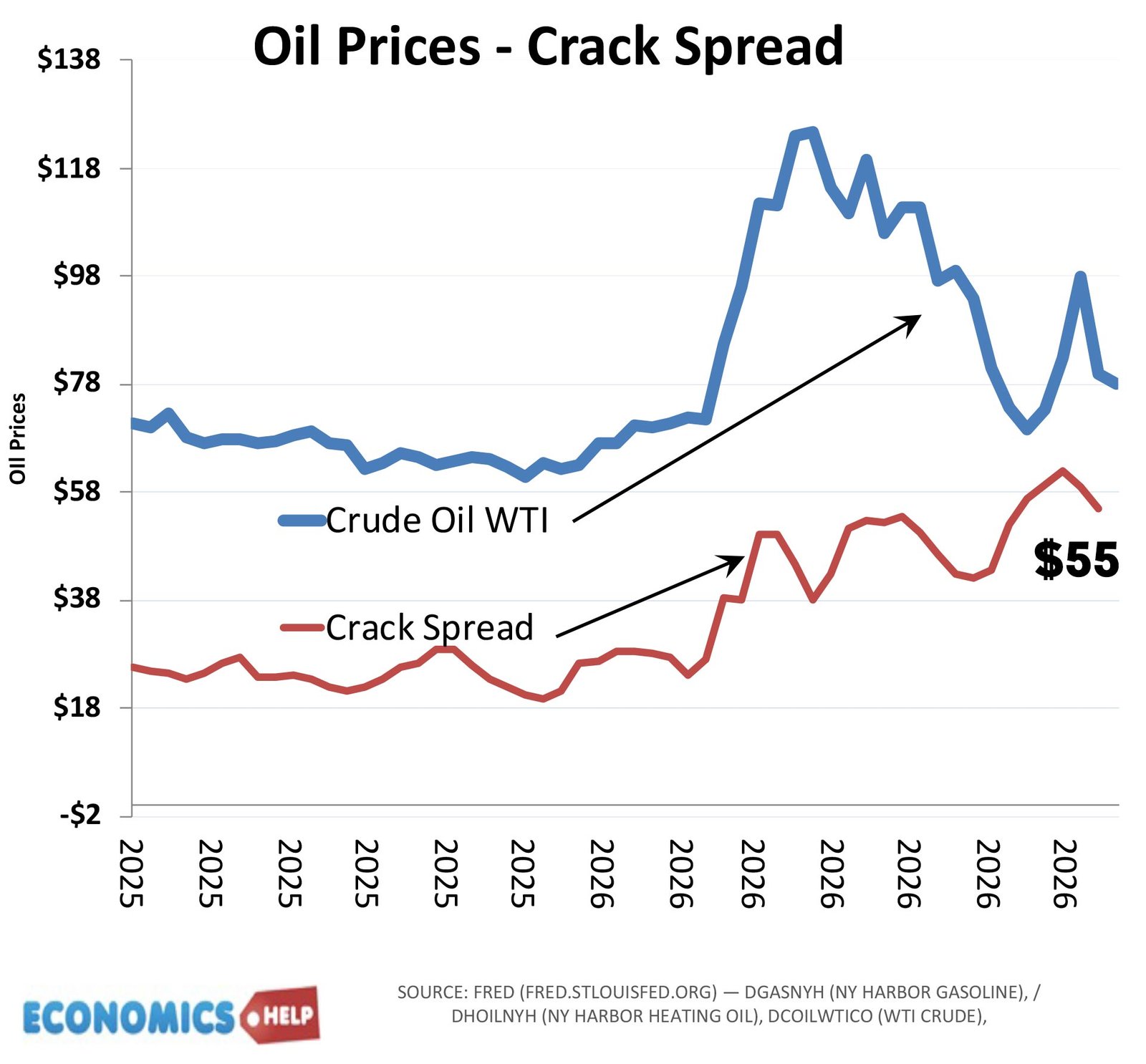
Two of the world’s most critical oil chokepoints — the Strait of Hormuz and Bab-el-Mandeb — are seeing almost no shipping traffic right now. Yet as the Iran conflict drags on, far from an oil apocalypse, prices are 30% down from their peak.

But if you’re filling up with diesel, you won’t have noticed — diesel and gasoline prices remain high, and the gap between crude oil and refined product prices keeps growing. It’s handed the oil majors record profits, and led some to argue the US government must be manipulating the market — and that it could all unravel badly. There’s certainly a clear motive, both economic and political, for keeping oil prices low. But is it actually possible? And is it really happening?

Well at the start of the crisis the closure of Hormuz lost nearly 2 0million barrels of oil, but this was covered by additional pipelines, OPEC spare capacity, China cutting imports and using inventories, but that left around 6.5 million of barrels shortage, which would have to be solved by increasing the price to reduce demand. So why aren’t prices higher? Certainly, if you look at bond yields, it suggests bond investors still see inflationary pressure.

The theory of oil price manipulation is based on three factors. Firstly, the US and IEA have been releasing inventories. In fact the SPR has fallen to historically low levels and the fear is that the US is now approaching tank bottoms – this can’t last much longer. Now this is not covert manipulation it is widely reported but the second part of keeping prices low is to assert with great confidence that oil supply is falling. Certainly President Trump has often posted about how oil is flowing a new deal signed. Perhaps this temporarily encourages investors to assume prices can come down. But, professional investors will not be bamboozled by social media posts, at the end of the day, they are trying to make money. The third part of the equation is to intervene in shorting oil futures. This means US Treasury, aggressively betting oil prices stay low. And therefore it means investors who speculate prices will rise, will be shorted by the US Treasury, and not make gains.

Traditionally oil prices were highly speculative, oil prices soared in 2022, when Russian sanctions led to a much small fall in supply. The US do have the means to do this. The Exchange Stabilization Fund, created in 1934 allows the Treasury secretary to intervene in securities without oversight. Some point to evidence that oil prices often fall during the illiquid overnight period only to recover in the morning – a suspicious sign that it is short-selling. But, short-selling before a major announcement may be suspicious but it’s not enough to alter oil prices in the long-term.

But, if the oil price is being manipulated, what is the point if diesel and gasoline prices continue to rise? The average consumer doesn’t care about crude oil prices, they do care about the cost of filling their car. Well, there is still a strong motivation to keep crude oil prices low. Traditionally there is strong link between oil prices and inflation. So if crude oil rises, then this increases future inflation expectations and therefore, puts pressure on the Federal Reserve to increase interest rates. This is something the new Fed chair Kevin Warsh is trying to avoid for 3 reasons. Higher interest rates will hit indebted US consumers, the president doesn’t want it and also the cost of financing US debt. This year alone, the US faces $9-10 trillion of rolled over debt. But a motivation for keeping oil prices low does not prove anything on its own.

One thing is certainly true. Whilst crude oil prices are low, refiners are making record profits. The spread between refined products like diesel and oil are very high. This basically means a very high profit margin. But how are the oil major companies responding to this windfall? There is an argument that in the long-term the oil industry faces major over-supply and when Hormuz re-opens crude supply will be greater than demand. Some like Javier Blas in Bloomberg claim that when crisis is over, oil prices could drop to $50 in 2027. Although, this ignores the impact of China and US rebuilding their inventories, which could keep prices higher and also the loss of capacity from disruption in the gulf.

Another important part of the story is China. China is a major oil player because it is the biggest buyer. When Hormuz closed, we were left with major shortfall, which should have pushed prices up. The fact, they didn’t soar is not because of US intervention, but Chinese response. Basically, China quite happily cut imports by 4.9 million barrels a day. It did this by importing less, restricting sales of refined products and using form its impressive reserve of at least 1.4 billion barrels. Also, China has switched to using more coal and electric cars. The oil crisis has caused record levels of coal consumption and also driving renewable energy like solar. Now in past crisis, there wasn’t really the option of switching to electric cars, but the infrastructure is now there. This long-term switch to electric lorries is another reason why long-term people feel the oil price may fall.
That is a reserve greater than the entire International Energy Agency combined. JP Morgan calculates the single move accounted for about 74% of the entire world’s decrease in global crude trade. This is the real reason oil prices have kept low.
Also, the oil market is huge, The US government is a big player but is dwarfed by the size of the market. Recently we looked at US intervention into trying to prop up the Yen. Basically, it is rare government actions can overcome economic fundamentals for long. Already, the Yen has fallen back down.
Conclusion
The oil manipulation story is really about three things. Firstly, China has proved it has more influence over oil prices than OPEC, and that is not going away. Traditionally we thought oil prices were all about managing supply, but China shows you can manipulate through demand. The second thing is that although oil prices have stayed lower than some fears, the price of gas and diesel are reaching very levels, showing there is a shortage of refined products. Why do we get shortage of diesel, but not crude oil.
Firstly, diesel supply has been badly affected by drone attacks on Russian refineries. Secondly, China restricted diesel exports to enable it to reduce imports. Thirdly, refineries in Asia, need the right kind of crude oil to make diesel. A big increase in supply from Venezuela, doesn’t’ really help diesel supplies, because it is the wrong kind of crude oil.
The real story is that the oil market has large degrees of intervention, but the price of oil is not really being determined by some secret Treasury short-term dealing. I think confidence and expectations are important, so in that case what the President of the US states on oil prices and supply does carry some weight, but at the end of the day, traders will look at actual supply and demand rather than rely on truth social posts. But this doesn’t mean that oil price will stay low. If Hormuz does remain shut, then the reality of shrinking inventories becomes really significant, and eventually there will be a point where prices are pushed higher quite quickly.
About The Author