
Meta Platforms Saw Free Cash Flow Plunge 91% to Just $784 Million as Artificial Intelligence (AI) Spending Ballooned. Here’s Why That Should Worry Investors.
Over the last few years, Meta Platforms (META +0.14%) has ramped up capital expenditures (capex) aggressively in pursuit of artificial intelligence (AI) leadership. Smart investors understand that higher spending locks up cash that would otherwise flow to shareholders. This relationship creates a clear tension between long-term bets and near-term liquidity.
During the second quarter, Meta poured $30 billion into capex and watched free cash flow collapse 91% year over year to just $784 million. Let’s dig into why this figure should give any investor focused on cash flow some hesitation.

Image source: The Motley Fool.
What is Meta spending capex on?
Meta’s AI road map spans software tweaks on ad-targeting upgrades as well as a number of next-generation hardware endeavors. The company is building out enormous clusters of specialized accelerators and custom silicon so it can train and serve its Llama family of models without remaining entirely dependent on external suppliers. In addition, Meta is accelerating investment in wearable hardware — specifically its Ray-Ban AI glasses.
The rationale behind Meta’s accelerating capital outlays is straightforward: The performance gap between models trained on generic cloud capacity and those developed on purpose-built silicon is widening. The pace of Meta’s spending suggests that management believes the company cannot afford to fall behind in either the enterprise-model race or the consumer-hardware push that will ultimately distribute new models and applications.

Today’s Change
(0.14%) $0.83
Current Price
$588.77
Key Data Points
Market Cap
Day’s Range
$580.12 – $601.00
52wk Range
$520.26 – $796.25
Volume
193.5K
Avg Vol
18.2M
Gross Margin
81.75%
Dividend Yield
0.36%
Why falling free cash flow could be a bad sign for Meta
When capex grows faster than a company’s profits, free cash flow inevitably shrinks. Meta is now in this position. The company is effectively investing tomorrow’s profits today at a pace that might outstrip its ability to sustain a cash surplus. If this pattern continues, self-funding its AI plans will become more challenging, and the balance sheet will have to absorb the shortfall.
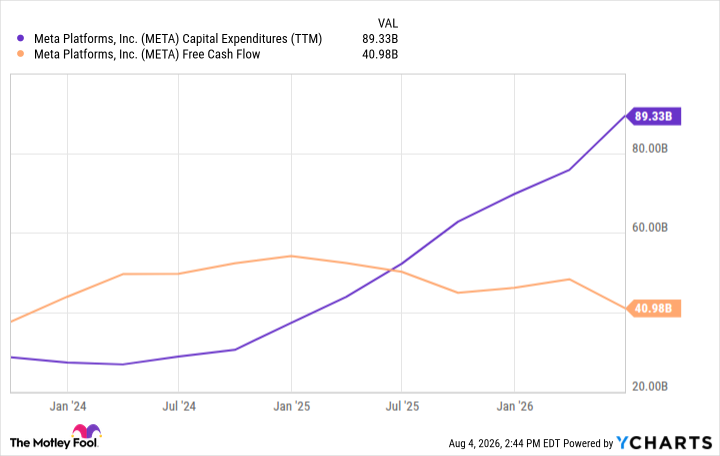
Data by YCharts.
This could very well come through additional debt issuances; Amazon and Alphabet have already taken this path to underwrite their own AI infrastructure builds. By issuing even more debt on top of its already enormous liability load, Meta’s interest expense will rise — reducing financial flexibility if advertising markets soften or AI monetization takes longer than anticipated.
Should you invest in Meta stock right now?
Meta’s high-margin advertising engine remains robust, so a temporary dip in cash flow does not necessarily mean the company is facing existential risk. With that said, buying shares aggressively right now essentially means you’re underwriting an open-ended spending spree whose payoff remains unproven at scale.
The prudent stance is to wait and watch the next couple of quarters to see if there is clear evidence that AI is translating into higher profit margins and a recovery in free cash flow. Sitting on the sidelines until management proves incremental revenue growth from generative AI can outrun the capex bill preserves your optionality and purchasing power. Until that happens, I think caution is the more defensible position regarding an investment in Meta stock right now.
Adam Spatacco has positions in Alphabet and Amazon. The Motley Fool has positions in and recommends Alphabet, Amazon, and Meta Platforms. The Motley Fool has a disclosure policy.