Jamie Dimon Says: Don’t Buy Long-Dated Bonds. These Short-Term Bond ETFs Could Be Better for Most Investors.
In an interview with CNBC’s “The Master Investor” podcast on July 20, Jamie Dimon, chief executive officer of JPMorgan Chase (JPM +0.84%), made headlines by talking about the bond market. Dimon said that he believes high levels of U.S. government debt will eventually “become a problem” by driving interest rates higher, and that he personally wouldn’t buy long-term U.S. Treasury bonds.
Many investors buy bonds as part of their long-term portfolio to earn steady income and (hopefully) diversify against the risks of stocks. But long-term bonds aren’t the best choice for every investor, and the past few years have been bad for long-term bond exchange-traded funds (ETFs).
Let’s look at a few reasons Dimon might be right to be worried about long-term Treasury bonds — and see what bond ETFs you should consider buying instead.
JPMorgan Chase CEO Jamie Dimon. Image source: JPMorgan Chase & Co.
Why not to buy long-term bonds: Interest rate risk
Bonds aren’t always a safe investment. That’s because when interest rates go up, bond prices go down (and vice versa). Buying a long-term bond that pays, for example, 5% fixed interest for 20 years can give you steady income. However, if interest rates go up to 6% or 7% during those 20 years, the price of your bond will go down, reducing the total return. The reason is simple: Why would another investor want to buy your bond when they can buy others that yield more?
Amid rising interest rates, the Vanguard Long-Term Treasury ETF (VGLT +0.17%) has delivered average annual total returns (by net asset value) of -5.63% for the past five years, and -1.37% for the past 10 years. If you had put $10,000 into this long-term Treasury bond ETF 10 years ago, today you would have about $8,421.
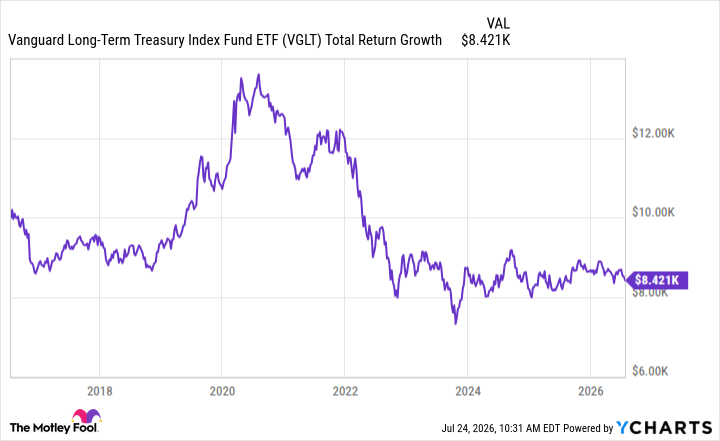
VGLT Total Return Level data by YCharts.
Long-term Treasury bonds like these are vulnerable to long-term interest rate risk. If bond investors around the world start to worry that the U.S. government is borrowing too much or is becoming less likely to repay its debts, they will demand higher interest rates to pay for the risk of lending that money. That’s why Jamie Dimon isn’t buying long-term Treasuries today.
Why buy short-term bond ETFs?
I believe that long-term bonds aren’t the best investment for most people who are trying to save for retirement. If you truly have a long-term time horizon and are prepared to commit your money to a 10-year or 20-year bond, most people might be better off investing that cash in stocks to try to earn higher returns. A 5% annual yield doesn’t feel like enough income from a bond to justify the risks of losing money to rising interest rates.
But bonds are worth buying for other reasons. If you want to protect against the risks of a stock market downturn, if you have short-term money that you want to keep growing ahead of inflation, or you want to maintain a diversified portfolio, buy bonds. If you agree with Dimon’s viewpoint about U.S. government debt and long-term interest rate risk, instead of long-term Treasury bonds, you might want to buy short-term bonds.
Here are two short-term bond ETFs that let you do that.
Vanguard Ultra-Short Bond ETF (VUSB): 1,286 bonds, 5 years of 3.49% annualized returns
The Vanguard Ultra-Short Bond ETF (VUSB +0.03%) takes a totally different approach than investing in long-term Treasuries. Only 1.26% of the ETF’s portfolio is invested in U.S. Treasury or government agency bonds. The fund’s entire portfolio of 1,286 bonds has maturities of five years or less, and 72% is in bonds with maturities of less than two years.
Instead of Treasury bonds, this bond ETF mostly invests in investment-grade corporate bonds, with some asset-backed bonds. Most of the fund’s top holdings are bonds issued by major banks. In the past five years, this bond ETF has delivered average annual returns of 3.49%.

Vanguard Bond Index Funds – Vanguard Ultra-Short Bond ETF
Today’s Change
(0.03%) $0.02
Current Price
$49.69
Key Data Points
AUM
$8.9B
Dividend Yield
4.35%
Expense Ratio
0.10%
Unlike many Vanguard ETFs that passively track an index, this bond ETF is actively managed, so it charges an expense ratio of 0.10%. That’s higher than the lowest-cost bond ETFs, but it might be worth paying if you want to avoid losing money on long-term interest rate risks to your bond investments.
T. Rowe Price Ultra Short-Term Bond ETF (TBUX): 4 years of 4.11% annualized returns
The T. Rowe Price Ultra Short-Term Bond ETF (TBUX +0.04%) is another short-term bond ETF that is actively managed and takes a similar approach to the Vanguard fund. This bond fund’s portfolio consists of about 49.6% corporate bonds, a combined 32.6% of asset-backed and mortgage-backed securities, and only 5% U.S. Treasuries. Of the fund’s bond holdings, 95.7% have maturities of less than three years.
Since the fund’s inception in September 2021, it has delivered average annual returns (by net asset value) of 4.11%. In the past year, it’s delivered a total return of 4.63%.

T. Rowe Price Exchange-Traded Funds – T. Rowe Price Ultra Short-Term Bond ETF
Today’s Change
(0.04%) $0.02
Current Price
$49.89
Key Data Points
AUM
$1.3B
Dividend Yield
4.44%
Expense Ratio
0.17%
This actively managed fund charges a 0.17% expense ratio, which is slightly higher than the Vanguard fund. If you like the approach of buying short-term bonds but want to save a bit of money on fees, the Vanguard ETF might be a better choice.