The modern corporate treasury function finds itself at a polarizing crossroads. On one hand, the industry is flooded with promises of paradigm-shifting innovations: autonomous AI agents, regulated stablecoins hinting at frictionless cross-border settlement, and a mandate for real-time liquidity visibility. On the other hand, macroeconomic realities, stubborn interest rate environments, geopolitical fragmentation, and tightening regulatory scrutiny, demand that treasury leaders maintain an unwavering focus on risk mitigation and fundamental capital preservation.
However, as the macroeconomic environment grows more volatile, the treasury function is being pressured to evolve from a back-office utility into a real-time engine of strategic value. At the heart of this transformation is a move away from vendor-driven technology cycles and toward internal architectural ownership.
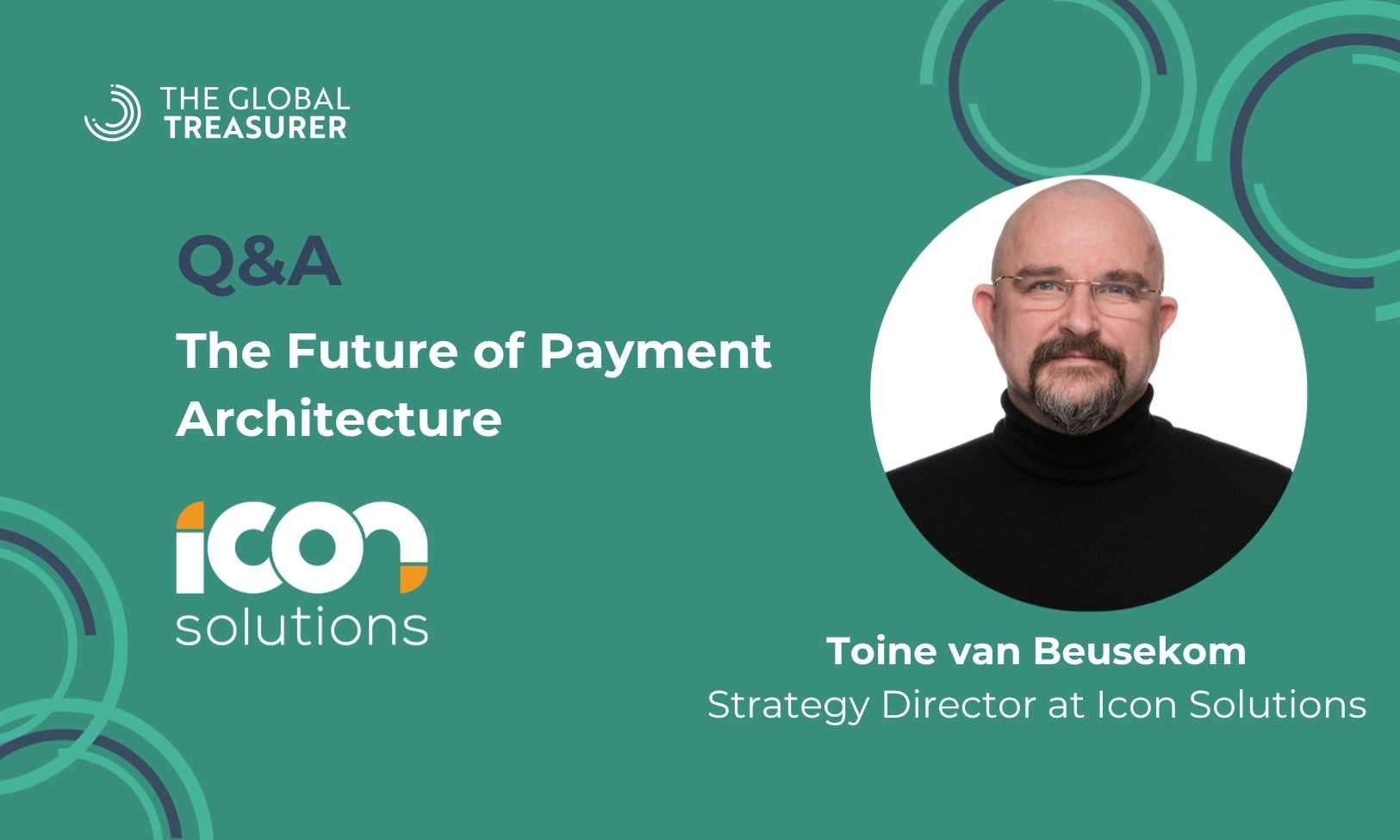
Toine van Beusekom, Strategy Director at Icon Solutions, notes that while the landscape is rich with potential, the key to scaling these innovations lies in a strict separation of process orchestration from underlying data models.
The Stablecoin Playbook: A Waiting Game for Yield
While digital assets frequently dominate industry conversation, the practical enterprise use cases for stablecoins remain highly dependent on regulatory clarity in the US. The progression of legislation, specifically the framework established by the domestic stablecoin regulations (such as the CLARITY and GENIUS Acts), marks a significant milestone. By creating clear licensing and regulatory requirements for domestic payment stablecoin issuers, it establishes a baseline for how stablecoins are managed and formally defines them as an asset class.
However, a critical inflection point remains unresolved: whether issuers will be legally permitted to offer interest on stablecoin holdings.
This policy debate is central to corporate adoption. If regulators prohibit issuers from offering interest, the value proposition for corporate treasurers drops significantly.
“Treasurers would effectively be placing vital working capital into a non-interest-bearing instrument,” van Beusekom warns. “In that scenario, the operational efficiency gains would need to be extraordinarily substantial to justify leaving yield on the table.”
Conversely, if interest is permitted, it opens up highly compelling use cases around liquidity optimization, exact cross-border settlement timing, and industry-specific stablecoins. Tailored digital instruments could be structured for sectors like healthcare or automotive, where embedded settlement efficiencies can be systematically realized.
Until this yield question is answered, van Beusekom suggests the most realistic position for corporate treasurers is a wait-and-see approach. Most organizations already operate relatively efficient treasury structures; therefore, adoption will depend on a clear, highly differentiated financial upside rather than technical capability alone.
Dismantling Legacy Monoliths with Frameworks
For treasury teams restricted by legacy IT infrastructure, the path to payment agility does not require a high-risk, all-at-once core overhaul. Instead, institutions are finding success by adopting a “framework-led” approach to payments infrastructure, an operational design rooted in Icon’s deployment of architectural solutions across global banks and government payment hubs.
This strategy dictates that organizations must not start with the technology itself, but by first defining their “north star” clearly mapping out desired business outcomes and the ultimate target operating model. Once this strategic direction is locked in, treasurers can deconstruct the traditional, tightly coupled payments value chain into distinct, modular components:
-
Initiation
-
Execution
-
Clearing
-
Settlement
-
Reconciliation
By decoupling these steps, treasury departments gain the flexibility to plug in any payment method, whether that is real-time payments, stablecoins, open banking rails, or future regional payment schemes, without needing to replace the entire core legacy layer. Crucially, this setup ensures that the underlying architecture is controlled internally by the corporation, rather than dictated by an external technology vendor.
“Treasurers struggle when they become entirely dependent on individual vendors, as it is nearly impossible to pivot quickly when you do not control the underlying building blocks,” van Beusekom explains.
Taking back ownership of the payments architecture is a distinct opportunity for large corporations. Smaller organizations, meanwhile, must be highly deliberate in selecting SaaS providers that actively offer the flexibility and interoperability required to remain agile. Ultimately, navigating legacy constraints comes down to writing smarter, outcome-based RFPs rather than focusing strictly on software features. Modernization can then happen incrementally, starting with a single use case and building toward a future-ready ecosystem over time.
The Real Orchestration Hurdle of Agentic AI
The concept of “agentic commerce” where autonomous AI agents handle corporate transaction flows, fits naturally alongside the ongoing evolution of open banking and API-driven infrastructure. In theory, the proposition is compelling: AI agents could intelligently and dynamically route transactions across disparate payment rails based on live variables like cost, execution speed, trapped liquidity, counterparty risk, or specific settlement preferences.
However, the real-world operational challenge is not the underlying AI model; it is process orchestration.
Many organizations are currently hyper-focused on the novelty of connecting individual AI agents to APIs or payment networks. Far fewer are thinking deeply enough about the business processes, rigid governance structures, and operating models that must sit behind them. Because payments are inherently sensitive, introducing autonomous decision-making into live transaction streams creates massive operational complexity regarding data models, messaging formats, interoperability, and error handling. Unpredictability is the absolute last thing a treasurer wants when dealing with cash flows, counterparties, or corporate bills.
To make AI-driven routing operational at scale, organizations must strictly separate process orchestration from the underlying payment messaging and data structures. Businesses need a flawless understanding of the manual outcomes they want to achieve before introducing AI into the flow.
This is the exact same architectural bottleneck that commercial banks are currently facing, made more frustrating by a market perception that ERP providers and banking partners are not moving quickly enough to bridge the gap. Without absolute architectural clarity, organizations risk creating fragmented, brittle processes that are difficult to govern and impossible to scale. The future of smart routing depends entirely on whether organizations can build resilient orchestration layers capable of managing multiple data standards in a controlled, future-proof way.
The Danger of Distraction
Looking ahead at the remainder of the year, van Beusekom believes the single biggest blind spot for treasury leaders is not a lack of technology awareness, it is distraction.
The staggering velocity of innovation across the broader payments landscape can easily become counterproductive noise in an environment defined by geopolitical volatility, interest rate uncertainty, and shifting regulatory signals. The reality is that most treasurers operate within complex, broadly functional treasury structures. The immediate risk today is being pulled too far into “future-state” conceptual thinking before the current operating model is fully optimized and under control.
The most effective leaders right now are tuning out the hype and focusing entirely on what they can directly influence:
-
Process Optimization: Strengthening and streamlining core internal business workflows.
-
Data Strategy: Improving granular visibility over global cash and liquidity through a centralized corporate data strategy.
-
Governance: Ensuring existing enterprise systems are resilient, tightly governed, and highly adaptable to change.
The true opportunity for modern treasury lies in executing “no-regret” moves, incremental architectural improvements that systematically enhance corporate resilience and optionality over time. Only once that foundation is immutably in place does it make strategic sense to layer in advanced, autonomous capabilities. By taking ownership of what can be directly controlled and strengthening those capabilities in-house, treasurers can build outward sustainably rather than reflexively reacting to every new market development. “That,” concludes van Beusekom, “is what will lead payments forward.”