Housing Market in 2026 – Good Time to Buy?

With war in the middle east causing a spike in oil prices, inflation and mortgage rates, it’s a turbulent time. But Not only that buyers face uncertainty over future property taxes, a potential AI Bubble and a stagnating economy. So what does this all mean for households, is it the worst time in years to buy a house or is actually better than the headlines suggest? There is no simplistic answer. This video shows what the data is actually showing and explains why the housing market is being pulled in different directions.

It is always worth bearing in mind, recent housing market history. Despite a rapid rise in nominal prices, if we adjust this for inflation, the housing correction has already started. According to the Nationwide, Real prices are lower than 2008 and lower than 2022. If you use ONS statistics and adjust using CPIH, you get a similar story of prices lower than 2022.

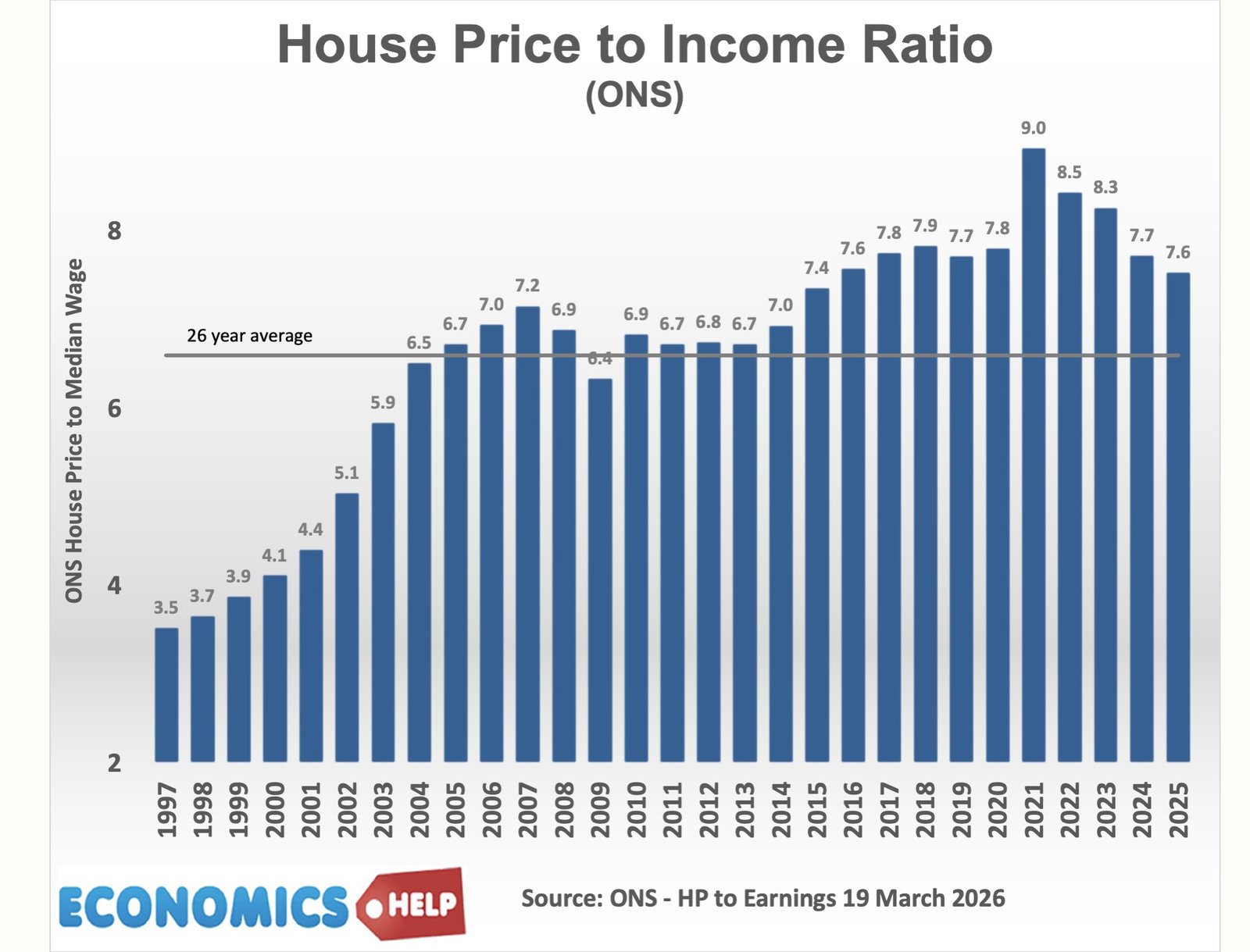
And this is reflected in the fact that housing is more affordable than 3 years ago. In 2021, House prices reached nine times median wages, record unaffordability. Unsurprisingly higher interest rates have caused this to fall to 7.6. The 26 year average is 6.6, so it could continue to decline. Though, if you go further back in time,, housing was a smaller share of income in the 70s, 80s and early 90s. So what is happening is that inflation has disguised the fact house prices have fallen. But, because of low real wage growth, it is still a relatively high income multiple. A good question to ask is whether house price to income ratios are ever likely to return to those early 1980s levels of around 4 times income. To any potential buyer hopeful of this possibility, I would be very wary of waiting for this to occur. You will probably spend the rest of your life renting, waiting for a housing crash that never occurs.
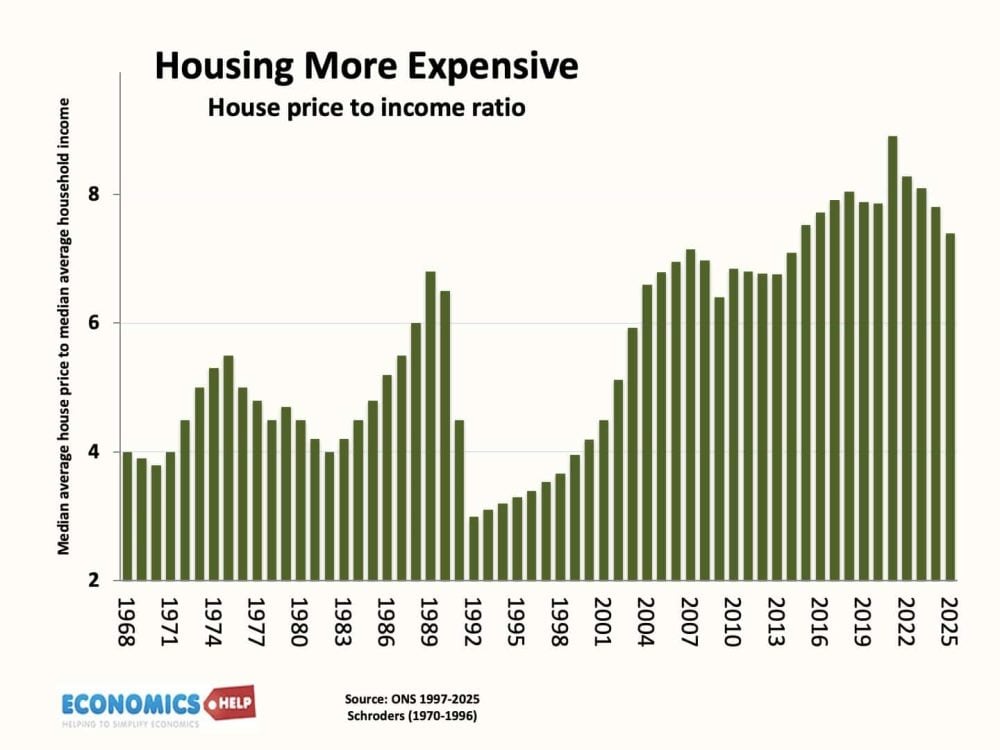
Why have long-term house price to income ratios risen, and is there any prospect it will change? There are a few factors, you have to know as a potential buyers. Firstly, the housing market is different these days. It’s not just income that determines buying power, it is also inherited wealth and family gifts. Savills suggest 53% of first time buyers get family help, with first time buyers receiving £11 billion in financial support.

This is not going to change any time soon. Because as the baby boomer generation passes on, there is a big increase in inheritance set to come, where will this end up? Gen X won’t be buying shares in SpaceX, they will be buying a house.
Another buy signal is that mortgage approvals are at their lowest level since November 2023, because of weak demand, there is evidence of sellers have to cut their asking price to sell. Rightmove, which measures asking price is seeing a small decline in asking prices. This is particularly noticeable in expensive areas like London and South East. In cheaper areas, house price growth have been stronger. There are also signs of landlord distress with a rise in the number of landlords selling up because of new regulations and costs of renting out. According to PropertyMark 86% of agents are having to sell below asking price, this compares to only 16% four years ago. According to the Telegraph Access Legal which collects conveyancing data found a median 22% gap between the original asking price and sale price. If you are thinking of buying bear this fact in mind when putting in an offer.

Having said that the first signal which may discourage from people buying right at the moment is the recent rise in mortgage rates, and prospect for more uncertainty. The conflict in Iran has been very start-stop, making predictions difficult, but it is worth emphasising there is now very real disruption in the oil and gas markets. What this means for households is elevated inflation and elevated interest rates. We have seen mortgage rates increase above base rates, and the recent escalation has again cause mortgage lenders to reconsider which products are offered.
However, should potential buyers hold back until the situation is more stable? We are entering a situation where there seems to be a never ending stream of crisis and disruption. Again, if you wait for calm in global economics, you may be waiting for ever, and there are actually a few things buyers should know. Firstly, the inflation shock has so far been less than feared. Headline inflation has actually fallen. I wouldn’t get carried away by this. Inflation will go back up. But, with economic growth fairly weak, the Bank of England is reluctant to increase interest rates due to temporarily higher oil prices. In fact, you could argue the premium for mortgage rates over base rates means if conflict is resolved, the mortgage spread could come back down by the end of the year. There is a worst case scenario where the conflict escalates and oil shortages finally cause oil prices to soar. But I do think there is a pain threshold, where the US will need a resolution. Mortgage rates are temporarily higher, but it is hard to see a situation where base rates rise back to 5 or 6%.
Cost of Building

For those expecting a big fall in house prices, there is another factor worth considering. It is really expensive to build houses in the UK. Estimates vary but some builders claim the cost is quite close to average prices. This is backed up by research from the FT, which shows how the profit margin of big builders has fallen considerably in the past five year. The house building federation argues it costs £76,000 more to build a house compared to five years ago. This rise in costs, is why house building has fallen way behind the government’s target. So there will be no supply surge to depress prices. In fact, there is still long-term shortage compared to recent population growth.

Interesting comparison between homes per capita in France, England

However, if you are nervous about the current economic situation and prospect of property taxes, The growth rate of house prices is really quite flat. There have been times, where if you dithered for 12 months, prices could rise 10 or 20%. But, if you have savings protected from inflation, then the current market means there is time to shop around, look for value.
Property Taxes?
What about New Prime Minister. Stamp duty has moved around quite a bit in recent years, and the high rates are blamed for fall in transactions. Because stamp duty and council tax are viewed as inefficient taxes, there was talk of replacing stamp duty and council tax with an annual tax on the value of a house. This would in short, be a big tax increase for expensive homes, predominantly in south east, and a tax cut for cheaper homes in north. It would also encourage people to move and downsize. If this was introduced, you would see a k-shaped effect. Expensive houses would see fall in demand, and cheaper houses a rise in demand. It has economic benefits, but also high political costs and it has effectively been ruled out in this parliament. But it could be a future issue.
AIBubble?
What about the AI bubble, could that influence the UK housing market. In recent video, I referenced the fact some say there are similarities between AI Capex investment and the 2008 bubble, when debt became hidden off-balance sheets. If the AI bubble popped, it would have a negative effect on economic growth. AI investment is a major part of US economic growth. However, even if the US economy tipped into recession (and it is often defied gloomy forecasts), it would if anything make it more likely that interest rates go down, the cost of mortgages fall. And there are differences to 2008, in that it is not housing in the firing line.
Rent or Buy?

A bigger question for whether to buy now or wait is really what is the alternative? If you are living with parents paying subsidised rent, it is fine to wait, but if you are paying average rents of £2,200 in London, this is money going to landlord rather than reducing mortgage balance. This Zoopla analysis from 2025 shows that for first time buyers, at least 33% of homes are for sale cheaper than the cost of renting. But this is only part of the equation. Mortgage payments don’t rise over time like rents do. Renters have seen a 30% increase in just four years. On the positive side, current rent inflation has slowed down to just above inflation. So in the short-term, this is another reason why waiting is not so bad. But in the long-term, buying a house will be cheaper than renting into retirement. And given failure to increase supply, and landlords selling him, there is likely to be upward pressure on rents, notwithstanding the fact population growth is starting to slow.
Overall
To answer the question, this is not the worst time to buy. Real Prices have come down in the past four years, affordability has improved. The Iran War has caused a spike in mortgage rates, but so far, base rates have not risen. The housing market is being pulled in different directions, but if you are buying a house to live in, I wouldn’t worry too much about external factors. Just make sure you don’t overpay.
Sources:
Sources
About The Author