📬 Would you prefer to receive this information in your email inbox every morning before the markets open in New York? Sign up here.
ONE BIG THING
Trump’s Truth API and less frequent SEC filings could create a “rigged” market
The proposal by Trump Media & Technology Group to sell access to President Trump’s posts on Truth Social milliseconds before they are made public, combined with a separate proposal to do away with quarterly earnings reporting to the SEC, could create a “a two-tiered market” where insiders get rich and ordinary investors will always be a step behind, sources told Fortune’s Mia Osmonbekov.
“When you have a market that looks like that, it looks rigged,” Tyler Gellasch, CEO of Healthy Markets Association and former SEC counsel, said.
MARKETS
Stocks are mixed as oil heads over $90 per barrel
- S&P 500 futures were up 0.2% this morning. The index closed up 1.01% in its last session.
- In Europe, the Stoxx 600 was flat in early trading, and the U.K.’s FTSE 100 was down 0.38% before lunch.
- Asia: South Korea’s KOSPI was down 4.46%. Japan’s markets were closed today. India’s Nifty 50 was down 0.41%. China’s CSI 300 was up 1.53%.
- Brent crude was $89 per barrel this morning, after briefly going above $91.
- Bitcoin was $64K.
QUANTUM
Hackers are stealing data they can’t even read yet—banking on quantum computers to crack it later
There is a debate about when quantum computing will be able to crack the standard forms of encryption that protect everything from bitcoin to your bank account. Some people think it’s a couple of years away. Others—notably the researchers at ARK Invest—say it won’t arrive until 2044 at the earliest.
Hackers, however, aren’t waiting for either of those dates. Instead, they are downloading whatever databases they can get their hands on, even if they cannot open them, and saving them for when commercial quantum computing makes it possible to decode the contents.
The phenomenon is called “harvest now, decrypt later,” and it looks like a business opportunity for TDK Ventures President Nicolas Sauvage, whose $500 million fund is looking to invest in cybersecurity defenses against the quantum hacking threat.
“We understand that there are a lot of hackers who are downloading our information today on the premise that in the future, they can hack that data with quantum, and if you and your password, if your data is still valid by the time they hack it, they have access to everything. And so, for us, that probably means we’re getting at the point where we need to look at quantum security, making sure that we are prepared for when that moment comes,” he told Fortune recently.
He points to Salt Typhoon, the Chinese government’s hacking operation which has harvested data from 200 or more companies in 80 countries.
“I think [the threat] it’s enormous. You think about all your financial data, my financial data, your privacy, your emails, all of the things that are impossible to hack today. Economically—I mean, everything is hackable—but economically it could become hacked so quickly once quantum kicks in.”
Sauvage thinks the point when everything that is not quantum-protected can be opened like an envelope is probably seven years away.
THE SPORTS PAGE
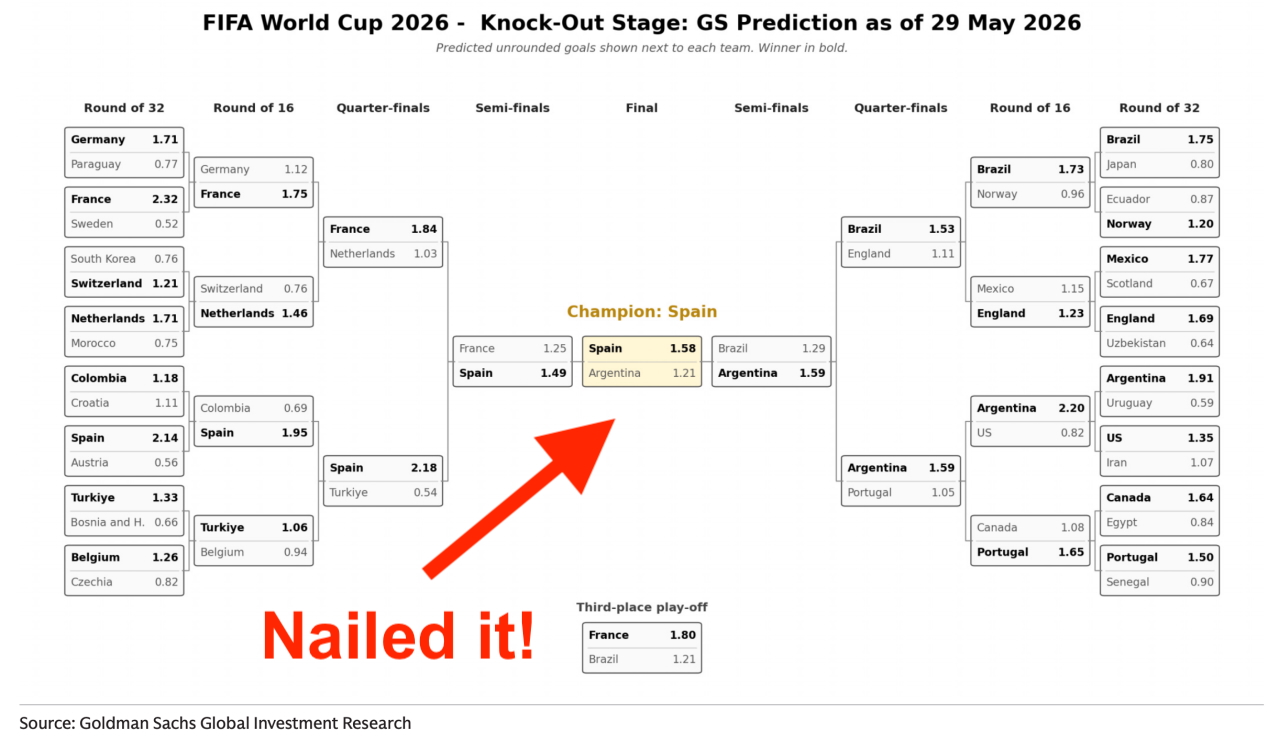
Goldman Sachs correctly predicted World Cup final
On June 2, we made fun of Jan Hatzius and his folks at Goldman Sachs for the bonkers level of work they had put into their World Cup predictions. Today, we owe the Goldman team an apology: The bank’s ultimate prediction—that Spain would beat Argentina in the final—was exactly right. Not all of their calls were correct, obviously. Turkey was bounced out almost immediately in the knockout stage, while Goldman had them facing Spain in the quarter-finals. The bank also thought Brazil would go all the way to the semi-finals, when in fact they were knocked out by Norway in the round of 16. But their final call, Spain v Argentina with the edge going to the Europeans, was exactly what happened. Here for posterity is their pre-cup prediction bracket:
IRAN
Iran vows to choke off Hormuz oil flow as U.S. death toll climbs
The U.S. continued bombing Iran in a ninth straight night of attacks, and three American service members were reported killed in Iranian attacks on Iraq and Jordan—yet Iran said talks between the two sides were ongoing. Total U.S. casualties so far: 17 dead, 420 wounded. Estimates vary for the total casualties across Iran and Lebanon so far, from above 4,000 to above 10,000.
The U.K. Maritime Operations Centre reported that one ship off the Oman coast was on fire; the Iranians claimed they had struck two ships in the Strait of Hormuz over the last 24 hours. The Islamic Revolutionary Guard Corps vowed to keep the Strait closed: “This passage will not be safe for the transit of petrochemical products, nor even a single drop of oil and gas.” Live coverage from The Guardian here.
MORE FROM FORTUNE
How Nestlé turned a chocolate heist into a masterclass in brand building – Sam Birchall
Agentic commerce is coming—and the battle to build its infrastructure is on – Diane Brady
The minimum wage is now the lowest it’s been in 70 years—making the federal wage floor ‘officially a poverty wage,’ report finds – Sasha Rogelberg
Warren Buffett says his $147 billion investing career was an accident: ‘I may be one of the 10 luckiest in the world’ – Sarah Glodek
Backed by Daymond John and Post Malone, this Afghan-born founder built a $150M brand. Her real mission: the women back home – Sydney Lake
CHART OF THE DAY
Deutsche Bank’s “Cheap Date Index” shows Geneva is the most expensive place for luuurve
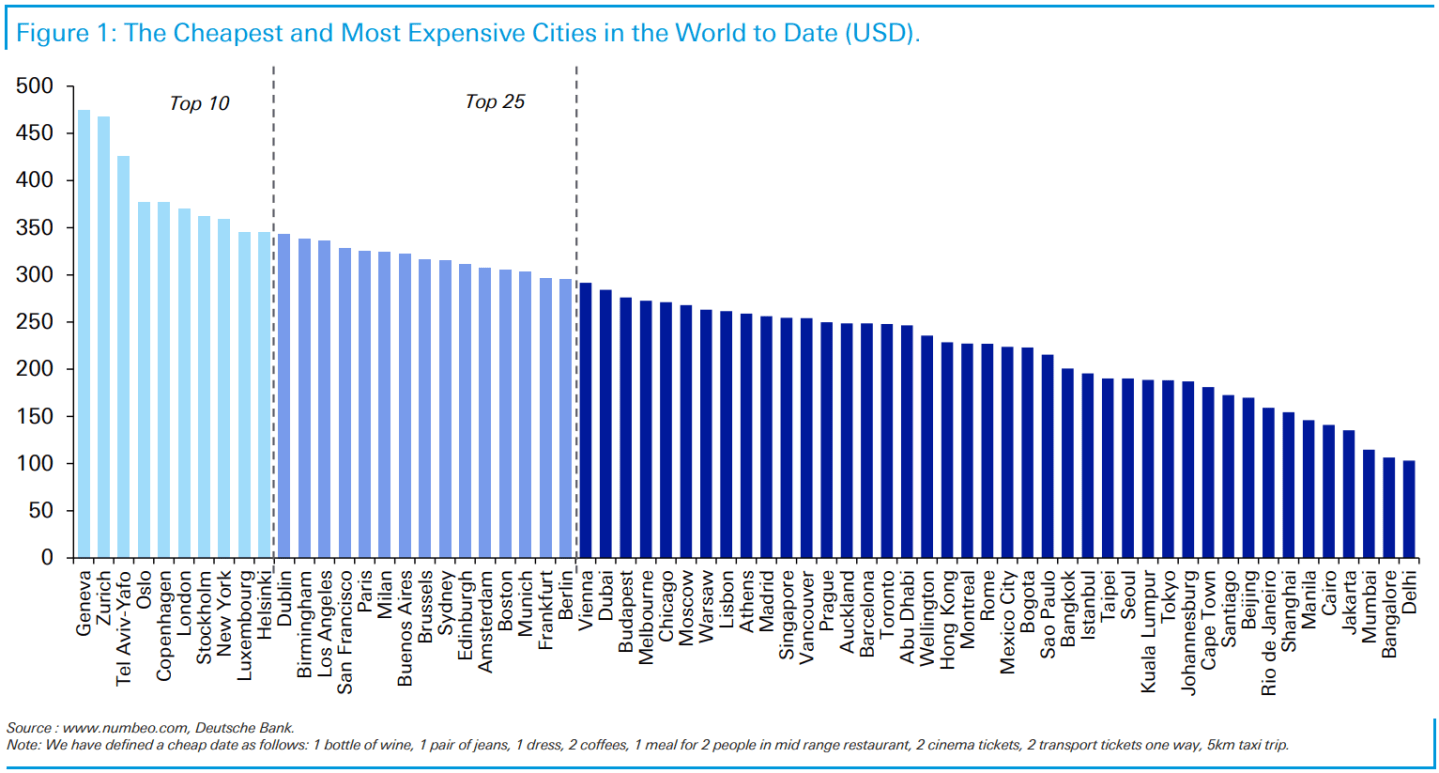
The index shows the cost, in U.S. dollars of “a new pair of jeans and a dress, two one-way public transport tickets, two coffees, a meal for two, two cinema tickets, a bottle of wine to dissect the film afterwards, and finally a taxi ride home,” according to Deutsche’s Jim Reid. “That last item may prove controversial depending on how established the relationship is.”
NUMBER OF THE DAY
$2 trillion
The amount of AI-related “remaining performance obligations” (ie agreements for future work that have not yet been fulfilled or paid for) listed by the top four cloud service providers for the next 12 months, according to Vivek Arya and his colleagues at Bank of America. Broken out:
- Microsoft: $627 billion.
- Oracle: $638 billion.
- AWS: $364 billion.
- Google: $460 billion.
THE FRONT PAGES TODAY
Ukraine Escalates Air War With Deadly Strikes on Russia’s ‘Amazon’ – WSJ
US day traders flock to ‘the most dangerous product in crypto’ – FT
Russia pounds Kyiv as NATO military chief warns Moscow would ‘lose a lot’ by attacking Baltics – CNBC
Top Pentagon official blasts OpenAI’s Dean Ball – Axios
Andy Burnham’s father unaware of son becoming prime minister due to Alzheimer’s – The Independent
Rubio Says U.S. Is Still Open to Diplomacy With Iran – NYT
ONE MORE THING
Esther Perel says your blurred Zoom background is causing “social atrophy”
Employees are slowly disengaging with their workplaces, according to a new Gallup poll that measured the level of psychological attachment employees have to their work. Esther Perel, the famous therapist and author of “Mating in Captivity,” believes AI, remote-hybrid working, and distributed global teams are causing a slow, invisible erosion of the everyday human contact that used to hold organizations together and build rapport among colleagues.
This is “social atrophy,” Perel told Fortune’s Sam Birchall. Professional relationships actually need physical proximity, she says.
Blurred Zoom backgrounds are a particular bugbear for Perel. “In the early days of video calls, people were unintentionally visible in each other’s homes, which paradoxically created more intimacy than the polished, decontextualized version we have now,” she says. “You go on Zoom, nobody says hello, everyone’s pretending to do something else while they wait so it doesn’t look like they’re just sitting there.”
“You can only handle difficult and important conversations as a leader if you’ve built up a foundation of small, insignificant ones first,” she says.