
Great Wealth Transfer vs. great disappointment: Baby boomers pass on a fraction of their fortune
Baby boomers are sitting on immense wealth after benefiting from a historic era of economic growth and financial gains, but heirs shouldn’t get their hopes up too much.
Estimates of the so-called Great Wealth Transfer vary, reaching as high as $124 trillion. A report last month from Visa Business and Economic Insights put the number at a more modest $93 trillion, though that’s still three times the size of U.S. GDP.
But millennials and Gen Xers with great expectations for inheriting that wealth may be setting themselves up for great disappointment. Visa likened it to winning the lottery, then seeing the eventual check whittled down drastically.
“You hit the jackpot, but you immediately lose half by—smartly—taking the lump sum,” the report said. “Next, you lose another 30–40% through taxes and fees. The advertised jackpot is enormous, but after the lump-sum haircut, taxes and fees, the take‑home number is much lower. A similar dynamic applies to the great wealth transfer.”
For the Great Wealth Transfer, Visa calculated that boomers will pass on $36 trillion of their $93 trillion in wealth, translating to about $515,000 per inheriting household.
That’s after excluding wealth from the top 1% of households, subtracting debts and other liabilities, as well as deducting retirement spending, charitable donations, taxes and fees.
Despite being the wealthiest generation, boomers are still burdened by significant debt. In fact, 41% of homeowners ages 65 to 79 and 31% who are 80 and older still carry mortgage debt, according to Visa.
Their other liabilities include credit cards and auto loans, borrowing against brokerage accounts and other investments, as well as personal and business loans.
“Taken together, the high share of cost-burdened older homeowners and substantial non-mortgage debt indicate that many baby boomers have far less financial flexibility—and potentially less wealth to pass on—than headline figures might suggest,” the report said.
After backing out all that debt, about $88 trillion remains. A third of that belongs to the top 1%, so excluding them leaves $60 trillion. But the top 2% to 10% owns $44 trillion, meaning the bottom 90% of boomer households hold the remainder—just $16 trillion.
Boomers will also spend a chunk of their wealth, roughly $16 trillion, during retirement. Think housing, food, healthcare, prescription drugs and other essentials. And of course, they must also pay taxes.
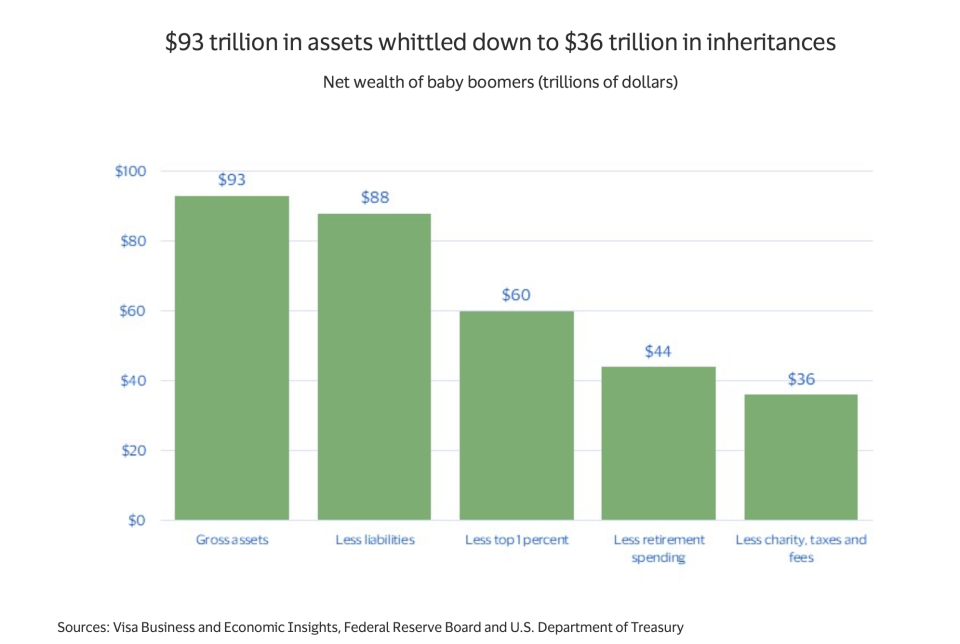
That’s how Visa arrived at its $36 trillion bottom-line inheritance figure. And the wide gap between affluent boomers versus the rest of their peers means the average $515,000 per-household amount overstates what most millennials and Gen Xers will actually receive.
Indeed, nearly 75% of people inheriting money from the wealth transfer are in the top 2%-10%. The top 10%-50% represent about a quarter of recipients, and the bottom 50% are just a minuscule share, according to Visa.
Because most money that’s transferred goes to households that are already affluent, an even smaller share of the inherited wealth will actually be spent.
Visa estimated that $28 trillion will likely be saved or invested, with only $8 trillion used to buy stuff. Given the economy’s immense size, that spending should lift average annual real consumer spending growth by just 0.1 percentage point to 2.1% over the next 20 years.
The good news for younger generations is that boomers are already showering some of their money on their heirs.
The rising popularity of “skip-generation trips,” where grandparents travel with grandkids without mom and dad, points to this trend. Twenty-eight percent of grandparents have taken such a trip, and 35% plan to in the next three years.
And among millennial homeowners, about a quarter got help on the down payment from their parents and wouldn’t have been able to buy their current home without it.
“For many, this support made it possible to qualify for a mortgage, lower their monthly payments or afford a more expensive home. It also reflects a broader shift among older generations toward giving while living,” Visa said.
“Rather than waiting to pass down inheritances later, many boomers are using their wealth to help their children clear major financial hurdles now, when the support will have the greatest impact.”