Enterprise finance leaders find themselves caught in a distinct operational paradox: while C-suite mandates to adopt artificial intelligence grow louder, the tolerance for unverified automated execution remains precisely zero.
For corporate treasury departments managing multi-currency liquidity pools, debt covenants, and foreign exchange exposures, an unverified calculation or hallucinated forecast isn’t a minor glitch, it is a material compliance risk.
Addressable market data underlines this tension. Gartner projections indicate that the average Fortune 500 organization could deploy over 150,000 AI agents by 2028. Yet, only 13% of organizations currently report having effective AI agent governance frameworks in place.
Seeking to bridge this trust gap, Ripple has announced a major expansion of GSmart, the native AI engine embedded within its Ripple Treasury platform. The rollout introduces policy-governed AI agents across core operational functions including cash forecasting, liquidity management, risk identification, reconciliation, and financial reporting.
Decoupling Calculation from Interpretation
The foundational challenge of deploying generative or agentic AI in treasury lies in its mathematical reliability. Standard large language models (LLMs) operate probabilistically, making them inherently ill-suited for strict financial calculations.
Ripple Treasury’s structural solution separates calculation engines from analytical interpretation. Under this dual-architecture design:
-
Deterministic calculation engines perform all underlying mathematical computations, debt ratio tracking, and balance aggregations.
-
AI agents analyze datasets to detect anomalies, evaluate pattern shifts, and draft operational recommendations.
-
Policy studio controls audit every proposed action against pre-defined corporate governance clauses before presenting options to human operators.
“Every CFO is under pressure to embrace AI, but they’re equally responsible for ensuring every financial decision is explainable, governed and compliant,” stated Renaat Ver Eecke, Senior Vice President of Ripple Treasury. “Rather than asking customers to blindly trust an AI system, GSmart works within each organization’s own treasury policies to surface recommendations transparently, while ensuring humans remain in control of every decision.”
Policy Guardrails and the Human-in-the-Loop Requirement
The expanded suite operates across distinct modules, controlled centrally by a Knowledge Studio layer that serves as the organization’s digitized treasury policy rulebook:
-
Orchestrated Operations Agents: Active across cash forecasting, risk, and reconciliation. Agents continuously monitor workflows, generate suggested actions, cite the exact internal policy clause granting authority, and halt until a human treasurer approves execution.
-
Analytics Studio & Ask GSmart: A natural-language interface allowing treasury teams to query complex, cross-entity financial data directly without constructing custom SQL queries or manual spreadsheet pivots.
-
Proactive Exposure Detection: Automated scanning of cash movements to spot emerging liquidity gaps and foreign exchange variance.
Early adoption metrics indicate strong appetite for automated risk oversight when wrapped in guardrails. According to company figures, 60% of eligible Ripple Treasury clients have active Risk Insights enabled to flag policy breaches, while 44% utilize Forecast Insights to compare projected vs. actual cash flows.
The Architectural Breakdown
To eliminate the risk of hallucinated actions or unverified market moves, modern agentic treasury systems enforce a strict three-tier architecture. Deterministic engines sit at the base, handling precise, unyielding mathematical calculations, such as debt covenant ratios, interest accruals, and balance aggregations. Operating above this foundation, governed AI agents analyze complex cross-entity datasets, detect anomalies, and match patterns against corporate risk policies. However, execution remains strictly gated: every proposed trade, transfer, or structural adjustment is checked against digitized treasury policy clauses in the Knowledge Studio and held for explicit human treasurer approval before a single dollar moves.
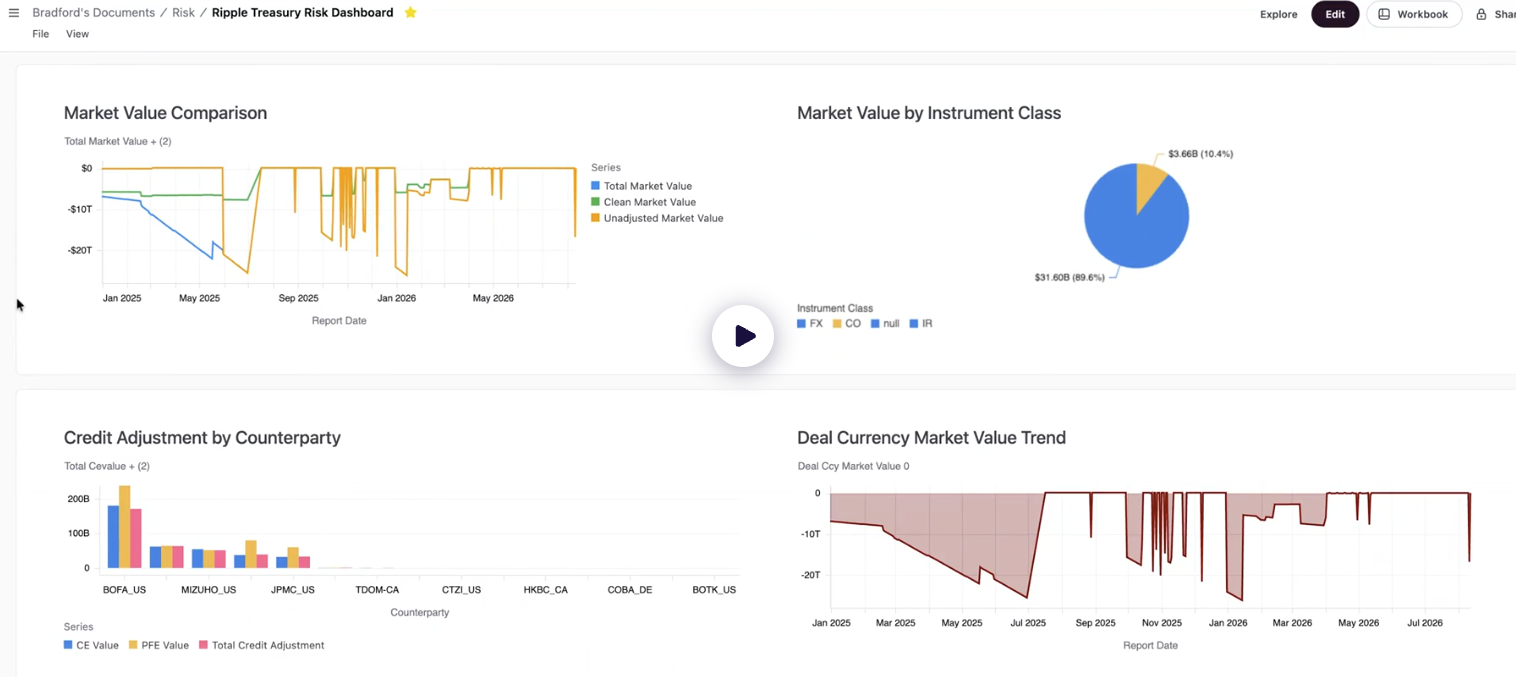
When evaluating macro-level exposures, consolidated risk dashboards allow teams to monitor market value fluctuations, counterparty credit adjustments (such as PFE and CE values across bank counterparties), and deal currency market trends side-by-side.
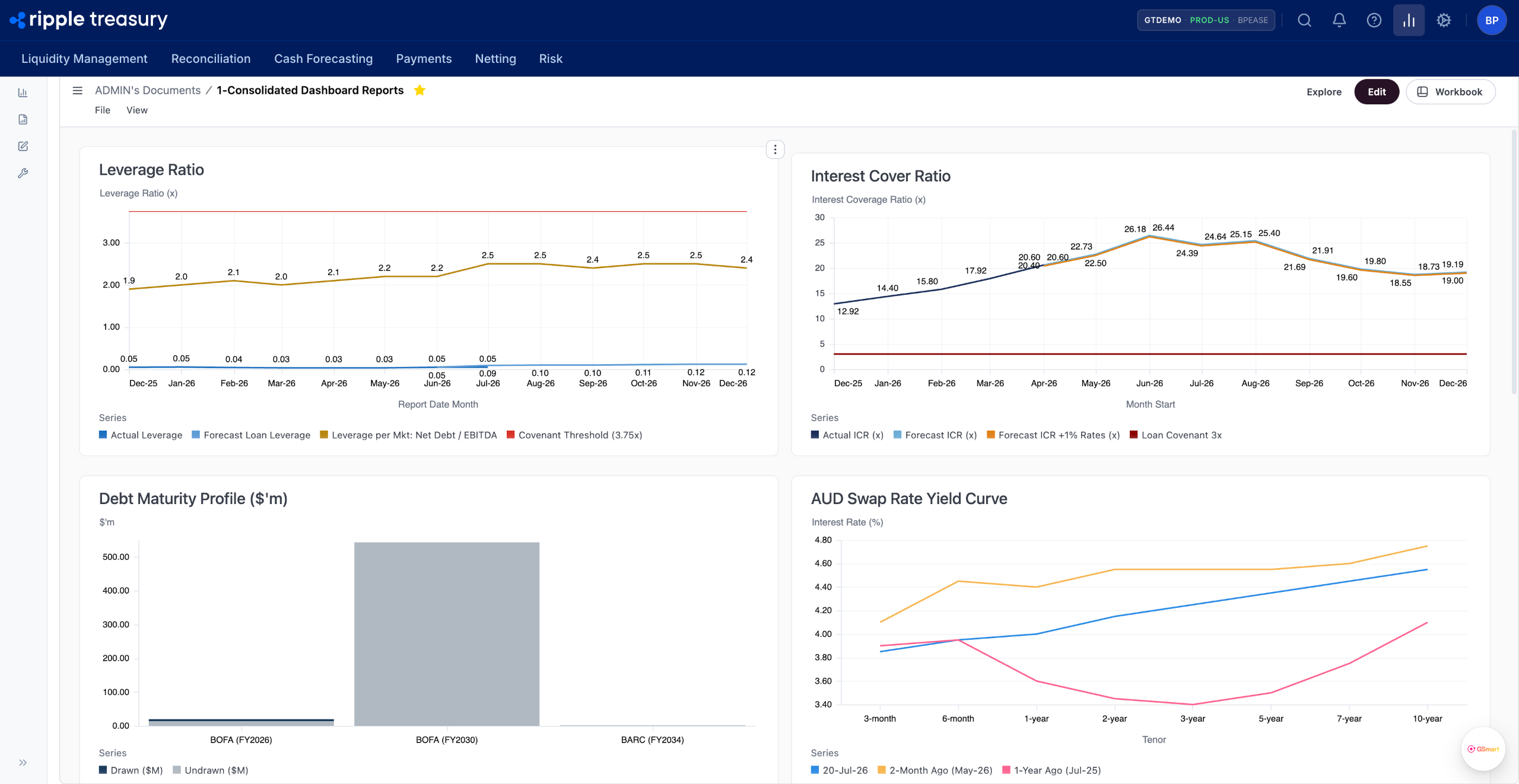
Similarly, for corporate finance executive reporting, consolidated views synthesize critical leverage ratios against fixed covenant thresholds alongside debt maturity profiles and interest rate yield curves, ensuring that AI insights operate strictly within contractual boundaries.
Why Policy-Gated Agents Matter for the Modern Treasurer
The broader implications of Ripple’s announcement extend beyond a single platform release. For years, treasury software providers have touted “automation,” which often meant rigid, script-based macro rules that broke whenever bank messaging standards or data formats shifted.
The transition to agentic AI offers the flexibility corporate teams actually need, provided the governance boundary is unassailable. By enforcing a policy-citation rule (where an agent cannot recommend moving cash or executing a hedge without citing the corporate policy clause permitting it), the model shifts AI from a “black box” risk to an auditable assistant.
As treasury departments navigate macro volatility, shifting yield curves, and the co-existence of traditional fiat with digital asset rails, the market standard is becoming clear: CFOs will accept AI intelligence, but only when human authority remains non-negotiable.