Financial Planning Fraternity Gains Traction
The insurance and accounting professions have long had professional fraternities for college students pursuing those majors. And about three years ago, Mac Gardner, founder and chief education officer at FinLit Tech, created Mu Nu Upsilon, the first professional fraternity for financial planning. The first active chapter started at the University of South Florida, where he sits on the board of the financial planning degree program, and there’s now a sister chapter at the University of North Texas.
Over the last several years, the wealth management industry has been challenged to attract young people and develop their talent. MNY is hoping to bridge that gap, said Alex Healy, chair of the USF chapter of MNY and director of growth and chapter development for the national organization.
“From the student perspective, we are seeing a real need for stronger bridges between universities and advisory firms,” Healy said. “Many students are interested in financial planning but do not always know where to start, who to connect with, or how to gain meaningful exposure before graduation. MNY is working to close that gap by creating a professional, student-led pipeline into the advisory profession.”
The fraternity has grown to just over 70 members, with 36 joining in the last year. Healy said he expects to add another 25 members this fall, bringing membership near 100. And over the summer, MNY saw 22 different members land internships in the wealth management space.
And the fraternity is elevating the financial planning profession. While the organization is open to students of all majors, just this past semester, 13 members switched over to the financial planning major.
“We’ve actually seen a majority of students in general that come in as whatever major have switched to financial planning because they are exposed to it and because you have other students advocating directly for it,” Healy said. “It’s one thing to have a professor telling you, ‘Oh, you should switch to financial planning’ or ‘You should switch to this or this major’ or ‘You should do this career path.’ But when you have other students that are advocating for it and telling from their personal experience why they fell in love with the career path, I think that’s where a lot of the impact comes.”
Not Your Typical Frat
MNY is not what you would consider a traditional fraternity, with pledges being hazed, members living together, throwing parties and paying dues. MNY is a co-ed, no-dues fraternity with a large professional development component.
“We don’t believe there should be a barrier to professional development for our members,” Healy said.
It starts with a two-week intensive rush process, where MNY hosts five events for students to participate in and learn about the fraternity. The fifth one is an invite-only event for those who are invited to join as members. Students make the cut if they put in the effort; they show up to events and get to know MNY board members. It’s not based on their experience or how well-suited they might be.
“It’s a common stigma within a fraternity that it’s very cliquey, or it’s very who knows who and who you’re going to talk to kind of thing to get in,” Healy said. “And that’s really not our goal. I think that’s highlighted by who we have within our fraternity and also how quickly we have grown because all the students we bring in are driven; they want to succeed.”

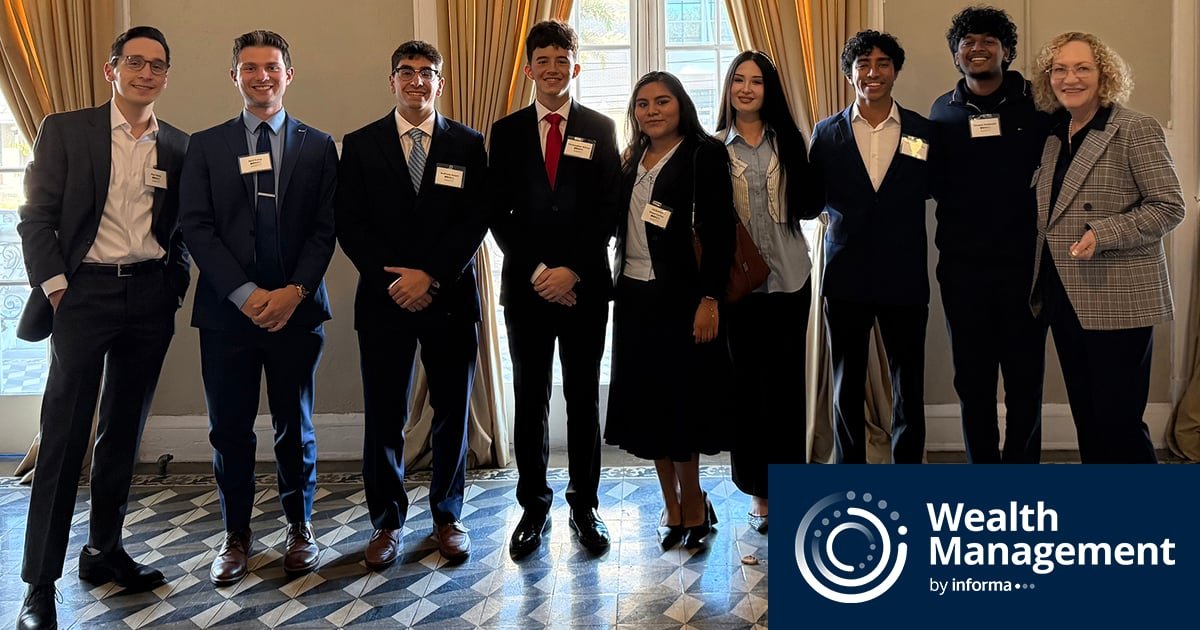
MNY members during a Bernstein Private Wealth office tour hosted by John Flores (back row, center).
The Professional Development Process
Pledges then go through a seven- to eight-week professional development process that includes earning the Bloomberg Market Concepts and Bloomberg Finance Fundamentals certifications.
During the development process, upperclassmen in MNY teach LinkedIn skills and run mock financial planning exercises. Pledges learn how to use eMoney Advisor, the financial planning software.
The group also has financial advisors come in and lead conversations on industry topics.
John Flores, a vice president and client advisor at Bernstein Private Wealth, is one of the local advisors who’s gotten involved. He hosted a group of MNY members at Bernstein’s offices. He then had four associates speak to the group for 30-minute sessions. He thought that would be good for the students, since the associate role is likely the one they would enter upon graduation.
Flores then had the firm’s managing director close out the event.
“It was good from him because he’s like, ‘Hey, this is what we’re looking for from an office level. This is what we’re looking for in the hiring process. This is what you guys should do. I think you should look to study for your SIE. You should start to network with people early on.’”
MNY has a scholarship program that covers the cost of the Securities Industry Essentials exam, the introductory test administered by the Financial Industry Regulatory Authority.
“Establishing these ecosystems has just been something that I’ve been super passionate about because it’s something I didn’t have,” he said. “I see a lot of myself in them. A lot of the students at MNY are actually first-generation college students. A lot of them are international.”
Flores also participates in the fraternity’s mentorship program, which pairs member students with industry professionals, and they meet three times per semester. Flores was paired with one of MNY’s board members. He said it doesn’t take up too much of his time, and it’s a rewarding experience.

MNY collaborated with USF’s student spirit squad to get exclusive seats in their section for a basketball game.
“I’ve gone to some of these volunteer organizations that we get involved in, and you’re going there, and the people really don’t want to be there. They’re checking a box,” he said. “But with the students here, some of them would literally keep you for hours if they could. They’re just sponges. They’re really trying, they’re ambitious, they’re hungry, they’re willing to listen. They’re very thirsty for knowledge.”
And a lot of times these mentorship relationships end up with the student getting an internship, Healy said.
“No. 1, that’s a learning opportunity,” he said. “No. 2, it’s an opportunity for the industry people to come in and pour into students. And No. 3, it’s an opportunity for them to recruit if the relationship works out really well.”
Austin Nesci, an MNY alum and paraplanner at Provise Management Group in Clearwater, Fla., said the fraternity was pivotal in helping him network with his current firm. Nesci met Raymond Ferrara, founder and executive chair at Provise, at a board meeting for the financial planning major, set up through MNY.
Nesci, a financial planning major, joined MNY during his senior year and quickly became the group’s treasurer. One of the most valuable aspects, he said, was hearing from real advisors who were out there practicing day to day.
“The personal financial planning major provided a lot of value there, but hearing the real stories is what helped my transition a lot, basically make it a lot easier going from college to Provise Management Group, where I’m at now,” he said.
Nesci said the vetting processes at wealth management firms have become more strenuous, making it harder for financial planning students to get a foot in the door. They want candidates with real-life experience.
“Without having hands-on experiences in those clubs that relate to what you’re trying to get into, it’s making it so tough, especially when you’re in those interviews, and you don’t have anything to speak of,” he said. “I got lucky with MNY because I already had experience with some of those mock client case studies where I could pull from something I did with X client and how I went about recommending this based on their situation.”
While there are some fun events, the ultimate goal of MNY is to prepare students to enter the industry and strengthen the advisor pipeline, Healy said.
“I think we do that by reaching students earlier,” he said. “A lot of university programs, the major starts as you’re at your junior year. We have open recruitment; you can be a freshman and just walk on the campus and be a part of MNY. And you can really learn a lot of technical skills.”