What GAO Found
The Department of Defense (DOD) and its components—relevant DOD offices and the military departments (Army, Navy, and Air Force)—are taking steps to prevent and mitigate the brain health effects of blast exposure. In 2024, DOD established several blast overpressure requirements, including one requiring that brain health be monitored. Specifically, this requires that all high-risk active duty service members complete a baseline cognitive assessment in fiscal year 2025 and all new service members complete one during initial military training. DOD also required tracking service members’ exposures to blast overpressure. As of fiscal year 2025, components have begun to implement tracking requirements, including updating the centralized data system to be able to track exposures.
Figure: Number of Cognitive Assessments Completed in Fiscal Year 2025
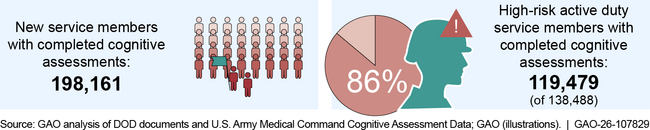 Note: For more details, see fig. 4 in GAO-26-107829.
According to DOD documentation and interviews, DOD components faced resource challenges:
- Cognitive assessments. DOD component officials reported that implementation was hindered by resource constraints, such as insufficient staff and technology to conduct the assessments, and that these challenges may affect their ability to meet additional requirements going forward. Such requirements expand assessments to all active and reserve service members, along with the goal to repeat assessments every 5 years.
- Exposure tracking. DOD component officials reported a lack of industrial hygiene personnel to complete exposure tracking requirements. Required tracking includes information about weapons systems used and exposures from those weapons for any service members exposed. Such tracking creates a record of the hazards that a service member is exposed to during their military service.
DOD officials said that because of the need to expeditiously begin cognitive assessments and start exposure tracking efforts, there was not an opportunity to fully evaluate and ensure they allocated the resources necessary, as required by DOD policy and guidance. Officials said a 1-year pilot starting summer 2026 of a new cognitive assessment tool may address resource issues, but DOD did not have documented plans to assess this. DOD officials said they also have efforts underway to assess industrial hygiene resources needed for exposure tracking but such efforts have not been finalized. These efforts are important first steps, but comprehensive assessments would provide a sound foundation for ensuring the resources needed to implement DOD’s requirements. Such assessments would ultimately strengthen DOD’s ability to identify and provide treatment to service members who may need medical care and help ensure vital records are maintained about their exposures during military service.
Why GAO Did This Study
There is growing evidence that using certain weapons that produce high levels of what is called blast overpressure (the sudden onset of a pressure wave) can affect service members’ brain health. Symptoms of blast overpressure exposure can include headaches, memory loss, and, most seriously, traumatic brain injury.
DOD is responsible for management of blast overpressure effects and issued a key memo with requirements for DOD components in August 2024. The requirements include prevention efforts such as mandated stand-off distances when firing weapons and monitoring efforts such as conducting periodic cognitive assessments.
A report accompanying the National Defense Authorization Act for Fiscal Year 2025 includes a provision for GAO to examine DOD’s efforts related to blast overpressure. Among other things, this report examines the status of implementation of DOD’s requirements and challenges DOD encountered in implementation.
GAO reviewed DOD policies and guidance and obtained DOD data on cognitive assessments completed in fiscal year 2025. GAO conducted interviews with DOD components and site visits to four military installations. The installations were selected to include an initial military training site, a site with special operations forces, and military department representation.