Canada & Permanent Full Expensing
After Canada’s snap elections in the spring of 2025, the 2025 budget was put on hold. This also stalled important taxA tax is a mandatory payment or charge collected by local, state, and national governments from individuals or businesses to cover the costs of general government services, goods, and activities. policies. In recent years, Canada’s capital cost recoveryCost recovery refers to how the tax system permits businesses to recover the cost of investments through depreciation or amortization. Depreciation and amortization deductions affect taxable income, effective tax rates, and investment decisions. policy has seen significant changes, so it is essential to understand why the current policy is worth maintaining and extending.
A capital allowanceA capital allowance is the amount of capital investment costs, or money directed towards a company’s long-term growth, a business can deduct each year from its revenue via depreciation. These are also sometimes referred to as depreciation allowances. is the amount of capital investment costs a business can deduct from its revenue through the tax code. When businesses cannot fully deduct capital expenditures in real terms, they make fewer investments in equipment and machinery, which also reduces worker productivity and wages. Companies should be allowed to fully deduct their capital investments in real terms—either through full expensingFull expensing allows businesses to immediately deduct the full cost of certain investments in new or improved technology, equipment, or buildings. It alleviates a bias in the tax code and incentivizes companies to invest more, which, in the long run, raises worker productivity, boosts wages, and creates more jobs. or neutral cost recovery. Instead, depreciationDepreciation is a measurement of the “useful life” of a business asset, such as machinery or a factory, to determine the multiyear period over which the cost of that asset can be deducted from taxable income. Instead of allowing businesses to deduct the cost of investments immediately (i.e., full expensing), depreciation requires deductions to be taken over time, reducing their value and disco schedules specify the life span of an asset—often derived from the economic life of an asset—and determine the number of years over which an asset can be written off. However, in most cases, these depreciation schedules do not consider the time value of money (a normal return plus inflation). As a result, businesses cannot fully deduct the net present value of capital investment. This inflates taxable profits, which, in turn, increases the cost of capital investment.
Improving capital allowances in these ways is an especially cost-effective way to raise investment because it directly lowers the cost of capital for new investment without negatively affecting tax revenue from the existing capital stock.
Temporary Full Expensing
In 2018, the Canadian government increased its capital allowances as a response to the temporary bonus depreciationBonus depreciation allows firms to deduct a larger portion of certain “short-lived” investments in new or improved technology, equipment, or buildings in the first year. Allowing businesses to write off more investments partially alleviates a bias in the tax code and incentivizes companies to invest more, which, in the long run, raises worker productivity, boosts wages, and creates more jobs. provided by the 2017 Tax Cuts and Jobs Act (TCJA) in the United States. In 2018, Canada adopted temporary immediate expensing for equipment and machinery used in the manufacturing and processing of goods, and for qualified clean energy investments. It also adopted accelerated depreciation schedules for non-residential buildings and intangible assets.
These temporary policies initially began phasing out in 2024. However, they were reinstated in 2025 and will stay in effect until 2029, after which they will be gradually phased out between 2030 and 2033. Immediate expensing was also implemented for patents, data network infrastructure equipment, and general‑purpose electronic data-processing equipment and systems software acquired after April 15, 2024, and that becomes available for use before 2027.
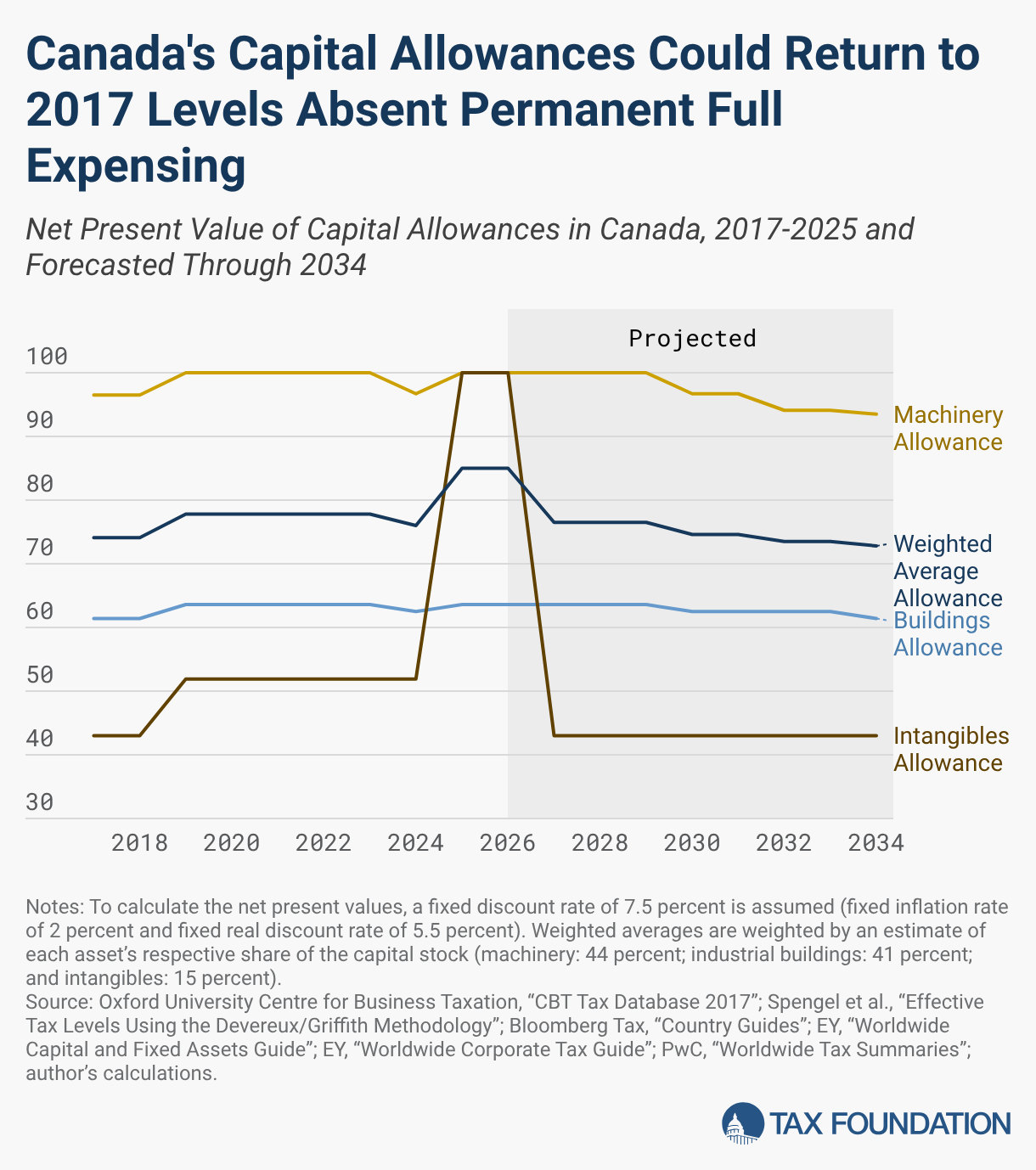
The rest of these policies are scheduled to phase out until they fully expire after 2033. Buildings used in manufacturing and processing will see their first-year write-off drop from 15 percent in 2025 to 10 percent in 2034; other nonresidential buildings will decrease from 9 percent to 6 percent. Without permanent full expensing, Canada’s deduction for equipment and machinery will decrease from 100 percent in 2025 to 93.5 percent in 2034, measured in net present value terms. Additionally, by the end of 2027, intangible assets will experience the second-lowest capital cost recovery in the OECD, at just 43 percent. Although Canadian businesses could deduct 85 percent of their capital investments across all asset types in 2025, this figure is projected to decline to 72.8 percent by 2034.
New Opportunity
Now, a second bill that would implement provisions from the 2025 budget is currently making its way through the Senate and is expected to introduce immediate expensing for manufacturing and processing buildings. If passed, temporary immediate expensing would apply to eligible buildings acquired on or after November 4, 2025.
Additionally, the government just launched public consultations ahead of the 2026 budget, providing an opportunity to permanently improve the climate for business investment.
The government should not only enact temporary full expensing for manufacturing and processing buildings, but also seize the opportunity in the 2026 budget to make immediate expensing for machinery and equipment a permanent feature of the tax system. Usually, the fiscal costs of accelerated depreciation peak in the first years of implementation and steeply decline thereafter, because accelerated depreciation schedules merely shift capital allowances forward in time once, without increasing their nominal value. This means that the peak fiscal costs of the provisions for the Canadian Treasury have already been incurred.
The Benefits of Permanent Full Expensing
Under the current policy, Canada has the 5th best capital cost recovery system in the OECD. However, Canada will drop to the 12th position in 2034 once all these provisions expire. To maintain its current position, Canada should follow the US’s lead, as it did after the 2017 TCJA, and make full expensing permanent.
In the United States, bonus depreciation, which was adopted in 2017, started phasing out in 2023. However, in 2025, full expensing was made permanent. According to Tax Foundation estimates, this provision will raise GDP in the long run by 0.6 percent and increase the stock of capital by 1 percent. Additionally, the US is temporarily providing 100 percent expensing for qualifying structures (covering close to 100 percent of all industrial buildings), with the beginning of construction occurring after Jan. 19, 2025, and before Jan. 1, 2029, and placed in service before Jan. 1, 2031. This represents roughly 10-15 percent of all buildings and structures in the US. These provisions temporarily gave the US the 3rd best capital cost recovery system in the OECD, up from its 2024 ranking of 21st.
While temporary measures, like the ones Canada has in place and plans to implement, may accelerate some investment decisions already planned, a permanent expansion of capital allowances would increase the level of investment overall and support economic growth over the long term. The macroeconomic benefits of these temporary policies will disappear as investment falls, melting the capital stock down to its previous level over time. At the same time, the peak fiscal costs have already been incurred by the Canadian Treasury.
Rather than adopt temporary policies that phase out and expire, Canada should focus its efforts on long-term reforms to support investment. Canada should aim to permanently provide immediate deductions for investments in machinery and equipment, and provide adjustments for inflationInflation is when the general price of goods and services increases across the economy, reducing the purchasing power of a currency and the value of certain assets. The same paycheck covers less goods, services, and bills. It is sometimes referred to as a “hidden tax,” as it leaves taxpayers less well-off due to higher costs and “bracket creep,” while increasing the government’s spendin and the time value of money for all other capital investments.
Stay informed on the tax policies impacting you.
Subscribe to our free newsletter to get the latest tax data, news and analysis.
Share this article