Canada cut air pollution despite more people, cars and energy
Canada cut air pollution despite more people, cars and energy
beng
EST. READ TIME 3 MIN.
Over the past 50 years, Canada’s population has grown from 23 million to more than 41 million people. The number of motor vehicles on our roads has more than doubled since 1975, from 11.3 million to 26.8 million. Concurrently, oil and gas production has reached record heights.
Considering these trends, one might reasonably expect our air pollution to have worsened. And in fact, a 2023 survey showed that seven out of 10 Canadians are concerned that outdoor air pollution is getting worse. But here’s the surprise—Canada’s air is now the cleanest it’s been in generations. Why? Largely because of reductions of smog-forming nitrogen dioxide pollution in three major areas: transportation, electricity generation, and oil and gas production.
Nitrogen dioxide (NO2) is an air pollutant with some of the most serious consequences for human health and the environment. For people, nitrogen dioxide can make breathing more difficult and can worsen or induce respiratory conditions. Prolonged exposure raises the risk of developing heart disease. Too much nitrogen dioxide can have negative consequences for the environment, too. Emissions can combine with other pollutants to create smog and acid rain.
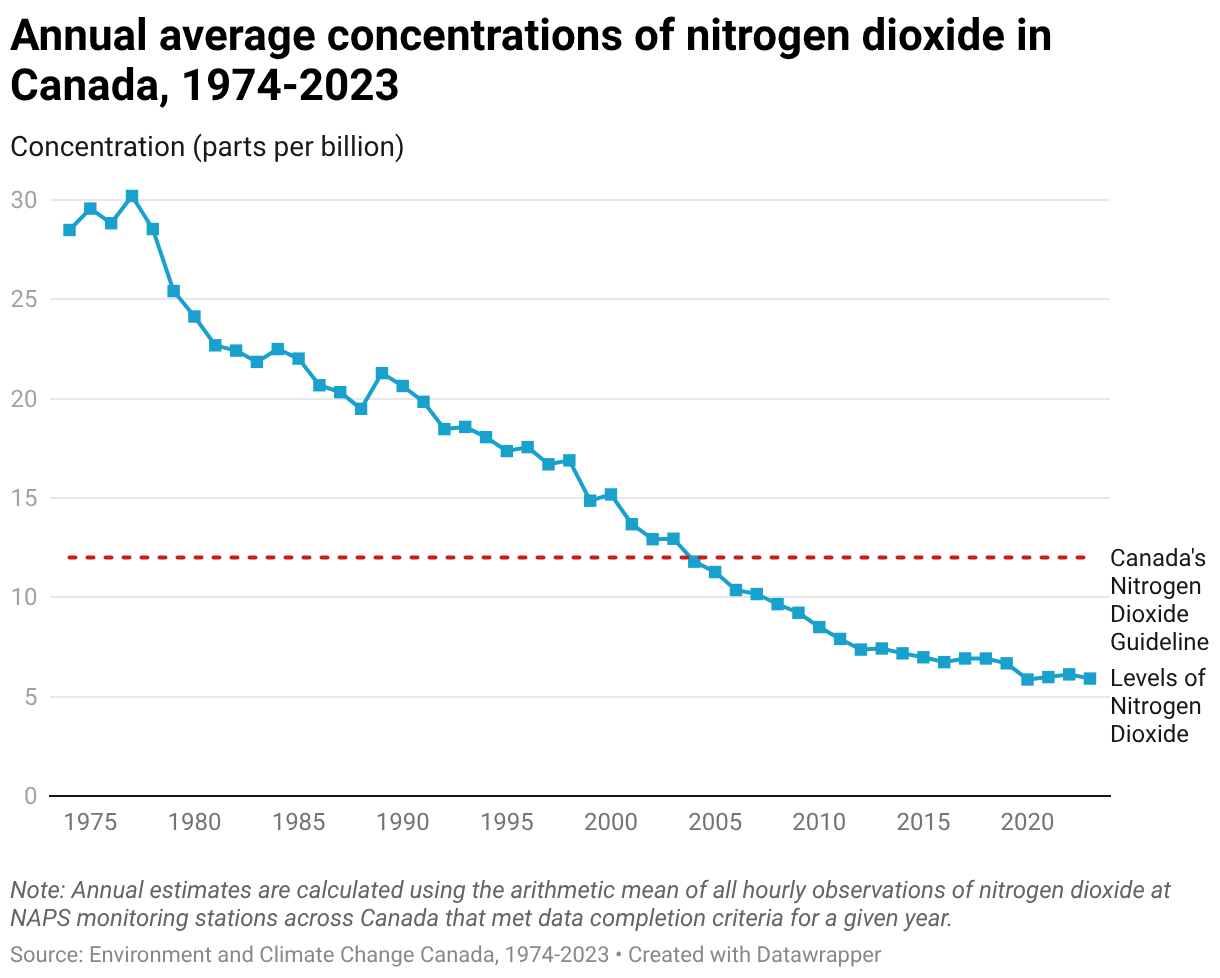
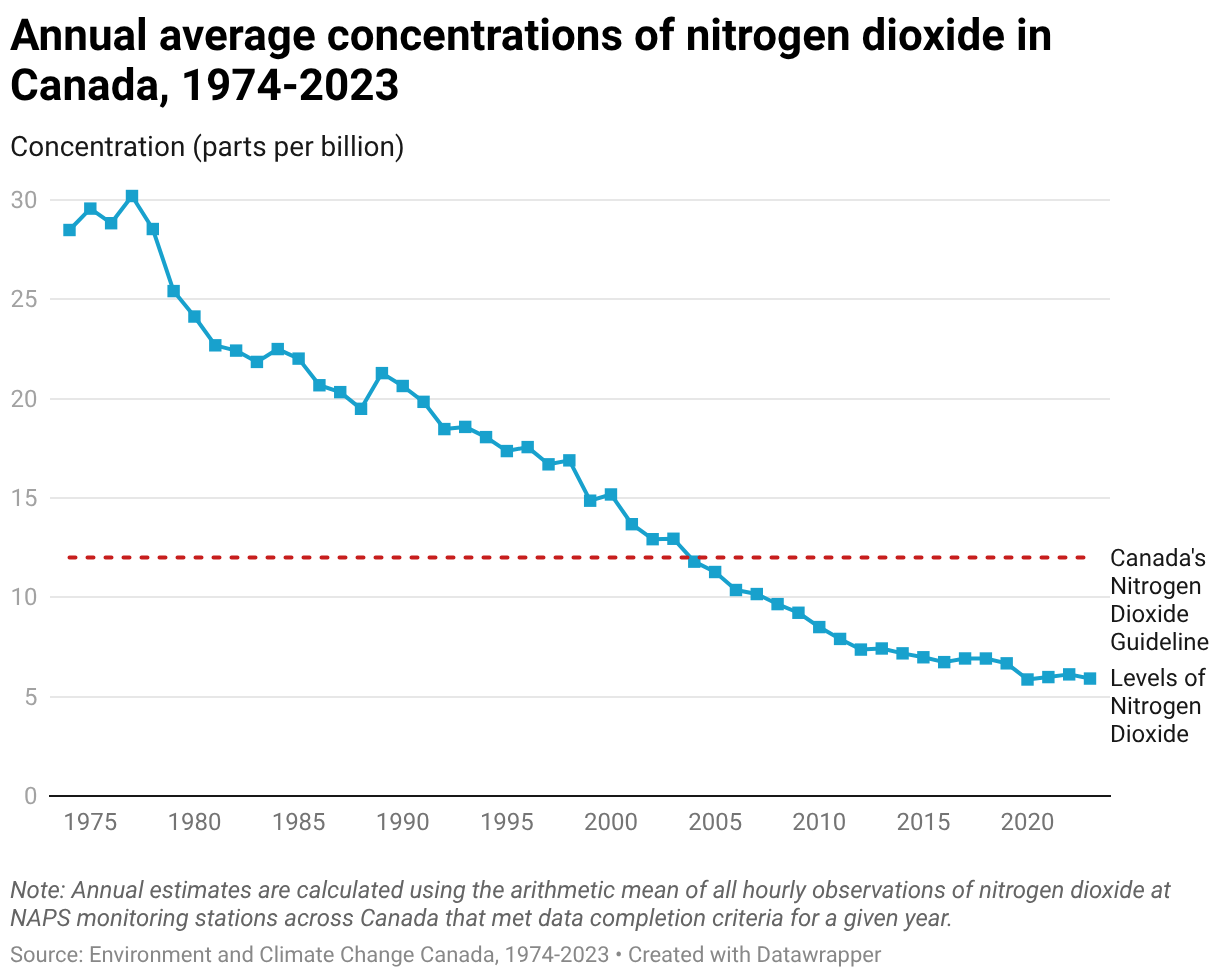
In decades past, uncontrolled nitrogen dioxide emissions resulted in air pollution levels much higher than we experience today. In 1976, the first year of available data, nitrogen dioxide levels in Canada were well in excess of double the current national guidelines. Between 1976 and 2023, as shown in the chart below, Canada’s national average levels of nitrogen dioxide fell by 79.5 per cent, meaning that average levels today are roughly one-fifth the average levels in the 1970s. Since 2004, average outdoor levels of nitrogen dioxide have consistently remained below the current Canadian health guidelines for air quality.
Motor vehicles have historically been the biggest source of nitrogen oxide pollution in Canada. When fuel is burned incompletely, gas and diesel cars emit nitrogen oxides into the air as a component of tailpipe exhaust. Between 1990 and 2023, nitrogen oxide emissions from transportation decreased by 71 per cent.
Transportation emissions fell mostly because of technological improvements in how cars and trucks operate. Catalytic converters, mandatory for Canadian vehicles since 1988, use precious metals such as platinum and palladium to convert nitrogen oxides and other pollutants into less harmful substances. Additionally, cars are generally more fuel efficient than in the past, meaning that less fuel is burned for each kilometre driven and less nitrogen oxide pollution is released.
Changes in how electricity is generated in Canada, including the shift toward lower-emission sources of electricity, along with improvements in pollution-control technology, have also helped reduce nitrogen emissions from the sector over time. As a result, emissions from electric power generation fell by 72 per cent between 2000 and 2023.
Even oil and gas, a sector often associated with nitrogen oxide releases, has made measurable strides in reducing emissions relative to output.
Oil and gas production requires equipment that produce nitrogen oxides as a byproduct. From 1999 to 2023, Canadian oil and gas production approximately doubled while nitrogen oxide pollution fell by 12 per cent. This means that less nitrogen oxide pollution is released per unit of oil and gas produced, reflecting changes in how oil and gas is produced. Better gas-flaring practices, along with improved burner and turbine technology, have helped lower nitrogen oxide emissions and reduce air pollution.
Canada has more people, more cars, produces more electricity, and exports more energy than ever before. Despite this, nitrogen oxide pollution has steadily fallen. The story of Canada’s air quality over the past several decades provides evidence that measurable environmental gains can be achieved alongside a growing population and economy.

By: and