Between the margins September 2026
jrdcyr

September 2026
Anthropic (probably) storms the gates

Executive summary
- They just keep getting larger: Investors expect Anthropic’s IPO to be the largest in history. Just three short months after SpaceX held the title.
- The market structure implications may not seem meaningful at first, but this is all part of the broader AI transformation in the U.S. economy and in U.S. markets.
- The more immediate question that may be on investors’ minds: Should they participate?
- Conventional wisdom says volatility may offer better prices in the wake of the IPO.
- Moreover, it’s not necessarily an open-and-shut case that Anthropic currently sells at an attractive valuation.
- And just because it’s the topic du jour: I think the Fed should hold. But it seems as though a hike is in the air.

Anthropic is coming for the public markets. Or so the evidence suggests. Expected in October, the Anthropic IPO is rumored to be the largest in history. Take a look at the relative size in our “Chart of the month.”
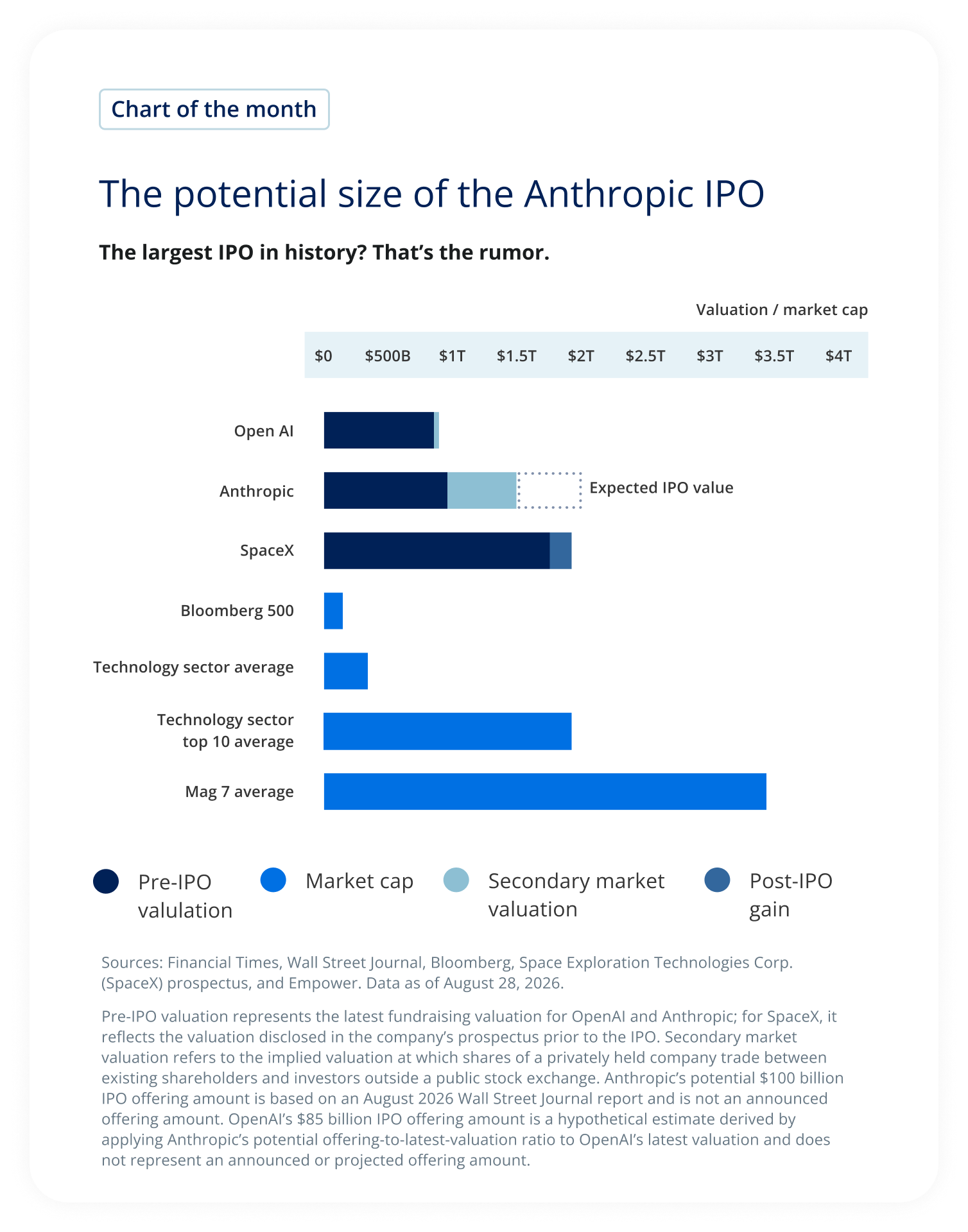
OpenAI’s pre-IPO valuation is shown at roughly $1 trillion, while SpaceX’s valuation is approximately $2 trillion after its post-IPO gain. For comparison, the Bloomberg 500 and average technology-sector company have substantially smaller market capitalizations. The average of the technology sector’s 10 largest companies is approximately $2 trillion, while the Magnificent 7 average is approximately $3.5 trillion.
The graphic notes that Anthropic’s potential $100 billion IPO offering amount is based on an August 2026 Wall Street Journal report and is not an announced offering amount. OpenAI’s hypothetical $85 billion offering amount is derived by applying Anthropic’s potential offering-to-valuation ratio to OpenAI’s latest valuation and likewise does not represent an announced or projected offering.
Key takeaway: If an Anthropic IPO occurs at the scale contemplated in the graphic, its valuation could place the company among some of the world’s largest technology companies and make the offering potentially historic in size.
The scale is daunting, but we’ve already had a dry run of this. When SpaceX went public on June 12, it was the largest IPO in history. (I guess in the AI era, those titles go fast.) And despite fears of trading stops, the day of was successful, with massive oversubscription and a 19% one-day pop, though it has since sold off to below its $135 IPO price.
What was most unusual about the SpaceX IPO, though, was the immediate impact it had on market structure. The 24-year-old company was added to marquee broad market indexes, including the Nasdaq 100 Index, in the days and weeks following its IPO. If insiders sell shares as lockups expire, we could see that weight grow meaningfully, allowing the company to have a greater influence on index price performance far earlier in its public life than other IPOs. (On that note: Meta and Alphabet were not added to the Nasdaq 100 until they had been public for seven and 16 months, respectively.)
Should we expect the same with Anthropic? At only five-plus years old, Anthropic perhaps doesn’t have the retail name recognition of SpaceX, or its CEO Elon Musk’s brand appeal (depending on your perspective). It does, however, sit at the very heart of the AI trade while boasting an eye-popping revenue growth rate. As a result, many expect equal or greater hype to the SpaceX phenomenon, potentially leading to a similar oversubscription and day-of pop despite what many may very well consider an exorbitant valuation.
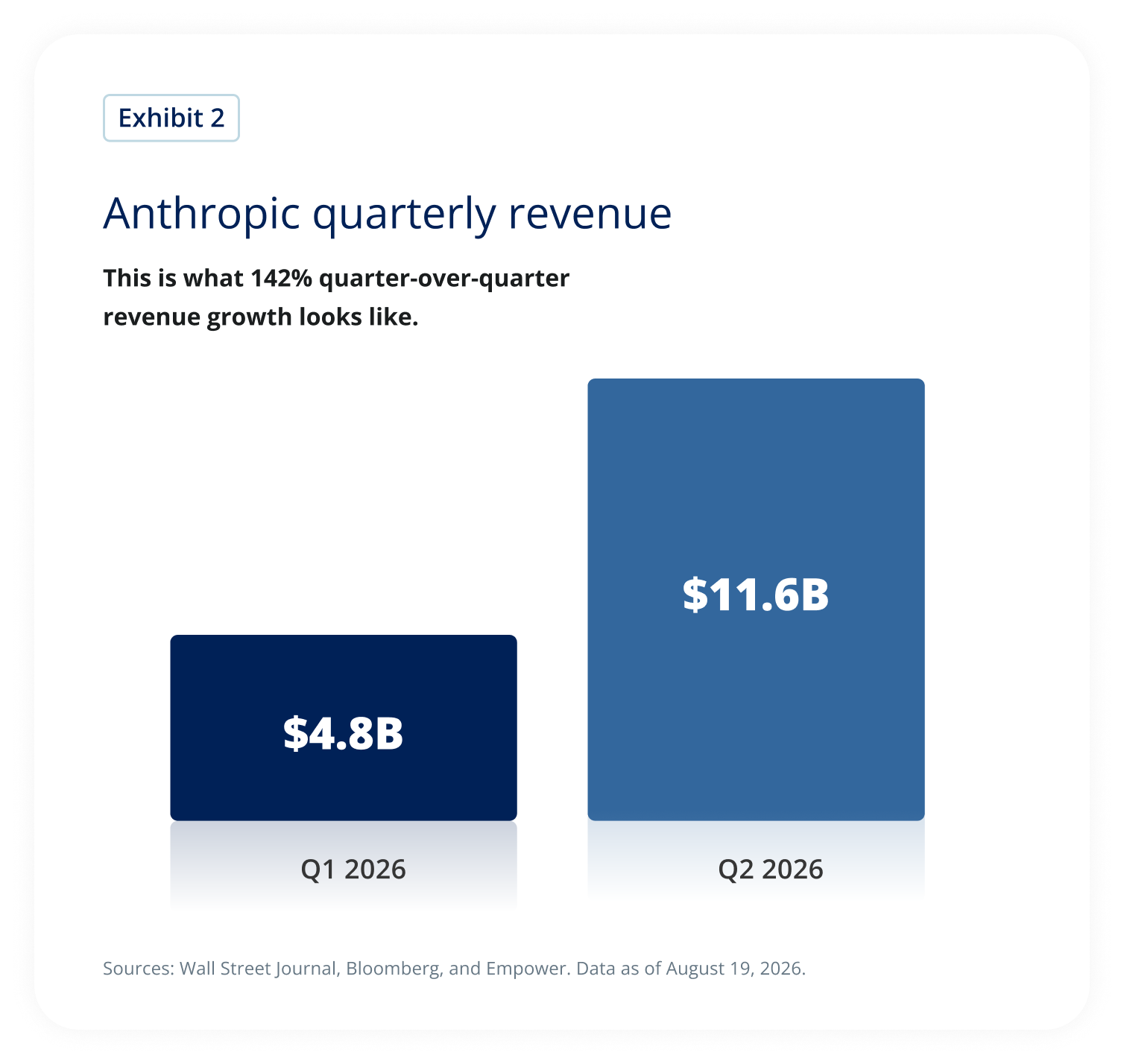
This represents 142% quarter-over-quarter revenue growth, meaning second-quarter revenue was more than twice the level reported for the first quarter.
Key takeaway: Anthropic experienced exceptionally rapid revenue growth between the first two quarters of 2026, with quarterly revenue increasing by $6.8 billion.
I think we could see Anthropic make its way into key indexes as well. Russell, the Nasdaq 100, and even the S&P Global changed their index rules to allow SpaceX in the mix (though the S&P 500® Index did not give SpaceX the fast track). That leaves the door open at many of these indexes for Anthropic and OpenAI, which also has IPO plans.
Near term, Anthropic — and potentially OpenAI — will likely have smaller index weights, similar to those of SpaceX. But don’t let early marginal allocations distract from the long-term impact: These IPOs, alongside the broader push by Big Tech and corporate America into AI, are remaking the U.S. market and the U.S. economy.
You get a sense of it here, through the Bloomberg Artificial Intelligence Index. The U.S. makes up roughly 80% of this global index; at just under 6% each, South Korea and Taiwan are distant seconds.
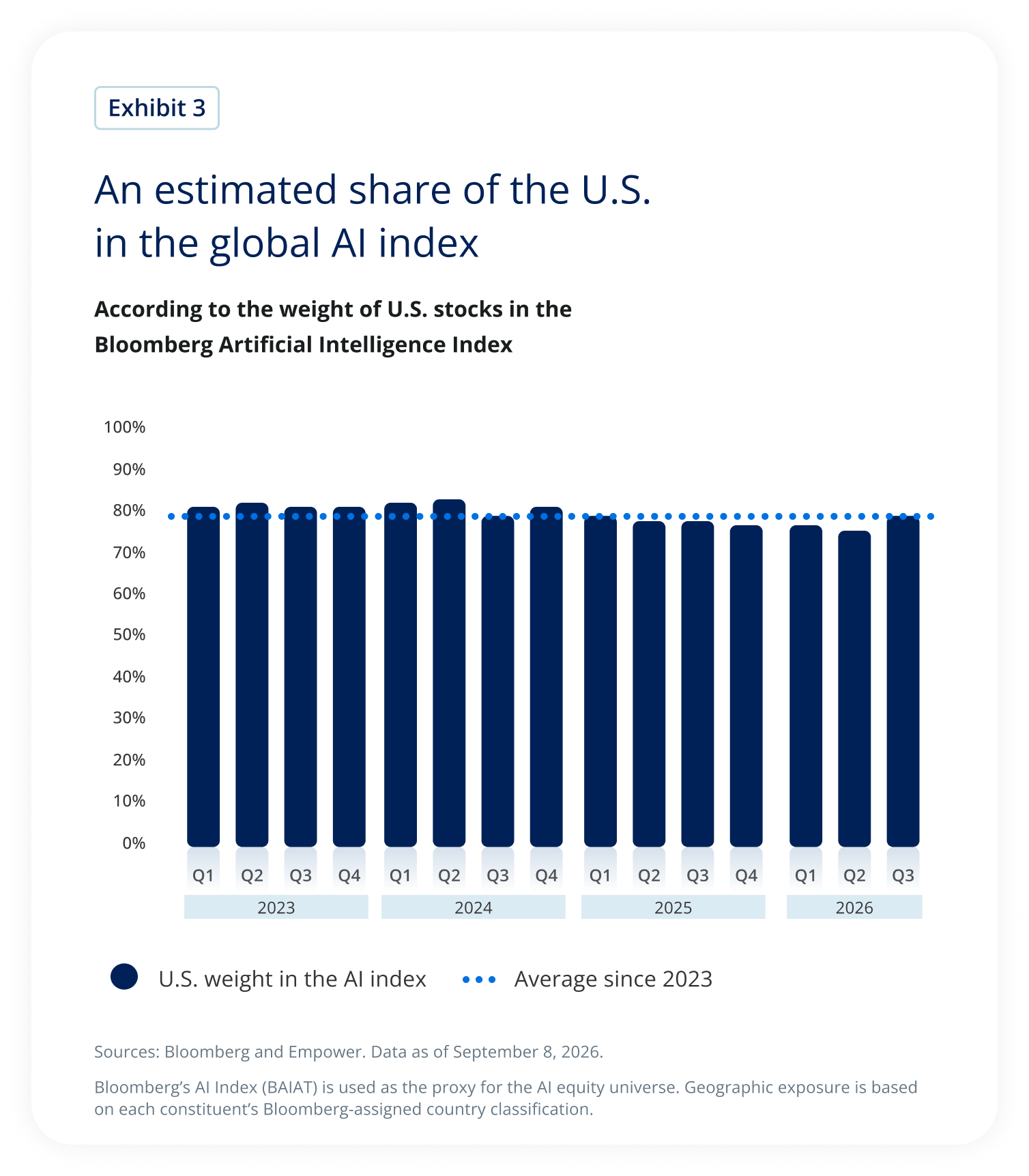
U.S. stocks account for roughly 75% to 82% of the index throughout the period, with an average of approximately 79% since 2023. The U.S. share generally remained near or above the average during 2023 and 2024, before declining modestly during portions of 2025 and the first half of 2026. By the third quarter of 2026, the U.S. share had returned to approximately the long-term average.
Key takeaway: U.S. companies have consistently represented the large majority of the Bloomberg Artificial Intelligence Index since 2023, illustrating the significant concentration of the global AI equity universe in U.S. stocks.
But even more interesting is the revenue share in the Bloomberg 500 Index related to AI. We’ve seen that climb from a quarterly $600 billion in Q1 2023 to more than $1 trillion each quarter for Q2 2026. And given expectations for future adoption, that may pale in comparison to where it stands in a few more years.
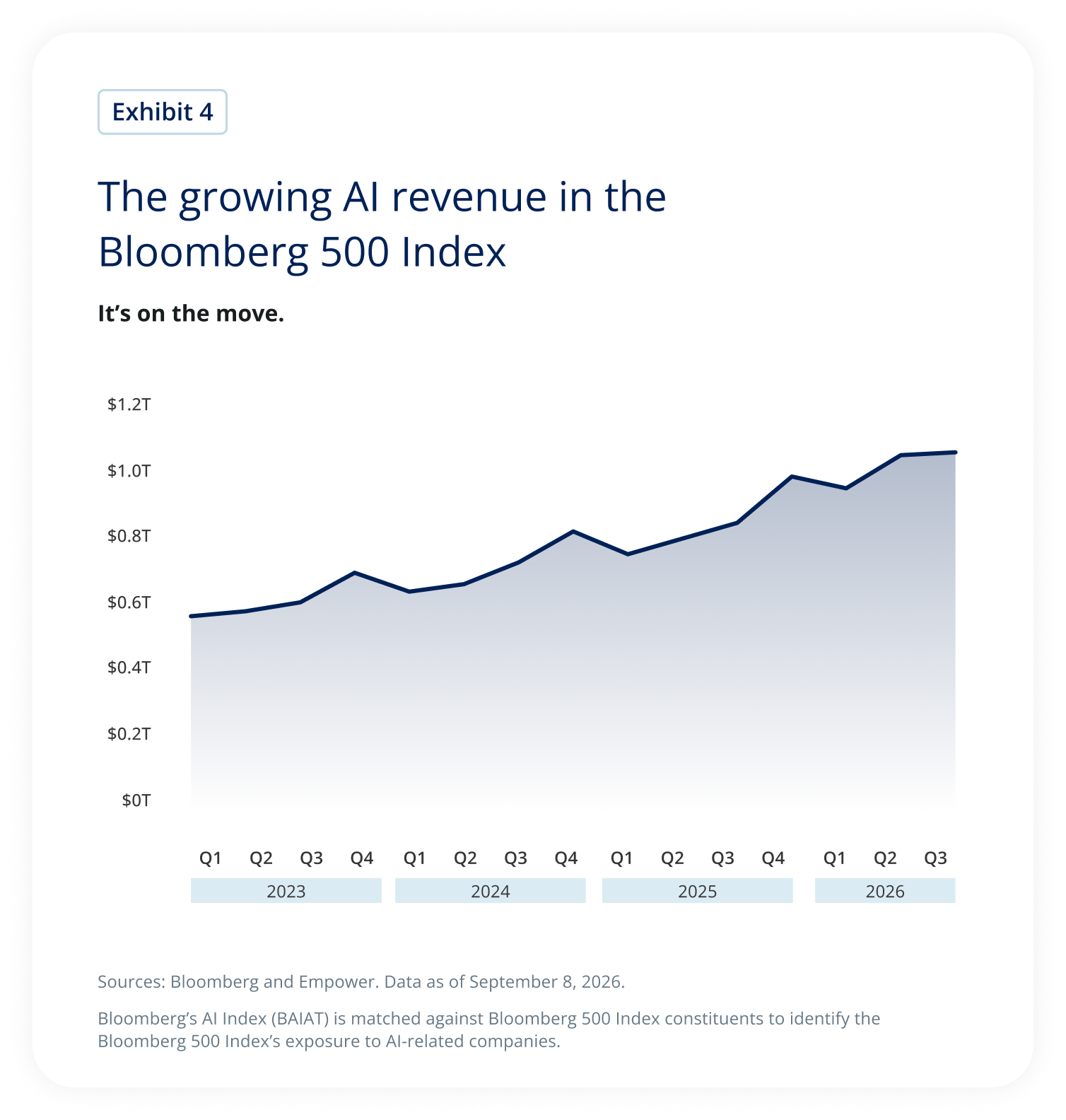
Estimated AI-related revenue begins at approximately $560 billion in Q1 2023 and generally trends upward over the period. Revenue reaches roughly $690 billion by Q4 2023, declines modestly in early 2024, and then resumes its upward trend, reaching approximately $810 billion by Q4 2024.
Growth continues through 2025, with revenue approaching $1 trillion by Q4 2025. After a modest decline in Q1 2026, estimated revenue rises above $1 trillion in Q2 2026 and remains slightly above that level in Q3.
Key takeaway: Estimated AI-related revenue within the Bloomberg 500 has grown substantially since 2023, increasing from roughly $560 billion to more than $1 trillion by the third quarter of 2026 despite several quarter-to-quarter declines.
So. Is this good or bad? As an AI bull, I think it’s critical that the U.S. ride AI technology to what I expect will be improved productivity and greater innovation. But there’s no question that as the AI trade consumes an ever-greater proportion of the U.S. equity market, diversification becomes increasingly rare and increasingly valuable — particularly given the likelihood of AI setbacks. This is one of the reasons I think U.S. investors benefit from taking a global approach to their portfolios rather than focusing myopically on the U.S.
But perhaps my existential questions on the future of the U.S. market structure resonate less than the most common question that comes up when talk turns to the Anthropic IPO: Should investors participate?
I’ll admit, I’m agnostic. Conventional wisdom suggests there’s no rush with IPOs. Plenty of research points to above-average volatility for newly public companies in the months following their IPOs, which gives investors ample opportunity to buy in at better prices. That said, it’s worth noting that many of the biggest names in tech today had very strong months and years following their IPOs, making their original IPO prices look reasonable by comparison.
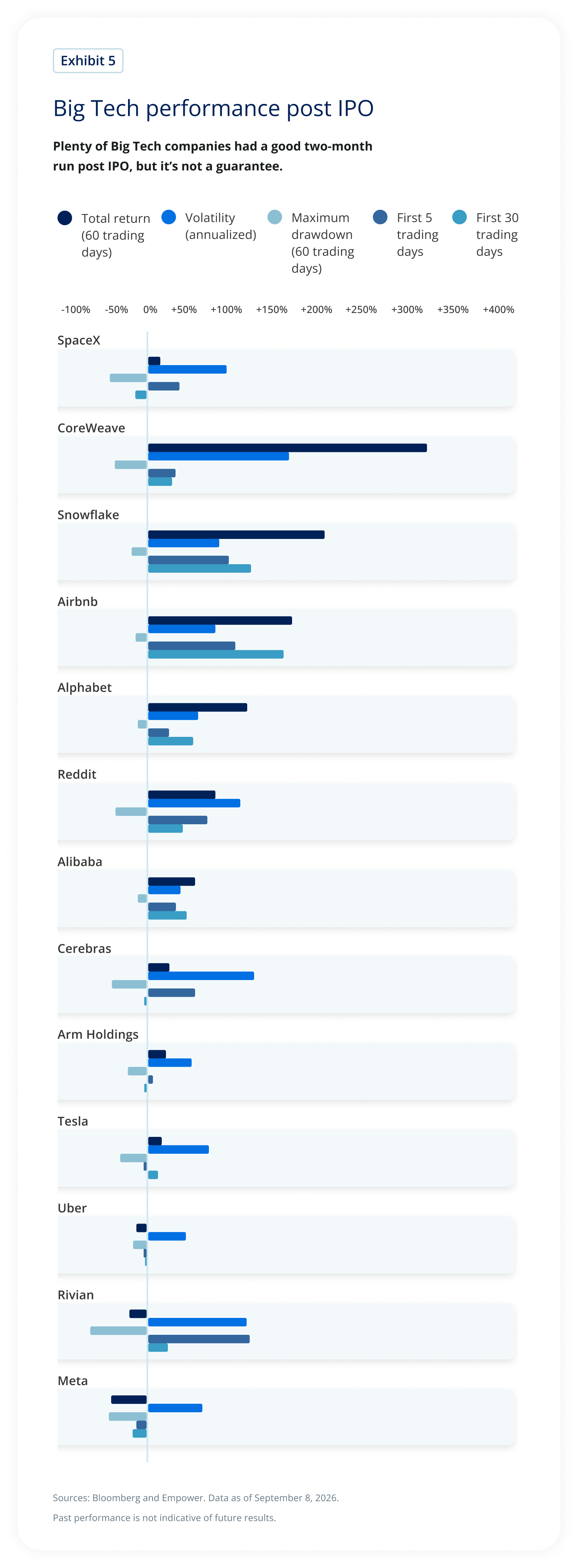
Results vary substantially. CoreWeave shows the strongest 60-day total return at more than 300%, followed by Snowflake at roughly 200% and Airbnb at roughly 160%. Alphabet, Reddit, Alibaba, Cerebras, Arm Holdings, Tesla, and SpaceX show smaller positive 60-day returns.
Uber, Rivian, and Meta show negative 60-day total returns, demonstrating that a successful early trading period is not universal among prominent technology IPOs.
Maximum drawdowns also vary considerably. Several companies experienced meaningful declines during their first 60 trading days even when their overall 60-day returns were positive. Returns during the first 5 and 30 trading days likewise differ substantially, showing that early IPO performance can change quickly over a relatively short period.
Key takeaway: Many prominent technology companies produced positive returns during their first two months as public companies, and some generated exceptionally large gains, but performance varied widely and positive post-IPO returns were not guaranteed.
Really, it comes down to fundamentals and where prices sit relative to their future trajectory. My colleague, Empower Portfolio Strategist Tom Nun, did a back-of-the-envelope calculation here. And surprise, surprise: The growth would have to be pretty tremendous to make expected IPO values make sense.
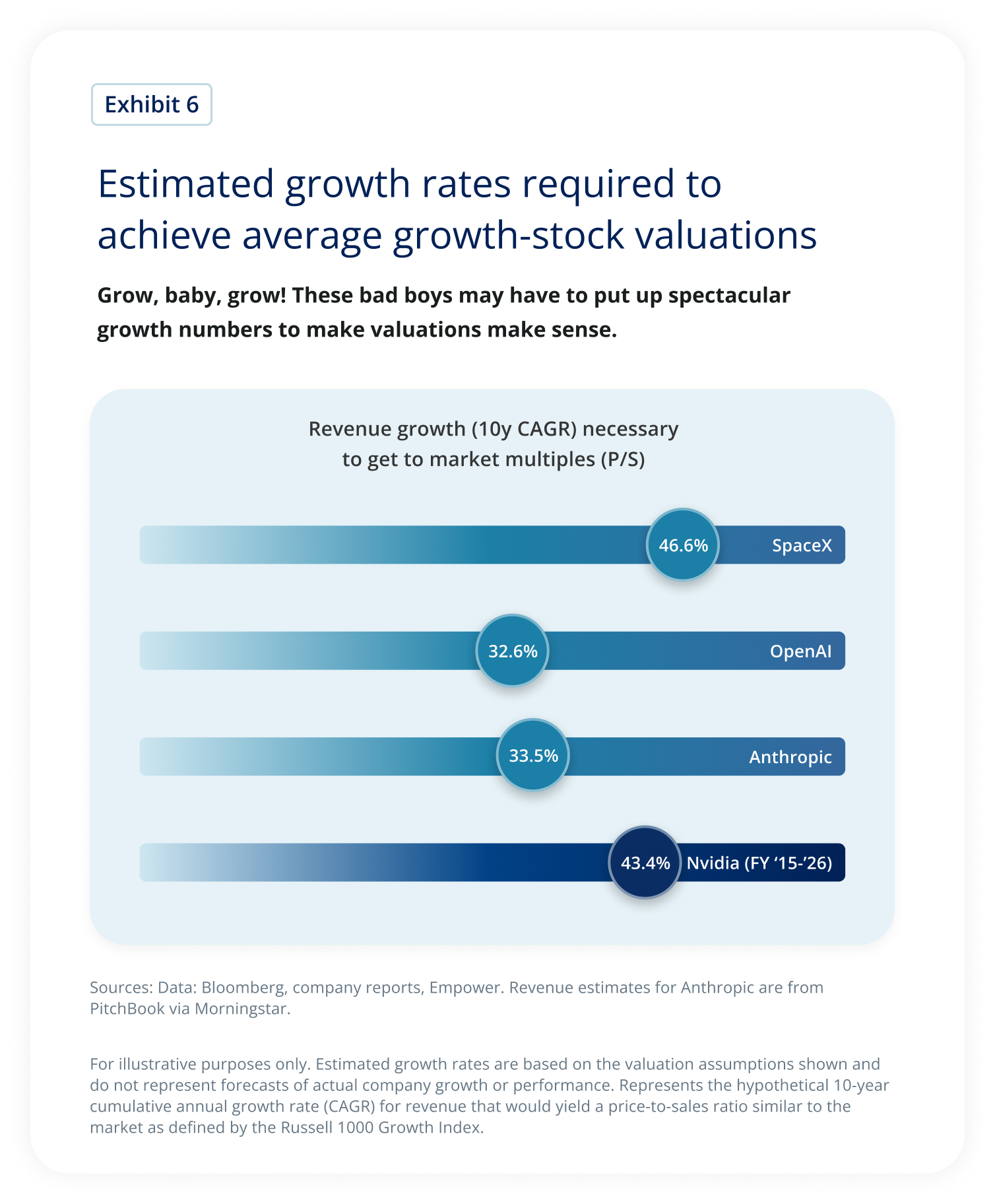
SpaceX has the highest estimated required growth rate at 46.6% annually. Nvidia’s historical fiscal-year 2015–2026 growth rate is shown at 43.4%. Anthropic would require estimated annual revenue growth of 33.5%, while OpenAI would require 32.6%.
These figures represent hypothetical 10-year compound annual growth rates based on the valuation assumptions used in the analysis. They are illustrative and do not represent forecasts of actual company growth or performance.
Key takeaway: Under the assumptions used in the analysis, the valuations shown for SpaceX, OpenAI, and Anthropic would require exceptionally high sustained revenue growth over a decade to decline to price-to-sales multiples comparable with the broader growth-stock market. Nvidia’s historical growth rate is included as a reference point for the scale of growth contemplated.
Impossible? No. As demonstrated, Nvidia pulled it off. And this is the AI-growth era. Still, when we’re looking at the uncertainty that faces any given company amid this technological transformation, I favor a valuation discount. At least by this analysis, it’s not entirely clear that’s what Anthropic will offer out of the gate.
Make of that what you will.
Looking forward
So this whole Anthropic thing may go down in October. More immediately, we’ve got the Federal Reserve meeting, which has apparently a 90% chance of a hike. Sigh. I’ll be real: I’m sick of talking about yields. Hence the Anthropic topic. But here’s my two cents (worth a lot less after all this inflation): I don’t love the idea of a hike. I don’t think we’re looking at demand-driven inflation! However, I’m not on the Fed, or even on the Fed’s speed dial. So what I’d do is of no consequence. And increasingly, I feel like a hike is in the air, particularly as energy prices go from a supply shock to a state of semi-permanence with the Iran conflict continuing indefinitely. And, my word, but Fed Chair Warsh’s Jackson Hole address felt like forward guidance (IYKYK). So. Let’s hold our collective breath tomorrow.
|
Our mission is to empower financial freedom for all
Empower is a customer-obsessed financial services company delivering investment, wealth management, and retirement services to more than 20M people.1
The following tenets guide the development and management of products and solutions we provide to the investors we serve:
Commit to an unwavering duty of care
Our investors are our priority. We steward every dollar we invest with care, attention, and respect.
Emphasize fundamental analysis
We keep our eyes on the horizon by rooting our analysis in the underlying drivers of long-term investment returns, not fleeting news and noise.
Plan for better outcomes through thoughtful diversification
We build resilient portfolios by relying on thoughtful diversification that plans for a range of outcomes, rather than a narrow result.
|
Explore previous editions
|
Stay up to date |
1 As of June 31, 2026.
Securities, when presented, are offered and/or distributed by Empower Financial Services, Inc., Member FINRA/SIPC. EFSI is an affiliate of Empower Retirement, LLC; Empower Funds, Inc.; and registered investment adviser Empower Advisory Group, LLC. This material is for informational purposes only and is not intended to provide investment, legal, or tax recommendations or advice.
“EMPOWER” and all associated logos and product names are trademarks of Empower Annuity Insurance Company of America.
©2026 Empower Annuity Insurance Company of America. All rights reserved.
INV-WMLPNV-WF-7019900-0926 RO5916513-0926
The content contained in this blog post is intended for general informational purposes only and is not meant to constitute legal, tax, accounting or investment advice. You should consult a qualified legal or tax professional regarding your specific situation. No part of this blog, nor the links contained therein is a solicitation or offer to sell securities. Compensation for freelance contributions not to exceed $1,250. Third-party data is obtained from sources believed to be reliable; however, Empower cannot guarantee the accuracy, timeliness, completeness or fitness of this data for any particular purpose. Third-party links are provided solely as a convenience and do not imply an affiliation, endorsement or approval by Empower of the contents on such third-party websites. This article is based on current events, research, and developments at the time of publication, which may change over time.
Certain sections of this blog may contain forward-looking statements that are based on our reasonable expectations, estimates, projections and assumptions. Past performance is not a guarantee of future return, nor is it indicative of future performance. Investing involves risk. The value of your investment will fluctuate and you may lose money.
Certified Financial Planner Board of Standards Inc. (CFP Board) owns the certification marks CFP®, CERTIFIED FINANCIAL PLANNER™, CFP® (with plaque design), and CFP® (with flame design) in the U.S., which it authorizes use of by individuals who successfully complete CFP Board’s initial and ongoing certification requirements.