Action Figures and the Balance of Payments
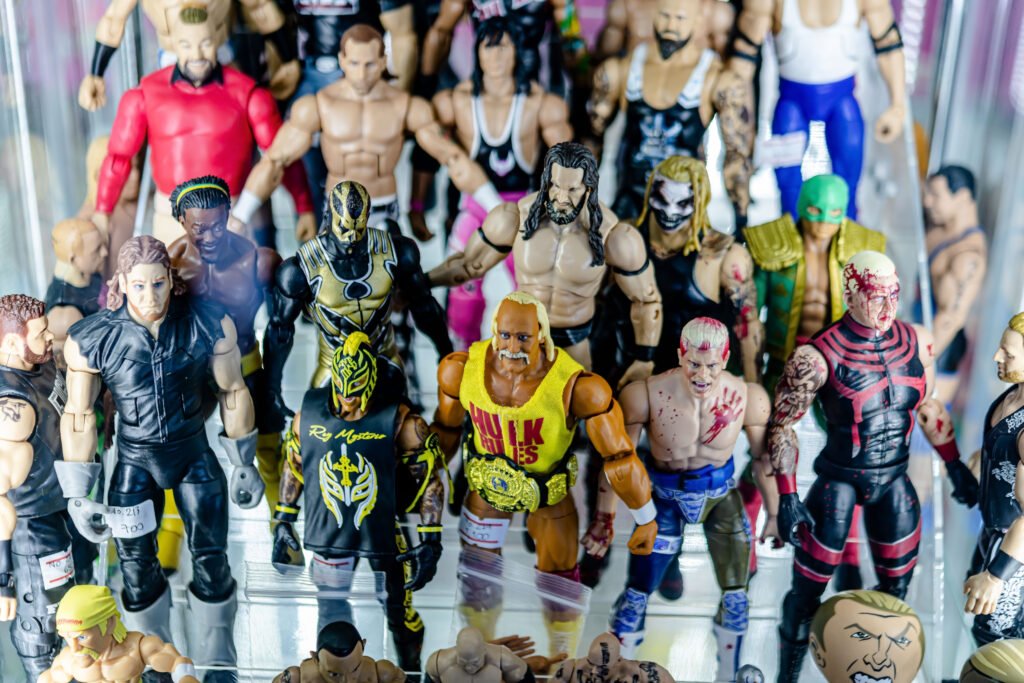
In their textbook, Modern Principles of Economics, Tyler Cowen and Alex Tabarrok ask what happens when Walmart buys toys from a Chinese supplier. I decided to test this once by going to my local Walmart and buying an action figure of All Elite Wrestling’s Brody King, which is part of the Jazwares “Unrivaled” collection and a Walmart exclusive. After tax, the figure cost me $21.82. The figure was manufactured in China for a company (Jazwares) based in Florida, represents an athlete who lives in Georgia and works for a company also based in Florida, and was purchased (and taxed) in Alabama. There is value added at every stage and by people around the world, but let’s focus strictly on the share of the figure that goes to the Chinese manufacturer.
What does the manufacturer do with the dollars he earns by selling me (via Jazwares and Walmart) a wrestling figure? He wants the dollars for dollar-denominated transactions. First, he might want to buy American goods and services. In the Chinese context, one of the services they seek to purchase is American higher education. Second, he might want to invest in the United States by (for example) buying new bonds issued by American corporations. Third, he might want to lend to the U.S. government by purchasing new Treasury bonds. In both cases, he might also want to purchase dollar-denominated assets, such as existing stocks and bonds. Fourth, he might want to increase his dollar reserves for several reasons. The US dollar is the world’s reserve currency; it is famously stable and widely used for transactions in the United States.
Fifth and finally, the Chinese manufacturer might want to sell the dollars to someone who wants to do any of these things.
How does the transaction affect the balance of payments? The trade deficit widens because we imported the figure. That receives considerable attention, but I think the attention the trade deficit receives is overstated. In the long run, countries pay for their imports with their exports. Additionally, the dollars “come back” to the United States as foreign direct investment. The current account deficit (the trade balance) is identical to the capital account surplus.
In the run-up to the 2024 election, many people claimed that, in “Econ 101,” GDP goes down when imports increase because the last part of the GDP equation is Net Exports (exports – imports). This demonstrates a failure to understand precisely what GDP measures and why net exports appear at the end of the equation. Gross Domestic Product is a measure of the economy’s total value added, and measuring value added is pretty complicated in a global economy where almost everything we buy has “value added” somewhere other than the United States, and many things people in foreign countries buy reflect value that was added in the United States. “Net exports” reflect this fact: “exports” represent the value added here (design, for example), and “imports” nets out the value added elsewhere.
The implication: higher imports don’t reduce GDP. Many people in many places contributed to my new Brody King figure, not the least of whom is Brody King himself, who earns royalties from the use of his likeness. The $21.82 transaction includes the value added by the staff at my local Walmart, Walmart’s Bentonville, Arkansas-based executives, the person who drove the truck from the distribution center to the store, the people (likely US-based) who designed the figure, and the executive acumen of AEW CEO Tony Khan. Part of the value added—actually forming and packaging the figure—happened in China. The purchase shows up in the national income accounts as a consumption expenditure with part of the $21.82 including the value that was added in China. GDP increases as a result of the purchase, but part of the transaction is netted out to reflect value added elsewhere.
A skeptic might ask, “But wouldn’t it be better if the figure had been made in America by Americans?” Maybe, but there’s a reason countries trade with one another: comparative advantage. It’s very expensive to manufacture in the United States compared to China and elsewhere, and I was barely willing to pay $21.82 for it, since I had decided to purchase a figure specifically to write this article and prepare for my final class meeting of the semester. If the price had been $30, I definitely would have passed. Yes, the fraction of value added in the United States would rise, but there would be less value created to enjoy.
In summaries and discussions of the balance of payments, economists offering public commentary have pointed out that there is probably no more misunderstood economic statistic than the trade balance. “Deficit,” Daniel Klein and Donald Boudreaux remind us, has negative valence and “surplus” has positive valence. However, the emotional reactions are misleading. Imports do not hurt us, and foreigners are our friends. Every transaction tells us so.