6 Things to Know About Ozempic and Vision Loss Before Your Next Dose
“Ozempic blindness.” If you’ve spent any time online lately, you’ve likely seen that phrase — usually in giant letters, stamped over a photo of somebody clutching their eyes in horror.
And if you’re one of the tens of millions taking Ozempic, Wegovy, Mounjaro or Zepbound, a headline like that is enough to make your stomach drop.
Here’s what I’ve learned in 35 years of watching these panics come and go: Scary headlines are built to grab you, not to inform you. The truth is almost always more complicated — and usually a lot less terrifying.
A new study just poured gas on the fire. So let’s do what the headlines won’t: separate what the research actually shows from what the internet wants you to believe.
1. The scare started with a real study — and real numbers
This didn’t come out of thin air. In July 2024, researchers at Harvard’s Mass Eye and Ear published a study in the journal JAMA Ophthalmology that lit the fuse.
They found that people with diabetes taking semaglutide — the active ingredient in Ozempic and Wegovy — were more than four times as likely to be diagnosed with a rare eye condition called NAION (nonarteritic anterior ischemic optic neuropathy). For those taking it to lose weight, the risk ran more than seven times higher.
Four times. Seven times. Those numbers got quoted everywhere, and I get why. They sound terrifying.
But a multiplier only tells you half the story. Four times a tiny number is still a tiny number. Hold that thought.
2. A brand-new study just landed — and it made headlines
The latest fuel comes from Rutgers University. In July 2026, its researchers published a study in Annals of Internal Medicine, funded by the National Institutes of Health.
They combed through insurance records for U.S. adults aged 18 to 65 with type 2 diabetes. People who started a GLP-1 drug had a slightly higher risk of ischemic optic neuropathy than those who started other diabetes medications.
How much higher? Roughly three to four extra cases per 10,000 people over 18 months. Lead researcher Chintan Dave said patients and doctors “should be aware of this potential association.”
And don’t assume this is an Ozempic-only problem. Semaglutide has been studied the most, but newer research is pointing at the whole GLP-1 family — including tirzepatide, the drug in Mounjaro and Zepbound.
One more detail worth knowing: Most of the people affected were men or folks between 50 and 65. And the researchers cautioned the link might reflect patients’ underlying health, not the drug itself.
3. ‘Vision loss’ doesn’t mean what you probably think
When you hear “vision loss,” you picture total darkness. That’s not what we’re talking about here.
More than 4 out of 5 of these cases are a type called nonarteritic anterior ischemic optic neuropathy. In plain English, that usually means blurring, dimming or a lost patch in the visual field of one eye.
It’s often permanent, though about a third of patients get some improvement within six months. Serious? Absolutely. But “going blind from Ozempic” oversells it by a mile.
Quick aside — most internet financial advice comes from people who weren’t alive during the last recession. I’ve been writing about money for more than 35 years. Want rock-solid advice? Sign up for the free Money Talks Newsletter. Takes 10 seconds. No fluff. No spam.
4. The absolute risk is genuinely tiny
Let’s go back to that “hold that thought” from earlier. In the Rutgers study, this eye condition showed up in fewer than 1 in 1,000 people — across every group, including those not taking a GLP-1 at all.
These drugs also do a lot of good. They help people lose weight, control blood sugar, and lower the risk of heart and kidney disease. That’s not nothing.
So this becomes a math problem, not a horror movie. A very small added risk on one side; real, documented benefits on the other. That’s a conversation for you and your doctor — not a reason to panic-quit.
5. Some of the research is actually reassuring
Here’s the part the scary headlines almost always leave out: Not every study points the same direction.
An analysis published in JAMA Ophthalmology in August 2025 found semaglutide wasn’t tied to a higher risk of many general eye disorders and diabetic retinopathy. And a Cleveland Clinic study found people who took a GLP-1 for five years had a sharply lower risk of dry macular degeneration than those on metformin.
Even Novo Nordisk, which makes Ozempic and Wegovy, calls NAION a very rare eye disease and says its own trial data doesn’t show the drug causes it.
The honest takeaway? The science is still mixed. Anyone selling you certainty in either direction is selling you something.
6. What to actually do about it
If you’re taking one of these drugs, don’t stop cold turkey because a headline spooked you. Talk to your doctor first — especially if you’re a man over 50 or you’ve had eye or blood-vessel problems before.
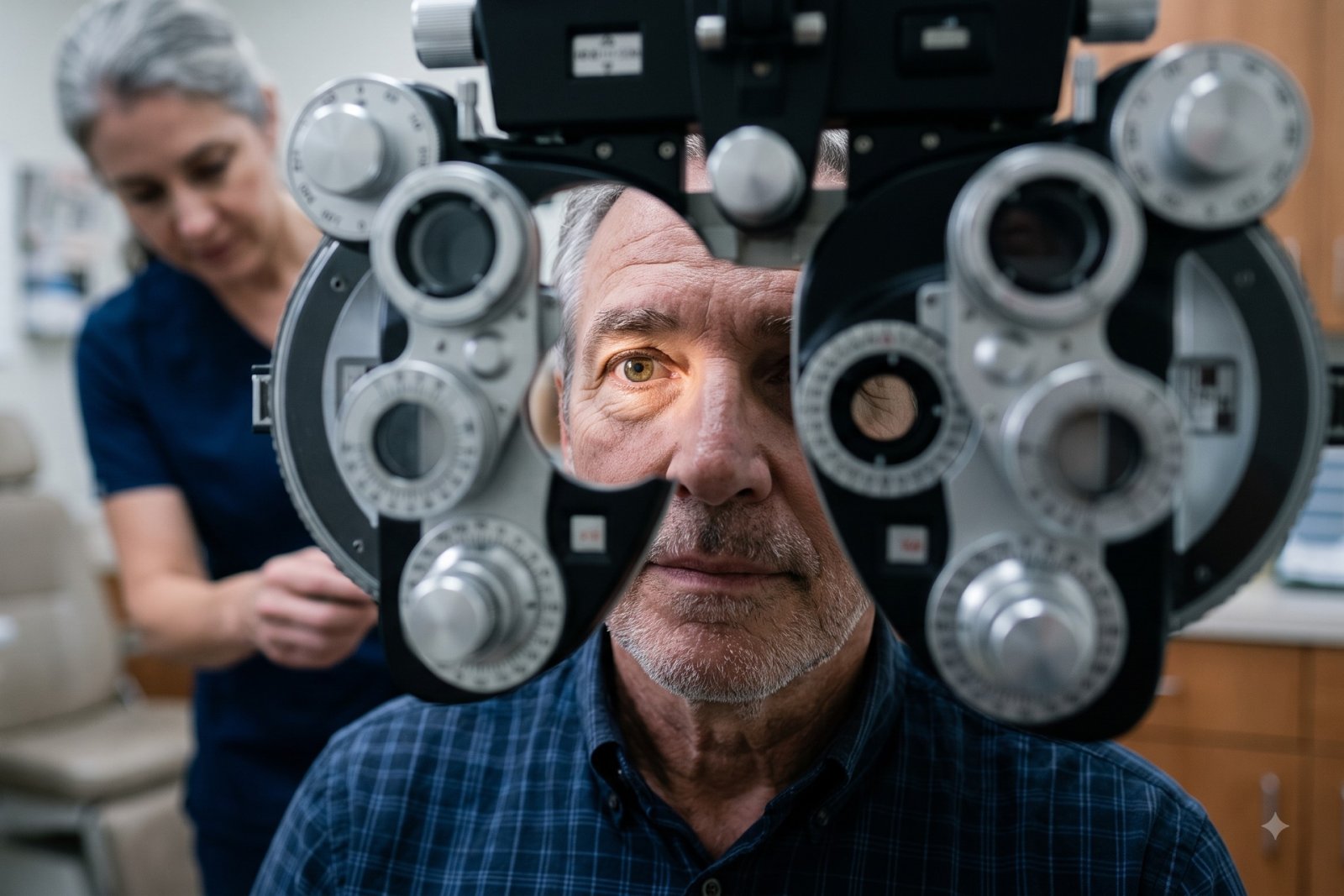
Ask about a baseline eye exam so you’ve got something to compare against. And learn the one warning sign that matters most: sudden changes in one eye. If that happens, call an eye doctor right away.
Cost may be part of your decision too, and that’s fair. These drugs can run more than $1,000 a month, and Medicare’s rules about covering them are a maze of their own.
Those rules have shifted yet again this year, so it’s worth knowing where you stand before you’re standing at the pharmacy counter.
It’s the kind of fine print people wish they’d sorted out before signing up. And if sticker shock is weighing on you, some folks lean on discount drug websites to soften the hit.
Look, I’m not here to tell you these drugs are perfectly safe. And I’m not here to scare you off them, either.
I’m here to tell you the truth: The risk to your eyes is real but small, and the benefits are real and often large. The right call depends on you and your doctor, not on a headline screaming for your click.
So read past the panic, ask good questions, and keep your eyes — and your judgment — wide open.