Power 4 Conference Programs Dominate College Football’s Preseason Top 25

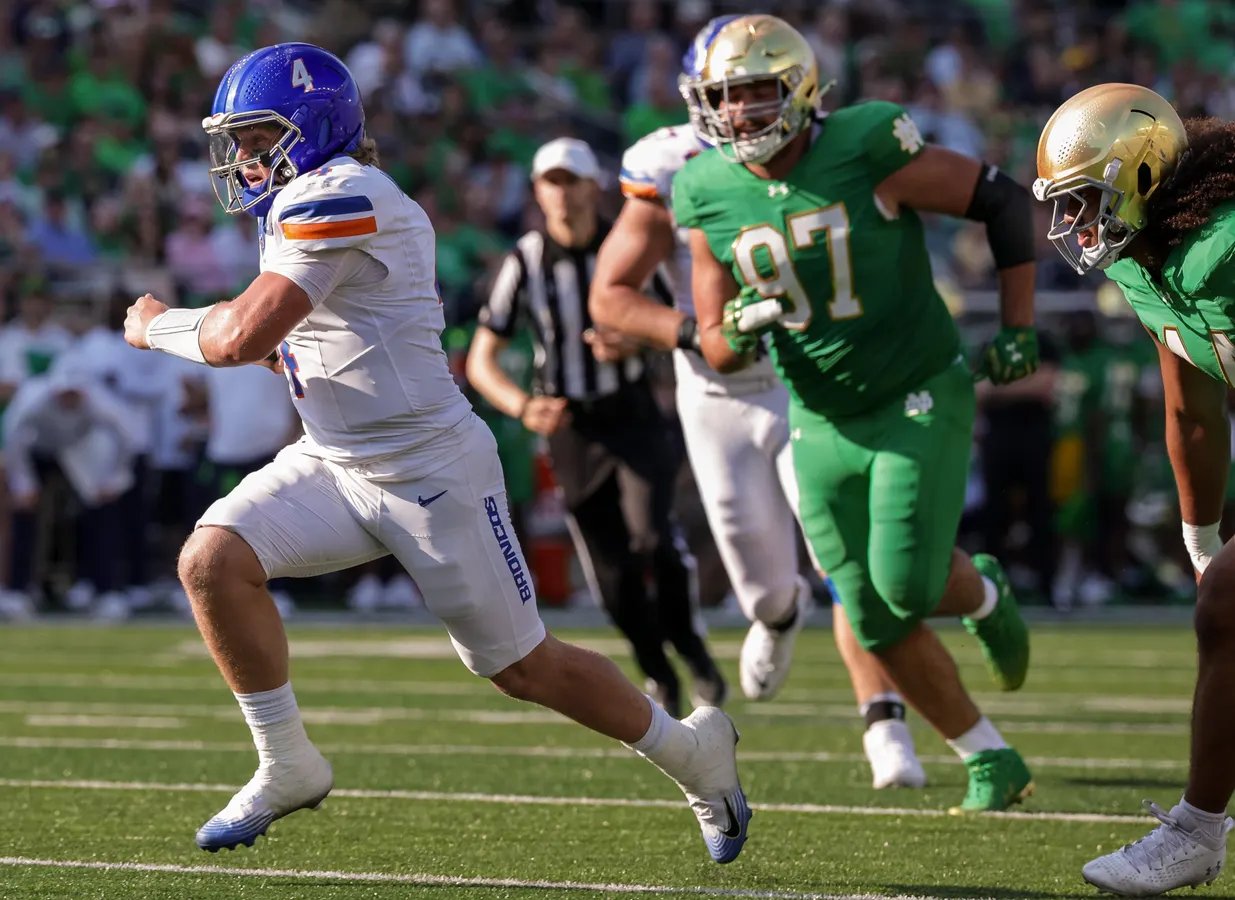
SOUTH BEND, INDIANA – OCTOBER 4: Maddux Madsen #4 of the Boise State Broncos runs the ball during the NCAA game between the Notre Dame Fighting Irish and the Boise State Broncos at Notre Dame Stadium on October 4, 2025 in South Bend, Indiana. (Photo by Michael Hickey/Getty Images)
Getty Images
If the past few years have taught college football fans anything, it’s that the gap between teams from major conferences and lower-tier leagues remains wider than ever. There is not only a major difference in revenue sharing and Name, Image and Likeness spending. Schools from the major conferences also sign most of the best players from lower-tier leagues via the transfer portal, leading to a significant disparity between the haves and have-nots.
The preseason poll from the American Football Coaches Association shows the discrepancy. Of the 25 ranked teams, 24 are from the so-called Power 4 leagues of the Atlantic Coast Conference, Big Ten, Big 12 and Southeastern Conference. The only exception is No. 5 Notre Dame, a longtime independent that has the finances and tradition to match any program in the nation.
Among the schools also receiving votes in the poll, the Power 4 has the next 10 highest vote-getters, as well. Boise State, a member of the rejuvenated Pac-12 Conference, is the highest-ranked non-Power 4 program with 24 votes, which is the 36th-highest total. The only other non-Power 4 teams to have more than five votes from the coaches are UNLV of the Mountain West Conference (17 votes), Memphis of the American Conference (9) and James Madison of the Sun Belt Conference (6).
New Mexico of the Mountain West (4), Navy of the American (3), Western Michigan of the Mid-American Conference (3), San Diego State of the Pac-12 (2), Hawaii of the Mountain West (1) and Jacksonville State of Conference USA (1) received votes, too.
Since the College Football Playoff expanded from four to 12 teams in 2024, the organizers have reserved an automatic berth for a program from a non-Power 4 program. In 2024 and 2025, the CFP’s rules stated that the five highest-ranked conference champions received guaranteed bids, meaning at least one spot was for a smaller league. Boise State qualified two years ago, while Tulane and James Madison qualified last year because they were ranked higher than Duke, which won the ACC.
This year, the CFP’s rules have slightly changed. The highest ranked team from the so-called Group of 6 conferences will receive the automatic berth even if it did not win its conference title, whereas the past two years that team had to win its league. The Group of 6 consists of the American, Conference USA, Mid-American, Mountain West, Sun Belt and the Pac-12. The Pac-12 only had two schools (Oregon State and Washington State) the past two seasons, but it has added eight football programs this season.
Although the CFP has reserved a berth for a non-Power 4 school, the results haven’t been pretty. In 2024, Boise State lost 31-14 to Penn State in its opener. And last year, Tulane and James Madison were each blown out in the first round, with the Green Wave losing 41-10 to Ole Miss and the Dukes losing 51-34 to Oregon.
This season, Tulane and James Madison are rebuilding after losing their coaches and several players to major programs, a consequence of their success. Florida hired Tulane coach Jon Sumrall, while UCLA hired James Madison coach Bob Chesney.
Sumrall only brought along kicker Patrick Durkin and punter Alec Clark from Tulane to Florida. Meanwhile, Chesney brought 10 players from James Madison to UCLA, including starting running back Wayne Knight (team-high 1,373 yards rushing and 40 receptions last season), receiver Landon Ellis (36 catches for 624 yards and five touchdowns), linebacker Drew Spinogatti (55 tackles and 7.5 tackles for loss) and defensive linemen Sahir West (seven sacks and 14 tackles for loss) and Aiden Gobaira (four sacks and 7.5 tackles for loss).
Tulane also lost players via the transfer portal to Power 4 conference schools such as Arkansas, Arizona State, Colorado, Houston, Indiana, Iowa State, Kansas, Louisville, North Carolina State, Oklahoma State, Pitt and Tennessee. And James Madison had players transfer to Auburn, Central Florida, Colorado, Iowa, Oklahoma State and Penn State.
Dozens of other players from Group of 6 schools transferred to Power 4 programs, including five of the top 50 transfers in the nation, per 247Sports: quarterback Drew Mestemaker and running back Caleb Hawkins transferred from North Texas to Oklahoma State; Memphis running back Justice Haynes headed to Georgia Tech; Boise State safety Ty Benefield transferred to LSU; and East Carolina safety Ja’Marley Riddle headed to Georgia.
The Protect College Sports Act, which was introduced in May, contains a provision that would limit players to transfer once without losing eligibility and then force them sit out a year if they transfer again. The Senate did not vote on the PCSA before it went on recess last week, although politicians are reportedly interested in getting involved in college athletics.
While a one-time transfer rule could help limit player movement, the best Group of 6 players would still head to the Power 4. And players whose coaches are hired away to Power 4 programs would likely be able to transfer without penalty. Meanwhile, Group of 6 schools will continue to not have the financial resources as their better-funded schools.
Still, the CFP for now is reserving a spot for a Group of 6 program, giving those schools a chance to play on the sport’s highest stage. If the CFP expands beyond 12 teams, the Group of 6 may have a better shot at an at-large berth, too. The Power 4 and Notre Dame dominate college football, but the other programs are still attempting to break the mold and compete with the major schools.