This Backyard Replaced Ground Cover With Winding Stone Paths and Native Plants

Most backyards beneath mature trees rely on evergreen ground cover and straight walkways to fill the space. This one took a different direction. Shared by Reddit user u/TreeThingThree, the property replaced invasive pachysandra and English ivy with winding stone paths, native planting, and layered garden beds over an 18-month period.

Rather than enlarging the patio or adding more lawn, the redesign connected every section of the yard with oversized stone slabs. Mature trees remained in place while grasses, shrubs, and flowering perennials filled the open spaces beneath the canopy, creating one continuous woodland landscape.
Curved Paths Replaced Large Areas of Ground Cover

The completed garden bears little resemblance to the original landscape. Wide stone slabs wind through dense planting beds instead of cutting across a carpet of evergreen ground cover, while mature trees provide shade over every section of the yard.
Large boulders, ornamental grasses, flowering perennials, and shrubs frame the path from both sides, creating a route that links the patio, seating areas, and side garden.
Dense Ground Cover Filled the Original Backyard

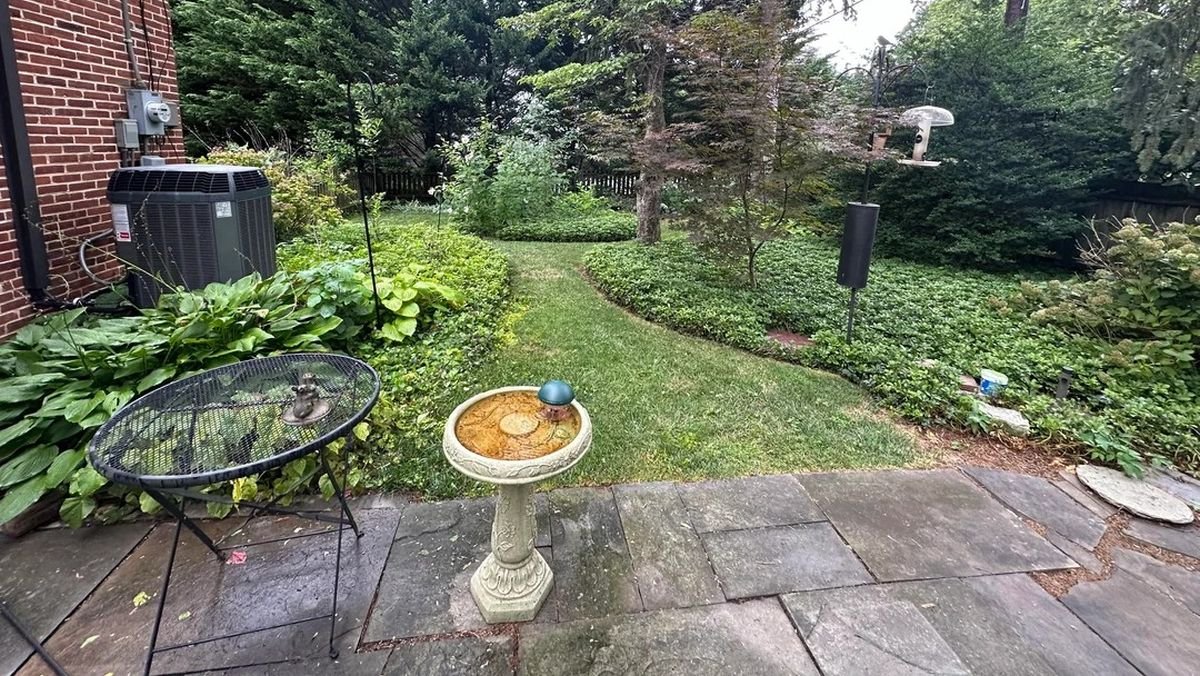
Before construction began, pachysandra spread beneath the mature trees across most of the yard. Narrow mulch beds bordered the lawn while straight walkways divided the landscape into separate sections.
The existing trees provided structure, but the planting below them remained almost uniform from one end of the yard to the other.
Narrow Side Yard Connected Front and Back

Rectangular stepping stones led through the side yard beside the fence. Ground cover and scattered planting filled the remaining space, leaving the passage as a simple connection between the front and backyard.
The redesign kept the same route while changing everything around it.
Oversized Stone Slabs Changed the Entire Walkway

Natural stone slabs replaced the small concrete pavers with a wider path that curves between new planting beds. Fresh mulch defines the edges while young grasses and shrubs establish the first layer of the woodland garden.
The irregular stone shapes create a layout that follows the surrounding planting instead of straight property lines.
Large Boulders Framed the New Garden Beds

Boulders now separate planting areas from the lawn and reinforce the curves established by the stone paths. Trees, shrubs, and grasses occupy the spaces between the rock, creating distinct planting beds instead of one continuous carpet of ground cover.
Each section connects with the next without repeating the same layout.
Wide Stone Paths Extended Across the Backyard

The same oversized slabs continue into the rear garden, linking the patio with surrounding planting beds. Open joints between the stones allow mulch and nearby plants to define the edges without hiding the walking surface.
Large stone outcrops anchor several corners of the path, tying the hardscape to the surrounding landscape.
Bubbling Fountain Sits Among Native Planting

A carved stone fountain rises from a bed of river rock surrounded by grasses, flowering perennials, and shrubs beneath the tree canopy. The water feature follows the same material palette as the rest of the garden, using stone instead of decorative concrete or metal.
Its location adds another focal point without interrupting the surrounding planting.
Sedges Filled the Edges of the Stone Path

Native sedges spread toward the edges of the stone slabs while shrubs filled the space beneath the mature trees. Tall spikes of cardinal flower rise above the surrounding planting, adding vertical contrast without interrupting the woodland layout.
Eighteen months of growth reduced the amount of exposed mulch as the planting expanded between the stone paths, boulders, and garden beds.
Side Yard Became a Woodland Walk

Native sedges form dense mounds along both sides of the oversized stone path, while black-eyed Susans, flowering perennials, and shrubs fill the remaining planting beds beneath the mature trees. The narrow corridor now carries the same layered planting found throughout the backyard.
Oversized stone slabs continue through the side yard without changing materials or scale, connecting this passage with the rest of the woodland garden.
Layered Planting Covers the Ground Beneath the Trees

Different heights and leaf shapes replace the single layer of evergreen ground cover that once occupied the site. Grasses, perennials, shrubs, and small trees now share the same planting beds beneath the mature canopy.
Natural stone remains visible throughout the garden without dominating the landscape.
Garden Bench Overlooks the Woodland Planting

A wooden bench faces the surrounding beds of native grasses and flowering perennials beside the winding stone path. From this point, the connected walkways, mature trees, and layered planting reveal how the entire backyard now functions as one continuous woodland garden.
Image credits: Reddit user u/TreeThingThree, r/NativePlantGardening.