Traders go full-time on prediction markets using AI bots and antennas
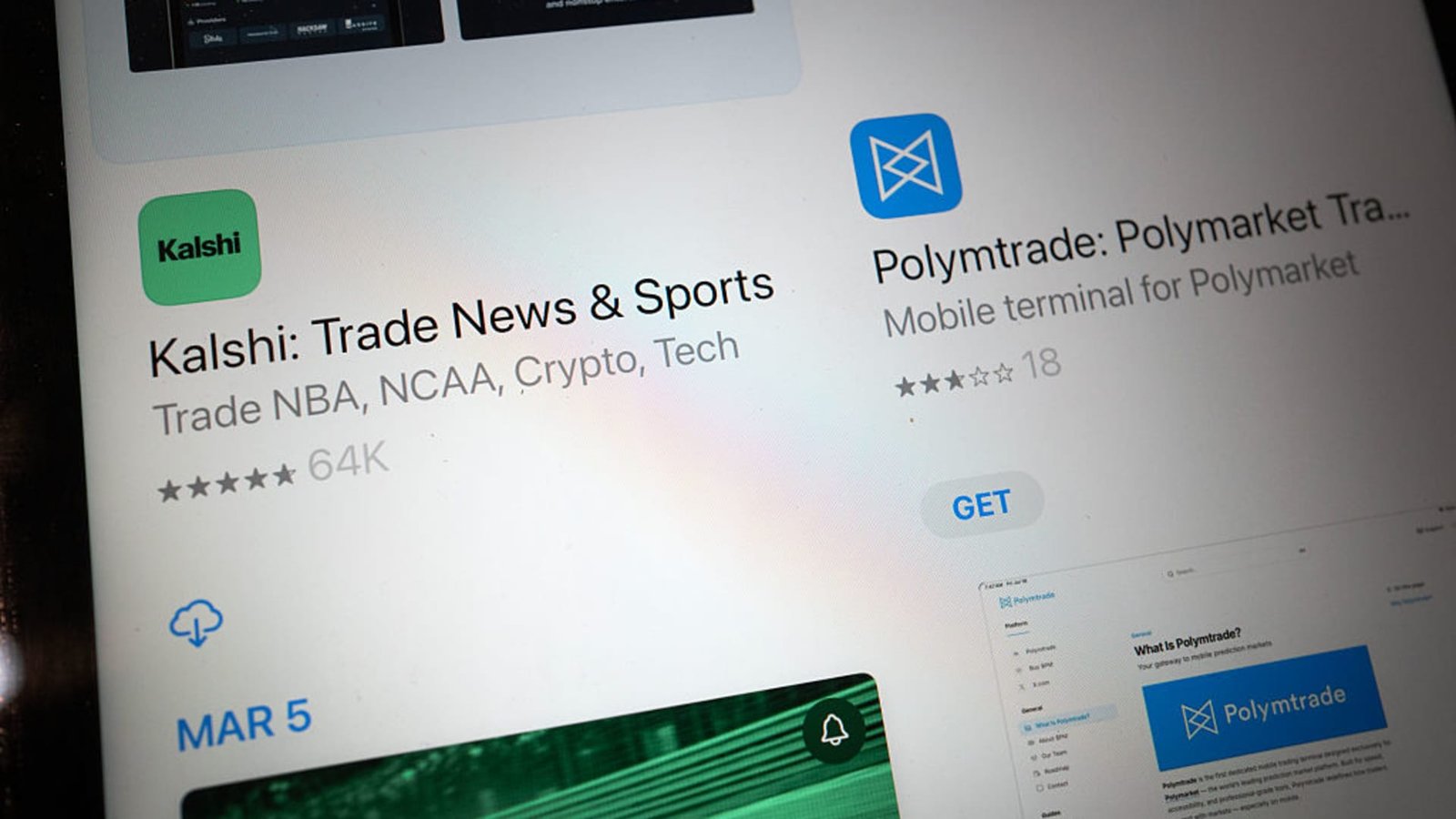
In this photo illustration, Apps for online prediction market sites are shown on an electronic device on Feb. 25, 2026 in Chicago, Illinois.
Scott Olson | Getty Images
It’s been less than a year since 26-year-old Logan Sudeith became a full-time trader on prediction markets and in one month alone he managed to collect $250,000.
That doesn’t happen from simply checking the odds of an event contract on the platform, he said. A clever trade requires tools.
“For the Super Bowl I bought an antenna, so that I could watch the commercials,” he said, noting online streaming services could face lags. Sudeith was able to quickly trade on what companies would show ads during the largest televised U.S. sporting event, or what would be said during those commercials. “I wanted to have the lowest latency access to those.”
Between Polymarket and Kalshi alone, there can be more than 100,000 active markets. That’s too much for traders like Sudeith to juggle on their own. And that’s why they don’t.
CNBC spoke to several active traders on prediction market exchanges about how they gain an edge. From using AI bots to purchasing an antenna, traders rely on tools and peculiar methods to compete against others, and it’s enough motivation for some to trade on the platforms full-time.
And while hedge funds and large institutional trading desks are known for using complicated tools that help them win in the market, these traders are often just one person doing the work from their homes.
Not every trader has the capacity to make custom workflows. That’s why some platforms are offering more advanced technology to speculators, so that they don’t have to build it all on their own.
But whether those new, accessible products can deliver the same results to what individuals have made for themselves is unclear.
The news, AI, repeat
One common theme among traders is reading the news. Kenneth Deneau, 32, calls it a “minimum requirement” to know what’s happening in the world but admits that it can get overwhelming.
He turned to AI to scan relevant information, including the newsletters he’s subscribed to and Discord servers, to find insight for potential trades.
“I think that has been probably one of the most transformative aspects of allowing me to do this now, being able to build out those tools,” he said about Anthropic-owned language model Claude.
Andrey Rudakov | Bloomberg | Getty Images
The surge in trading volume on Kalshi and Polymarket last fall drove Deneau to become a full-time prediction market trader. He left behind nearly a decade of work in institutional investing but carried over one key skill to his next gig: deep research under a time crunch.
Earlier this year, when an event contract asked the date for when President Donald Trump would fire former Attorney General Pam Bondi, Deneau relied on Pacer, a database providing court records, to figure it out before it became viral.
“If you found those filings, which I did, you could use that as a baseline to help you determine when [Bondi] actually left the office,” Deneau said. “As far as I know, I was probably one of the first ones to take advantage of that.”
A coder’s paradise
Prediction market platforms have an Application Programming Interface, or API, that makes their live and closed markets accessible. It’s a playground full of analysis for Atlanta-based data engineer Steve Farmer.
From his wife’s “big closet”, Farmer spent countless hours building an AI bot that would trade on Kalshi all day.
Fotograzia | Moment | Getty Images
“As a trader, I wouldn’t do very well myself because you know, impulses and greed and all that will just drive me nuts,” he said. “A bot doesn’t have all that.”
His bot has about a 70% win rate in trading on economic-related event contracts on Kalshi, though he admitted it’s likely not a long-term investment strategy, noting it’s not replacing his retirement fund.
What it is, however, is “enough to pay for my AI bills,” he said.
Protecting the edge
Michael Boss placed his first trades on Kalshi during the 2024 presidential election, and decided he wanted to start speculating more often on the platform in summer 2025. But he didn’t start trading full-time until February this year, waiting until he had the necessary software.
The software Boss uses is placing many trades all the time across various markets. He wouldn’t reveal exactly what he uses to train his software, showcasing just how much he wants to protect any edge he has over other traders.
“On something like Kalshi, a lot of different things need to go well,” he said. “There’s a ton of markets on Kalshi, so it’s kind of a big problem to tackle in that way.”
Cheng Xin | Getty Images News | Getty Images
Expanding access
Prediction market exchanges know their most active traders have elaborate software and tools. Some platforms are looking to make trading easier for highly-engaged speculators.
Kalshi, for example, recently launched a “Pro” trading terminal, which it says makes it easier to place trades faster and view data about individual markets.
Deekaraul “Deek” Harinath, a Kalshi speculator who has placed more than 5,700 trades on the platform, was part of a select group that tested the terminal before its official launch this month. He told CNBC he often trades on the 15-minute cryptocurrency contracts, which ask if Bitcoin prices will go up or down in a quarter hour.
“Everything is faster on the Pro, and that’s a big deal for me,” he said. Harinath said having the ability to only click once to submit a trade, a feature of Kalshi Pro, is also an upgrade.
Still, while Harinath plans to use Kalshi Pro to place manual trades, he also intends to develop a bot for automation purposes and place trades on various short-term contracts that he’s too busy to participate in manually.
Beyond the two major exchanges, startups are also trying to convince traders their tools will give them that missing edge.
Jay Malavia is a co-founder and CEO at Kairos, an Andreessen Horowitz-backed prediction market trading terminal that allows speculators to trade across various exchanges, including Kalshi and Polymarket.
Kalshi and Polymarket.
Gabby Jones | Bloomberg | Martin Lelievre | Getty Images
Malavia said the goal at Kairos is to offer strong technology to those who can’t or don’t know how to build it themselves.
“There’s these big trading firms that are going to build the best tech in the world, and we are going to give you the closest technology to go and compete and win in these markets,” he said.
Kairos allows traders to see different contracts and price moves across exchanges, as well as deliver real-time data and headlines across various events.
And while Kairos is geared to “democratizing” technology for prediction market traders who don’t have their own, Malavia also said it can be a solution for highly active traders too. That’s because Kairos takes on the job of maintaining the software rather than an individual having to do it.
So long as people are manually placing trades, Boss thinks a speculator will be behind those who have tools to do the work for them.
“Anything discretionary can be systematized,” Boss said. “No person is going to be as competitive as good software.”
Disclosure: CNBC and Kalshi have a commercial relationship that includes customer acquisition and a minority investment.