
Future-proofing digital capability: Why governments need to be ‘smart customers’
Image: Pexels: Marcelo Dias
The fifth in a series of extracts from Global Government Forum’s new study on future-proofing digital capability examines how a strong internal workforce alone is not enough – governments must also harness external capability effectively
The Future-proofing government digital capability study, led by Kevin Cunnington, executive advisor at GGF and former director general of the UK Government Digital Service, explores how government organisations can ensure they have the right capability in place to deliver on their digital visions.
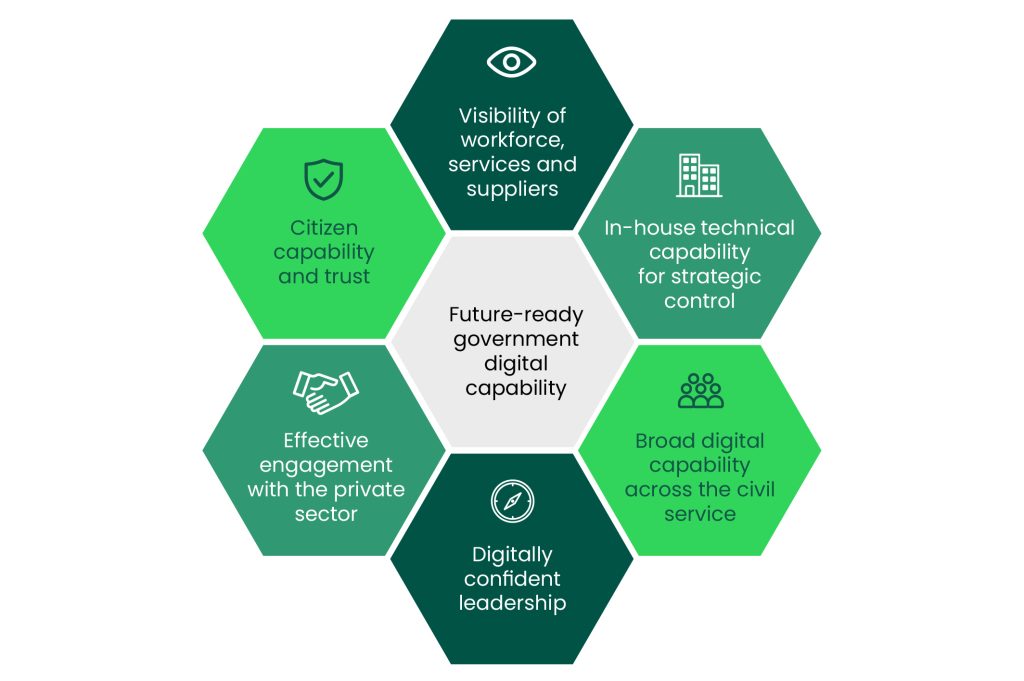
Based on interviews and a roundtable with over 20 digital leaders from around the world, including the UK, the US, Canada, Singapore, Australia and New Zealand, the report identifies six common foundations that underpin digital capability across governments, and how to make sure these foundations are resilient in a fast-changing environment.
Cunnington writes in the foreword: “The ability to meet today’s expectations and capitalise on tomorrow’s opportunities depends on capability – the right people, skills and partners to deliver. Governments need a clear understanding of their digital service priorities; strong in-house technical capability to retain control; a workforce that is confident in using digital tools and approaches; and a strategic approach to engaging and shaping the supplier ecosystem. They also need to ensure citizens are well-equipped to adopt digital services.”
This extract explores the fifth pillar: effective engagement with the private sector.
Download the report: Future-proofing government digital capability: Six foundations for success
Effective engagement with the private sector
Across governments, engagement with the private sector is widely recognised as an essential component of digital capability. No administration expects to design, build and operate all digital services internally, particularly given the pace of technological change and the specialist expertise required in areas such as cloud infrastructure, cybersecurity and artificial intelligence.
However, interviews revealed a clear shift in how governments understand this relationship. The central question is no longer whether to work with the private sector, but how to do so in a way that strengthens – rather than replaces – internal capability.
Governments need to be able to call on the right partners at the right time and to have the skills to commission and manage this work.
As one interviewee put it: “Going outside should be a conscious choice on the basis of effectiveness and cost-effectiveness.”
Another described the risk of excessive reliance more directly, warning against becoming “hostage” to external capability.
These issues are gaining further attention as a growing number of governments focus on digital sovereignty amid both geopolitical tensions and the need for economic growth.
Read more: Why governments must ‘grab the nettle’ on digital capability
The importance of being a ‘smart buyer’
A consistent theme across interviews is that effective use of the private sector depends on the right internal capability.
Governments need sufficient technical and commercial expertise to define requirements clearly, assess options and manage delivery. Without this, they risk becoming passive recipients of external solutions rather than active shapers of them.
One interviewee summarised this requirement: “There is always going to be a role for specialist IT expertise and for being able to flex up and down by using external resources. But what we need to do is have the internal capability, firstly, to manage, plan, set the strategy and make sure that we commission properly.”
Others emphasised the importance of developing internal understanding before procuring external support. As one interviewee explained, being a “smart buyer” requires first engaging deeply with the problem before turning to the market.
Several had experienced the consequences of failing to maintain this capability, noting that over-reliance on suppliers had weakened their ability to act as a smart buyer.
Build or buy?
As governments rebalance their approach, some emphasised the need for clearer frameworks to guide decisions about when to build internally, when to buy externally, and when to combine the two.
These decisions depend on factors such as the strategic importance of the service, the availability of internal capability, cost considerations, and the need for flexibility.
Several interviewees highlighted that such frameworks are still underdeveloped. As a result, decisions are often made on a case- by- case basis, without a consistent approach across government.
Turning strategy into delivery: Find out more about Global Government Forum’s training and advisory services
Supplier engagement
Governments are experimenting with a range of models for working with the private sector and they report good progress. In a pre-roundtable survey, all respondents said they have active engagement with digital suppliers to support a strong supplier ecosystem and most said it was developed or advanced.
Some are seeking to integrate external expertise more closely into internal teams. One interviewee described an approach focused on “buying relationships” rather than products, bringing specialists into government to work alongside civil servants in cross-functional teams. This was seen as a way to ensure knowledge transfer, maintain oversight and align delivery with public sector objectives.
At the other end of the spectrum, some governments are using framework agreements to manage supplier engagement at scale. Digital Iceland, for example, operates with a small internal team that leads delivery while drawing on external consultants through structured frameworks and clear standards. This allows the government to scale capacity while retaining strategic control.
Procurement reform and market shaping
Some governments have also sought to reshape and strengthen the external market through procurement reform.
The UK’s Digital Marketplace provides one example. By breaking large contracts into smaller components and making it easier for a wider range of suppliers – including SMEs – to participate, the government has increased competition and reduced dependence on a small number of large vendors.
For the first time, the UK also recently set individual targets for departments for the amount they spend with SMEs, aiming to boost economic growth and deliver on the Plan for Small Business. Another example is the Buy Canadian policy, which aims to prioritise Canadian suppliers where possible for large contracts.
Beyond procurement, governments are also engaging with the market through conferences, hackathons, roundtables and ongoing dialogue with suppliers. Singapore’s Stack conference, for instance, is the largest government-led technology event in Singapore, dedicated to connecting government, industry and the tech community for cross-sector collaboration.
These interactions help governments stay informed about emerging technologies and give suppliers greater visibility of public sector priorities.
One leader commented: “I think the biggest fallacy is the assumption that the private sector is just going to create tools and we’ll just buy them. We need to tell them the types of tools that we need to create.”
Another stressed the importance of “being very clear and transparent about direction”. They noted that previously there had been a lack of plan and “architecture of what we were moving towards, so companies didn’t know how to respond to us. Or if they wanted to, it was a one-on-one conversation”.
Having a clearer plan in place has meant vendors getting in touch with specifics on how they think they can help.
“That level of transparency is definitely helpful,” the leader said.
Overall, the interviews confirmed that effective engagement with the private sector is a core capability issue, not just a procurement one. Further, governments need to take active steps to understand, shape and harness external capability to its full potential.
Building the foundations for future-ready capability
- Internal capability to act as a ‘smart customer’. Governments need sufficient technical, commercial and delivery expertise to define requirements, assess options and manage suppliers effectively, rather than relying on external providers to shape solutions.
- Clear frameworks for what to build or buy. As digital becomes central to public services, governments will need more consistent frameworks and guidelines to decide which capabilities must be held internally and where external support adds value.
- Visibility of the supplier landscape. A clear, system-wide view of suppliers, contracts and dependencies will be essential to manage risk, avoid fragmentation and support more strategic engagement with the market.
- Active market shaping. Governments will increasingly need to engage the market proactively – outlining priorities and plans, fostering competition and supporting innovation.
GGF will now take the collaborative opportunities identified in this report forward – if you’d like to be involved, get in touch by emailing [email protected] so we can structure the work to be as useful as possible.

Participants in the study were as follows (job titles reflect those at the time of interview/roundtable participation):
- Dr Subho Banerjee, deputy commissioner, head of the Australian Public Service Academy and capability, Australian Public Service Commission
- Gregory Barbaccia, federal chief information officer, Office of Management and Budget, United States
- Thomas Beautyman, deputy director of government digital capability, Department of Science, Innovation and Technology, United Kingdom
- Dominic Chan, assistant chief executive, product, and chief information officer, GovTech Singapore
- Marie-Chantal Girard, president, Public Service Commission, Canada
- Shafiqa Dawood, chief digital and technology officer, Department for Education, United Kingdom
- Wolfgang Ebner, federal chief digital officer, Austria
- Richard Gevers, head of service design and delivery, Digital Services Unit, South Africa
- Luukas Ilves, former chief information officer and undersecretary for digital transformation, Government of Estonia, and advisor to the deputy prime minister and minister of digital transformation, Ukraine
- Valeriya Ionan, advisor to the deputy prime minister of Ukraine on innovation, digitalisation and global partnership and former deputy minister of digital transformation, Ukraine
- Birna Íris Jónsdóttir, CEO, Digital Iceland, Iceland
- Paul James, government chief digital officer, New Zealand
- Romina Kostani, deputy general director of the National Agency of Information Society, Albania
- Chris Leck, group chief technology officer, Public Sector Science & Technology Policy & Plans Office, Prime Minister’s Office, Singapore
- Barry Lowry, government chief information officer, Ireland
- Lauri Luht, government chief information officer, Estonia
- Dominic Rochon, government chief information officer, Canada
- Haseley Straughn, digital development policy coordinator, Ministry of Industry, Innovation, Science and Technology, Barbados
- Jaanus Vant, AI and data strategy coordinator, Ministry of Economic Affairs and Communications and Ministry of Justice, Estonia
- Paul Wagner, chief executive officer, Canadian Digital Service, Canada
- Vicky Wang, senior director, digital workforce transformation, Smart Nation, Singapore
- Claire Wraith, head of strategic workforce and transformation, Government Digital Service, United Kingdom