Canada’s physician shortage—bad news may only get worse
beng
EST. READ TIME 5 MIN.
Canada’s physician shortage has dominated media stories about health care in recent years, as millions of Canadians report not having access to a regular family physician, with millions more lined up waiting for specialist consultations and treatment.
The media attention may lead some to believe this is a recent development or perhaps even a post-pandemic shift in health-care access. But there’s actually nothing new about Canada’s lack of physicians. Canada has had fewer physicians than other high-income universal health-care countries for decades (when compared to the size of our population).
Data on the number of physicians per population in high-income countries are available from the Organisation for Economic Cooperation and Development (OECD). Looking back two decades from 2023 (the latest year of available comparable data), and including only those countries where data are reported for each year, it’s possible to compare Canada with 22 other high-income countries that also have universal health-care systems.
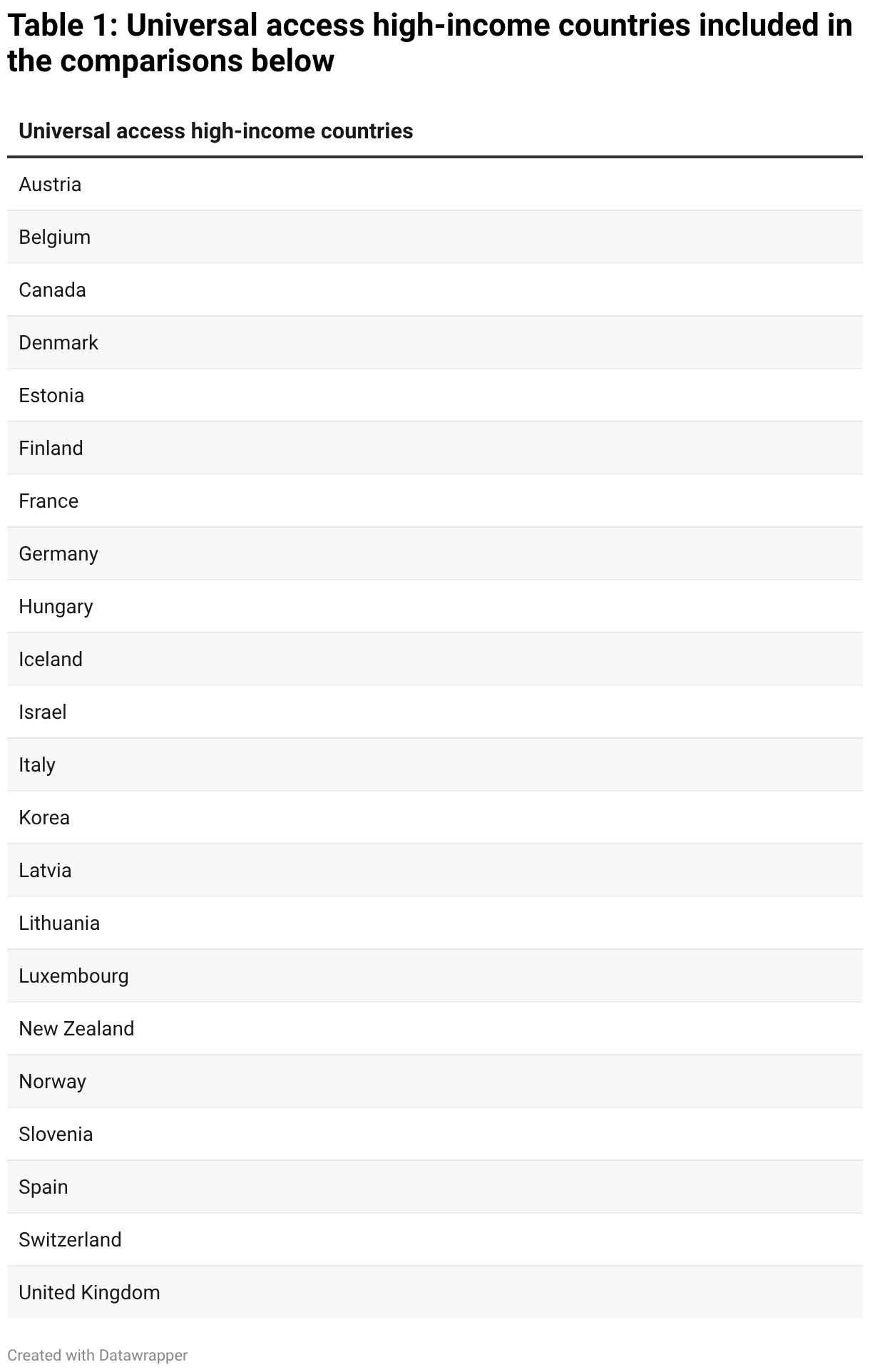
Of course, not all these countries are the same demographically, and because age is an important driver of demand for health-care services, it’s important to account for differences in population ages to make the data more comparable. To do this, the data for each year are age-adjusted using the same method used in the annual international comparison of health-care systems. This provides a two-decade long view of physician supply in Canada as compared with that in peer countries on an age-adjusted basis.
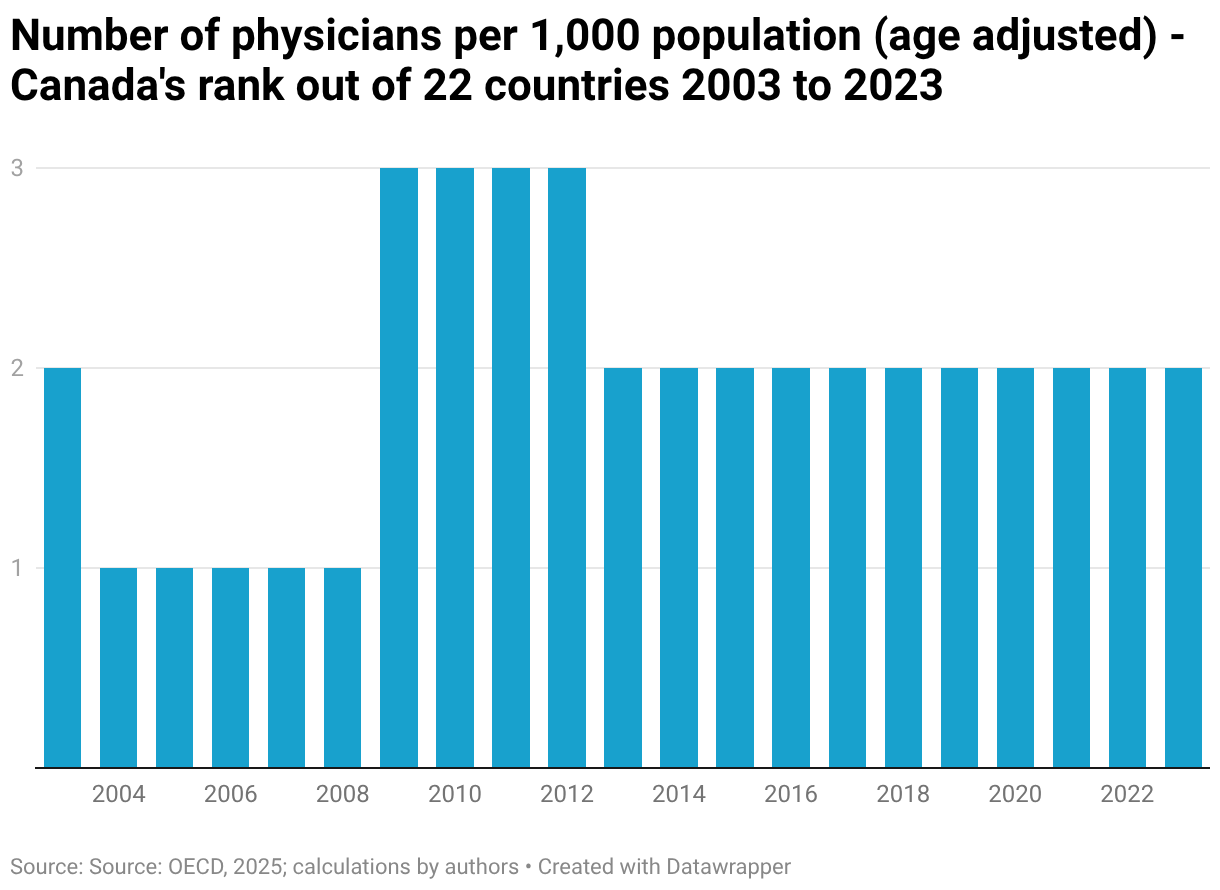
The results in the graph below reveal that Canada has persistently ranked near the bottom among the 22 countries for the number of physicians per 1,000 population since 2003.
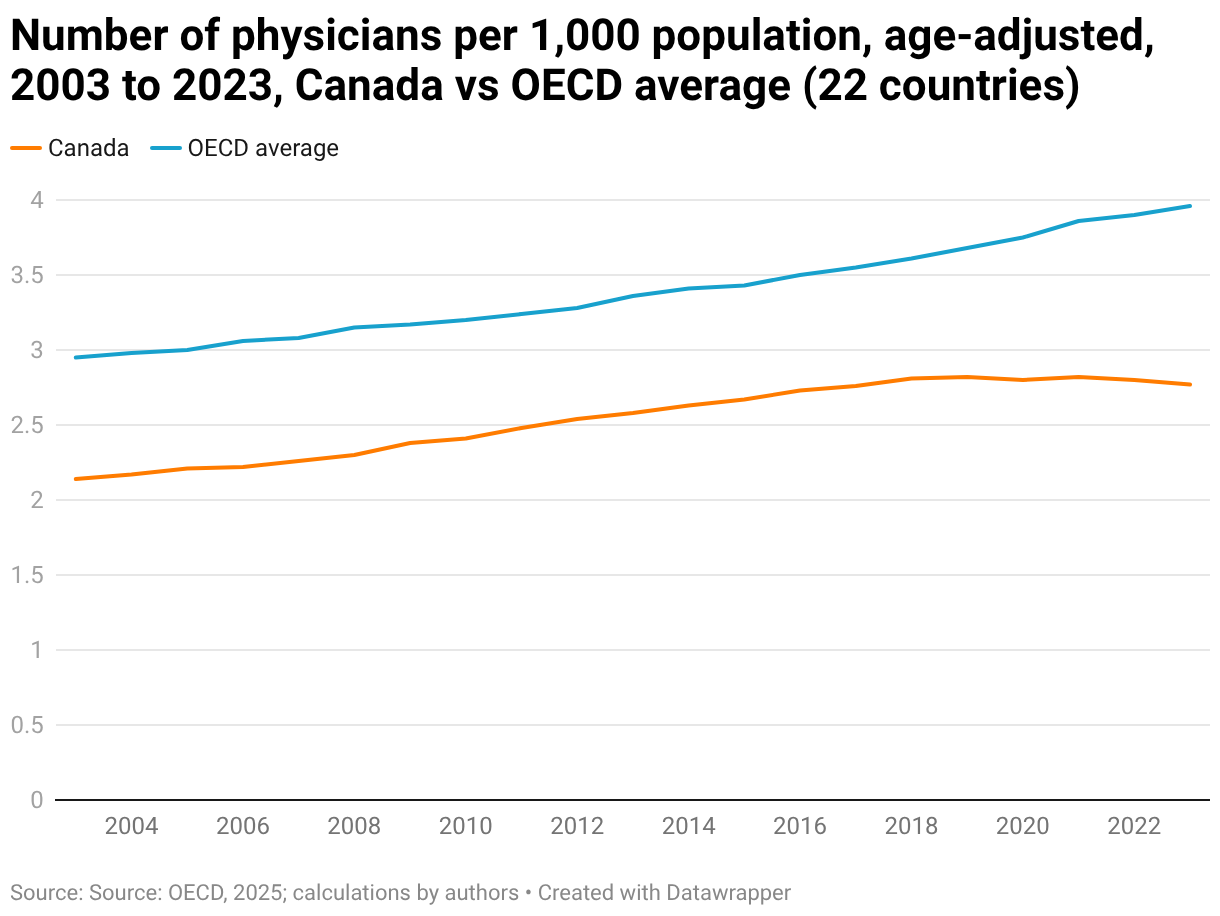
Looked at another way, Canada’s physician supply has remained well below the OECD average for the last two decades. In 2003, Canada had 73 per cent as many physicians as the average universal health-care country, and by 2023 managed to have 70 per cent as many, the lowest proportion in 20 years. That gap is fairly consistent over the two decades, and only got as high as 78 per cent between 2015 and 2018.
Remember that Canada maintained one of the developed world’s most expensive universal health-care systems throughout this period.
Far from being a more recent or post-pandemic phenomenon, Canada’s relative physician shortage is clearly a longstanding one. But it wasn’t always this way. After substantial expansion of the country’s medical training capacity in the 1960s (aimed at ensuring sufficient supply for the newly minted Medicare program), alongside increasing the number of international medical graduates practicing in Canada, Canada had one of the developed world’s highest physician-to-population ratios in 1970.
But as governmental concerns about having too many physicians took hold during the ’70s, ’80s, and early ’90s, medical enrolments were cut alongside plans to reduce recruitment of international medical graduates. A few years later, many were already arguing against this policy approach and anticipated that these changes, alongside other demographic challenges, were a “recipe for disaster.”
They would be proven right.
In late 2022, RBC estimated that Canada was facing a physician gap of at least 44,000 by 2028, and would need an additional 30,000 physicians just to reach the OECD average, all on top of an estimated 120,000 physicians in practice in 2028. To put this into perspective, Canada’s total physician workforce in 2023 was 97,384 doctors.
There’s little indication governments are on track to plug this gap.
While Canada’s first-year medical school enrolments increased by 7 per cent between 2022/23 and 2023/24 and again between 2023/24 and 2024/25 (compared to an average growth of 3.8 per cent between 2003/04 and 2012/13, and 1.5 per cent between 2013/14 and 2022/23), Canadian medical schools still only enrolled around 3,800 students last year. Remember, these new medical school enrollees are still 6 to 11 years from completing their training and entering practice as physicians
While enrolments have risen, and are likely to rise by maybe even a few hundred more in the next few years following any further expansions in existing medical programs and the introduction of new medical programs at several universities, it’s important to acknowledge that Canada graduated barely more than half the medical graduates as the OECD average in 2023 (7.5 per 100,000 population compared to an average of 14.2).
Canada’s supply of doctors is of course also bolstered by the international medical graduates who manage to practice here after successfully running the gauntlet, which includes passing Canadian licensure exams offered only a few times a year, competing for limited residency opportunities, and accepting provincial restrictions on post-training practice locations. In 2024, international medical graduates made up 27 per cent of the physician workforce. But these international and Canadian additions to the physician supply are counterbalanced by retiring physicians and physicians leaving practice for other reasons.
This leaves us with a depressing outlook.
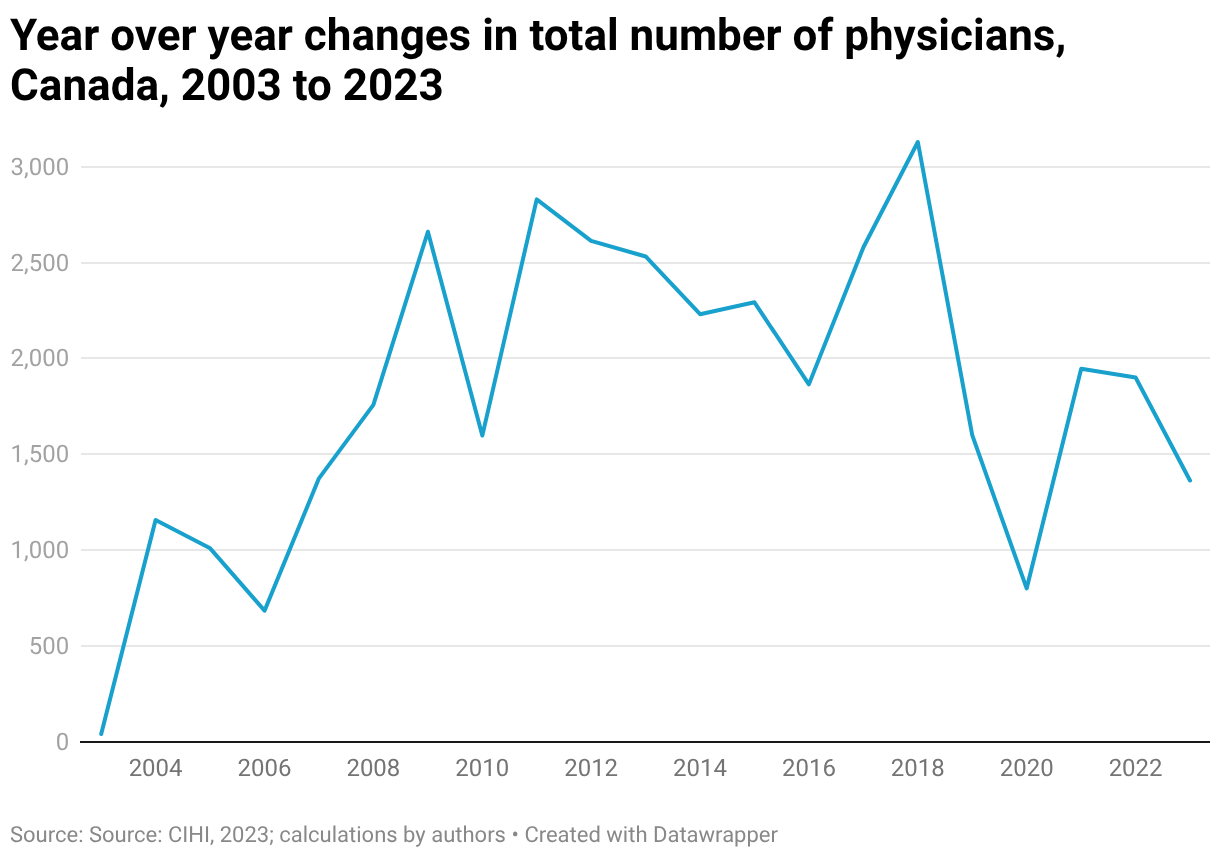
Between 2022 and 2023, Canada only managed to add a net of 1,364 physicians to the workforce, which is below the average of the 10 years prior (2,088), and below the average between 2003 and 2012 (1,573). The highest increase in the net number of physicians added to the supply since 2003 was 3,129 in 2018.
Contrary to recent headlines, Canada’s relative shortage of physicians has been ongoing for decades. And while it may be tempting to be optimistic given recent media and governmental attention, the data make it much harder to have a rosy outlook. Unless something changes significantly, including a larger role for international medical graduates in the near term, Canada’s relative doctor shortage will likely persist given current Canadian medical school enrolment and graduation counts.

By: and