
So the UK is set to have its 7th Prime Minister in ten years. In this time, it is no co-incidence we have seen a continued stagnation in living standards. At the root of the problem is a decline in productivity growth; the years of growth are over.

Every prime minister had a plan for economic growth, but nothing really worked. Why is it so hard to fix?

Well Andy Burnham famously said we should be less in hock to the bond market. And ever since Truss, British Prime Ministers have been nervously looking over their shoulders at bond yields, and mostly they don’t like what they see. Higher bond yields and inflation mean the UK spends more than ever on debt interest payments. The extra £50 billion in debt interest, is equivalent to 8 pence on the basic rate of income tax and the pressures of meeting fiscal target have led to unpopular choices.

In an effort to balance the books, Keir Starmer’s popularity fell off a cliff after plan to means test winter fuel payments. It was deeply unpopular, despite only potential savings of £1.5 billion. His Premiership never really recovered. But, the UK does have a problem. Health and disability benefits are set to reach just under £100bn by 2030. But an even bigger rise is the predicted rise in pension spending as a share of GDP. Whether it is right wing or left-wing think tanks, the pension triple lock is described as a very expensive policy.

It means pensions will take a larger and larger share of GDP. Also, with falling birth rates, the UK has an ageing population and this demographic change will translate into lower economic growth. It is more than demographics, but the older we get, the harder it will be to grow our way to finance higher spending. This is the unwelcome trend of UK growth.
But, whilst this is a future problem, there is a reluctance to face up to unpalatable choices. Andy Burnham recently said he will retain the pension triple lock and give a tax cut to pensioners. That may be politically popular, but it does means higher taxes. And this is after taxes have risen to a post-war high.
 Source: Tax Policy
The other problem is that after big tax rises, there is less appetite for more tax increases, unless it is tax on the wealthy. But Dan Niedle shows that as taxes have risen as a share of GDP, the tax wedge, the overall tax on the average wages is actually significantly lower than in the 1980s. The UK has raised taxes by raising tax thresholds, raising corporation tax, cutting capital gains thresholds and higher stamp duty. Compared to other countries, the UK is actually quite successful at raising high levels of tax compared to the average tax on median wages. The OECD’s recent report into the UK warned it will be hard to raise more tax without broadening the tax base. But there is no political appetite for this.
Housing costs
Another economic problem is the cost of housing. High prices reduce living standards, make it difficult to move and are a drag on economic growth. In a recent campaign speech, Burnham said he wanted the biggest programme of council house building since the Second World War. He suggested this could be funded by rediverting the existing £39bn affordable housing programme entirely to social rent homes. But there is just one problem, £39 billion might sound a lot but this would fund only 20,000 homes a year over 10 years. In 1954, the UK built 198,210. UK house-building is in long-term decline. The problem is that it has become really expensive to build houses. Estimates suggest building costs are around £280,000. That’s why Keir Starmer’s ambitious plan to build 1.5 million homes has failed.

The private sector doesn’t want to build houses, when the profit margin is very small. And it is in the most expensive areas, where housebuilding has fallen the most. Housing is one of the most intractable problems, and it is not a uniquely UK problem. If you believe landlords are the problem, recent changes have actually encouraged landlords to sell, and this has modestly reduced house prices. But it doesn’t help renters who have seen big rises.
Public Transport
 Source: Britain Remade
Another solution to the UK economy would be to improve public transport. Since Manchester is all the rage, you can point to how the Manchester tram has helped the Manchester economy. So all we need to do is replicate this nationally and build more trams and trains. The problem is the UK already spends more on public transport, than you might expect, higher than OECD average. The problem is we get a very poor return on our money.
 source: Britain Remade
UK transport projects cost 1.2 to 2 times more than peer-equivalent countries, due to regulation, legal challenges, labour costs and planning. The result is despite high transport infrastructure spending, rail and motorway network per person is quite low compared to European competitors. The thing is it is not just about spending more money, there is a need to make money go further. To be fair to Starmer, they did take tentative steps, trying to reduce scope for legal challenges which can become a major hidden cost of projects. And by the way, it is not just HS2, the FT report how the Thames Lower crossing spent £450 on planning related activities, before a spade in the ground.
Privatisation
One reason for cost of living crisis has been the poor performance of privatised utilities. Water has been a particular burden with privatised companies paying high dividends, though increasing debt, and holding back on investment. The result is that companies are near bankrupt and Burnham has talked about the desirability of nationalising key utilities to undo some of the problems of privatisation.

The only problem is that whilst privatisation has many failing there is no guarantee nationalisation will solve them. If you take high electric costs which have caused a big fall in UK industry, the nature of the new grid is that high fixed costs are now baked into future prices, independent of wholesale costs
Brexit
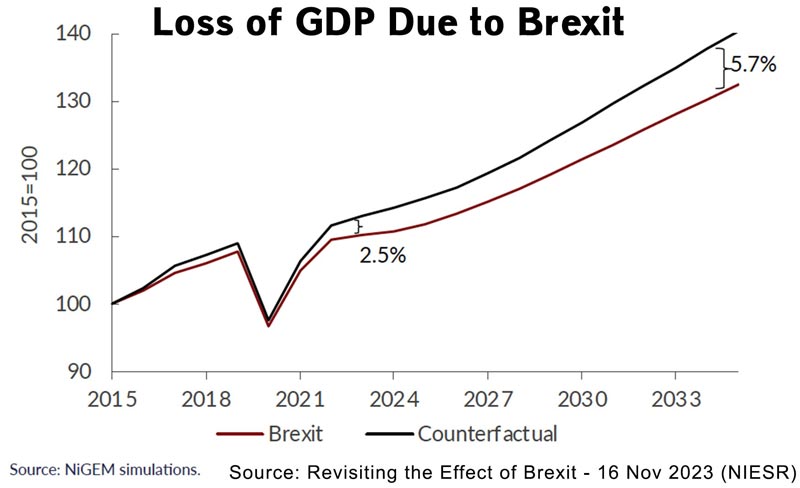
We started video by mentioning six Prime Ministers since 2016. 2016 was of course the referendum to leave the EU. Since pursuing a hard Brexit, the estimated cost of Brexit varies from 2-6% of GDP. It has created uncertainty, lower investment, and greater friction over trade. It has led to a growing sense of regret, yet after leaving the EU, it is hard to undo the break-up. Starmer may have reset EU-UK relations, but it doesn’t address the issues of being outside the Single Market. One idea of Brexit is that the UK show pursue a free trade deal with the US because of our special relationship. Yet, recent years show the UK doesn’t have a special relationship. Just recently, the UK saw its access to the latest Anthropic AI models cut off because of decision by US government. If AI is the key technology of the future, it is not controlled by the UK. UK scientists may have helped develop it, but increasingly we feel at the mercy of big tech giants. Even efforts to launch a digital tax on US tech giants have received threats of US tariffs. Also, since 2016, geopolitical events have led to soul-searching about defence spending and being more independent of the US. But, even in defence we see the British disease of costly and wasteful spending. British taxpayers are spending more than £5bn on the army’s Ajax armoured vehicle, being delivered eight years late, arriving just in time for a modern warfare where tanks have been devalued in favour of drones. The UK’s deindustrialisation and reliance on imports from solar panels to electronics, does make UK vulnerable to future geo-political shocks.
Any Grounds for Optimism
Now, this post title is admittedly a big negative; you could take a contrarian view that PM Starmer wasn’t as bad as the media made out. Economic growth was better than expected, though still pretty low. Despite the Iran war, inflation has fallen, closer to international levels. Interest rates have come down from 5.2% to 3.75%. There have also been some steps to reform planning and infrastructure constraints, changes which will have effect in the future. Even debt to GDP ratio has been stabilised. It’s not exactly a disaster, yet economic confidence has hit a near all-time low. Households have responded to low expectations by saving more, spending less. The rise in NI contributions has hit hiring levels and unemployment has risen.
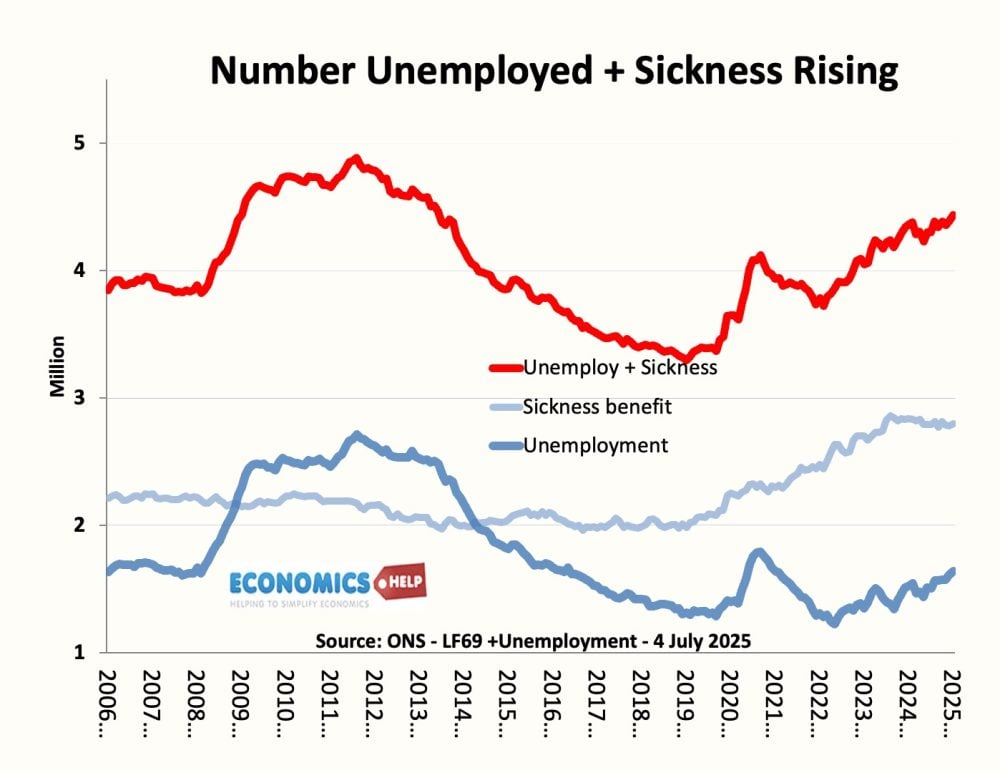
If you include hidden unemployment in economic inactivity, unemployment is even more of a problem – especially for young people. Finally the tax burden has reached a decade long high, but the future rise in spending on health, pensions and welfare have not been addressed.
There is no quick fix to the underlying economic problems in the UK, but it shouldn’t be used as excuse for fatalism. There is a huge range of incremental policy changes that can start to reduce the cost of producing electricity, planning and building. Also, just a sense of purpose and dynamism would help overcame the pervading sense of pessimism which holds UK back.
Sources
https://www.britainremade.co.uk/moreforless
https://spectator.com/article/twelve-graphs-that-expose-starmers-dismal-legacy/
https://taxpolicy.org.uk/2026/06/05/taxing-other-people-uk/
About The Author
