What’s your relationship with your favorite client’s adult children? Not their trust documents. Not the file with their name on it. The actual individual. Do they pick up when you call? Seek your advice? Trust you with important life decisions? If not, it may be time to invest in that relationship. As one Rising Gen member of a family office investment team told me:
We want to work with advisors who spend time to get to know us well. We want collaborators who are flexible. When there’s a cultural fit and genuine rapport it feels effortless. Expertise is great, but the relationship is the litmus test.
Why This Matters
These relationships have become increasingly important due to a variety of factors, including:
• The “Greatest Wealth Transfer in History” is underway, with $83.5 trillion expected to be transferred to Gen X, Millennials and Gen Z by 2048.1
• Approximately $46 trillion is expected to flow to Millennials (30 to 45 year-olds) alone.2
• Only 20% to 27% of inheritors expect to retain their parents’ advisors.3
The primary reason inheritors leave their parents’ advisors isn’t poor service or even performance. They leave because they don’t have an independent, trusted relationship with the family’s advisors.
Rising Gen Perspectives & Priorities
When I ask Rising Gen (ages 25 to 40—Millennials and older Gen Z) family members to describe the qualities that come to mind when they think about their trusted advisors, they use words like:
• Accessible
• Authentic
• Collaborative
• Curious
• Genuine
• Holistic
• Proactive
The quality that surfaces most often is empathy, described by one as “They understand my pain points quickly and zero in on what I need.” Another shared, “What inspires trust is their clearly demonstrating care for me. They listen first and want what’s best for my family and me. They’re not focused on
making a sale.”
Many Rising Gen family members wrestle with polarities4 (for example, wealth and responsibility and independence and reliance on the family office) and the burdens of wealth they didn’t earn. They may feel guilty, wonder about the authenticity of their friendships or feel like they need to pick up the check. At the same time, they’re navigating the changes that come with big life events, often all at once.
One third generation, Rising Gen family leader told me:
There is so much happening in my life right now. I got married, moved to a new city, took a new job, accepted the role of Chair of the Family Council and am expecting my first baby—all in the last several months. I try for quarterly meetings with my advisors with the caveat—if you don’t hear from me, please
keep trying.
Technical qualifications, experience and respect for privacy are table stakes. Rising Gen family members are looking for advisors who understand their unique circumstances and possess the emotional intelligence to make them feel understood and respected as individuals.
Building Trust
Here’s how one family office Chief Learning Officer described her approach to building trust:
When I started, I went on a listening tour. I spent time in person getting to know each family member. I shared my background, told them about my kids, what I love about my work and asked them about their lives—not their finances. Tell me about your cat. I care about them and want to help them, and they feel it. I’m available when they need me. We text. One client called me every day on her drive from work for a time just to talk about her day. I ask about their communication preferences and honor them.
When asked how they build trust with Rising Gen family members, family office leaders consistently emphasize one thing: time together—more connection rather than more meetings.
While no one enjoys a meeting that could have been an email, there are ways to make communication with the Rising Gen more enjoyable, for example, by having social time over a meal, at their favorite sporting event or in their home. These create opportunities to build real relationships. What works:
• Lead with curiosity, not advice: Take time to understand who they are before jumping to problem solving.
• Check your assumptions at the door: Learn about their background, their children and their relationships, not just the transaction at hand.
• Honor boundaries and privacy: Ask how they prefer to communicate and how involved they want to be, and respect their decisions.
• Balance support with independence: When you’re a client of a family office, there’s often tension between wanting guidance and wanting autonomy. Serve in a way that fosters self-reliance.
• Leave “I remember you when …” behind: If you’ve known them since childhood, be intentional about building a new relationship with them as the adults they’ve become.
Trusted relationships with the Rising Gen require you to show up with authenticity and bring more of yourself to the conversation than may feel comfortable. As advisors, we’re trained to be experts, technicians and problem solvers. This generation is inviting all of us to step beyond that comfort zone.
Switching Gears
How do busy professionals with high demand technical expertise, complex, multi-generational relationships on their desks and not enough hours in the day expand their capacity to build trusted relationships with the Rising Gen?
They can start by learning from Jill Barber, Single Family Office President of CYMI Holdings and generous practitioner of trust-based leadership and:
• Take a page out of Jill Barber and Greg McCann’s book, Reshaping Reality, Chapter Four.5
• Take a lesson from Jill’s leadership journey, generously shared in Redefining Our Leadership Roles in Changing Times.6
• Most importantly, pause before every client conversation to consider how they’re showing up relative to what the client needs in the moment.
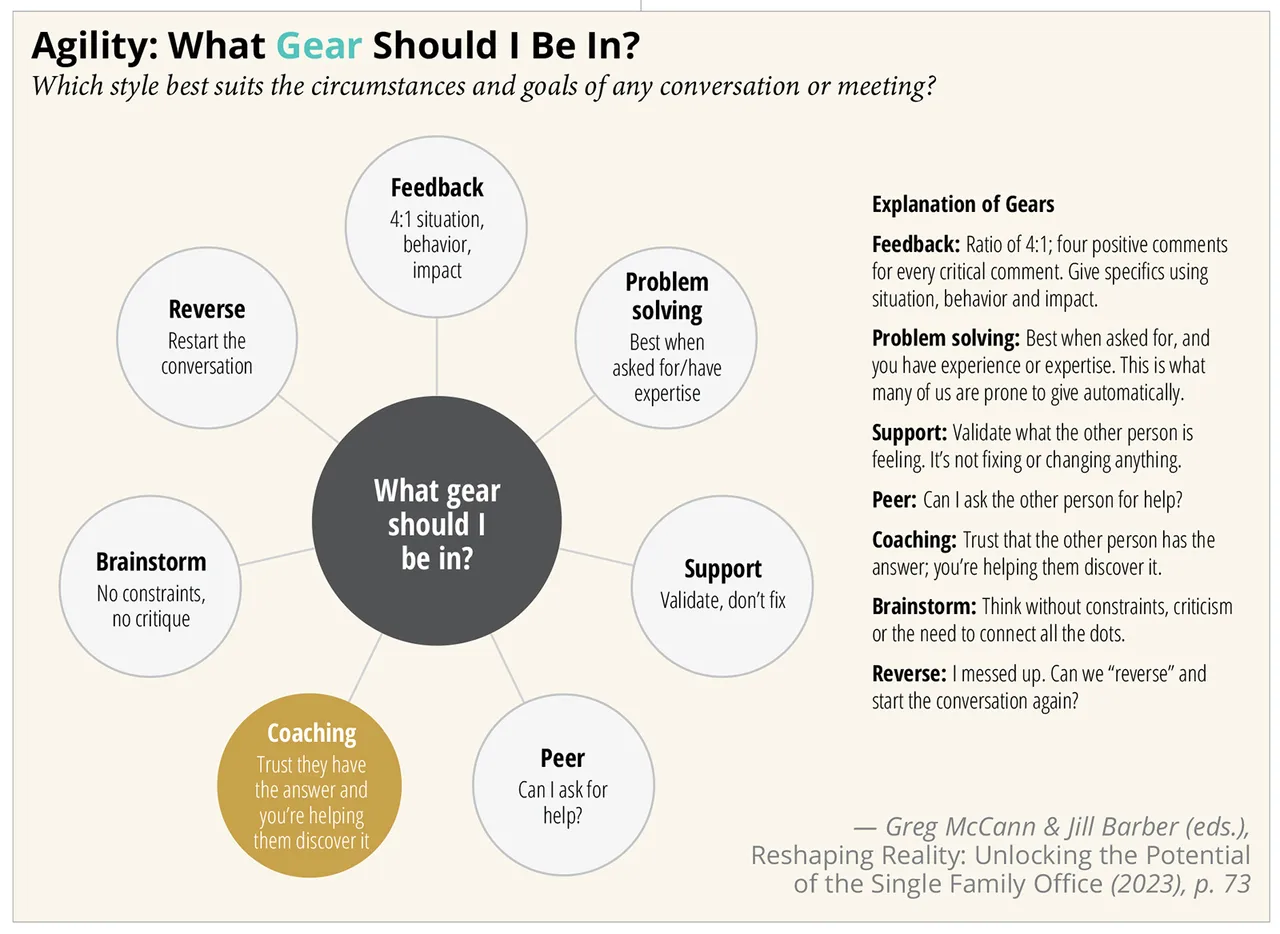
Jill’s team developed the framework shown in “Agility: What Gear Should I Be In?” p. 45, to establish a common language for the style, or “gear,” that best suits the circumstances and goals of any conversation or meeting. Different topics and client situations require different approaches.
Moving beyond advice and the problem-solving gear we know well may look like coaching, where the best course of action is to ask open-ended questions and wait quietly for the client to uncover the answer they haven’t had the space or time to discern. When they reach out for advice on getting involved in the family’s governance, brainstorming may lead to better outcomes than rushing to sign them up for board service. Validation is one of the most powerful gears. Few things feel better than sharing a struggle with someone who truly “gets it,” who acknowledges that it’s frustrating, painful or annoying and validates your experience.
Test this in your next client or team meeting. Make these gears your own. Practice with your kids at home. Like the wise advice I wish I’d learned earlier as a parent, which was to ask, “Are you looking for ideas, advice or just someone to listen?”—pausing to select the right gear for the conversation leads to better outcomes.
Respect Their Attention
Rising Gen clients, like all of us, are overwhelmed by the volume and variety of demands for their attention. Emails. Texts. WhatsApp. Oh my! The last thing you want is for your communication to end up in the TLDR pile (Too Long Didn’t Read).
What do Rising Gen leaders want? Here are some common responses I’ve heard:
• “Contextual flow matters. Start with the big picture and include details in the Appendix. I’m a visual learner and like images and graphs to bring data to life. One-page dashboards with detail in the Appendix are best.”
• “I need three or four sentences: (1) What is the ask? (2) Why is it important/how does it benefit me? (3) What is your recommendation and why? (4) What is the timeline for the decision?”
• “I like data, but share it in an Appendix or in links in a quick, digestible summary.”
Written materials must be short, tailored for the recipient’s interests and level of expertise and clear about the desired action. Mass emails typically end up in spam folders and go unanswered. If you must email and the ask is time-sensitive, be prepared to use what one family office executive described as “the full blitz” and remind via text, Teams or, worst case, pick up the phone. I’ve seen some families tap Grandma or the cousin on the committee to ensure that folks show up for important gatherings.
Family office execs find success with a multimedia approach that’s tailored to the topic and ask. They ask for communication preferences, track these in their customer relationship management systems and honor them.
Smart Brevity in Action
Developed by the founders of Axios and outlined in the book, Smart Brevity: The Power of Saying More With Less,7 the goal of smart brevity is to respect people’s time by delivering maximum value with fewer words. The intent is to make information easier to absorb, understand and act on. Not surprisingly, it’s a quick and practical read.
A smart brevity template for client communications aligns with the preferences quoted above:
• Bottom line: one sentence summary
• What’s happening: brief explanation
• Why it matters: implications for the client
• What we’re watching: future developments
• Next steps: two to four action items
It’s ideal for meeting recaps, client updates, family office newsletters and board materials. I spoke with a family office executive who’s applied this approach to all PowerPoint presentations and is exploring a smart brevity overhaul of their board materials. Another office executive shared that their office created a GPT to convert their email drafts to align with the Axios Smart Brevity Checklist.8
While I’m not aware of anyone referencing this approach in the context of trust documents, it’s an effective tool for client communication and preparing for Rising Gen conversations in which understanding the “Why?” behind the documents or planning is a priority.
A simple test we can all use before sending any communication is to ask:
1. Can the reader understand the main point in 30 seconds?
• The email subject line should tell readers why they should open it, understanding that they’ll take about three seconds to decide.
• PowerPoint slide titles should state the key takeaway so the audience can understand your story at a glance.
2. Can they scan the headings and bolded text and understand the key points?
3. Do they know exactly why it matters to them?
4. Have you told them what to do next?
When it comes to cadence and preferred means of engaging, most of the Rising Gen leaders I spoke with connect quarterly with trusted advisors and have annual in-person touchpoints. Virtual meetings are convenient for readouts and training but aren’t the right vehicle for connection.
Bottom Line
Building meaningful relationships with Rising Gen family members is one of the most effective forms of continuity planning. It strengthens your relationships today and extends the impact of your work across generations.
Families that bring their next generation into trusted advisor conversations, explain the reasoning behind important decisions and encourage them to develop relationships of their own with the advisor team set the entire ecosystem up for success.
Ultimately, Rising Gen clients want many of the same things their parents want: competence, trust and positive outcomes. They value partnership grounded not only in technical expertise but also in a genuine interest in who they are as individuals. Trusted advisors who sustain their relationships across generations meet Rising Gen family members where they are with curiosity, empathy and a desire to collaborate.
— This article wouldn’t exist without the generosity of the Rising Gen family members, family office leaders and trusted advisors who shared their experiences with me. I’m deeply grateful for their time, candor and willingness to reflect on what builds trust in intergenerational relationships. Their stories, insights and practical wisdom informed every section of this article and will, hopefully, help others build stronger relationships across generations.
Endnotes
1. Capgemini Research Institute, World Wealth Report 2025: Sail the Great Wealth Transfer—Setting a Course to Win Next-Gen High-Net-Worth Individuals (2025).
2. Cerulli Associates, “Preparing for the Great Wealth Transfer,” webinar summary and related research (Jan. 29, 2025).
3. Cerulli Associates, The Cerulli Edge—U.S. Retail Investor Edition, 3Q 2025, “Many Investors Expect Inheritances, Yet Few Likely to Maintain Benefactor’s Advisor” (Aug. 28, 2025).
4. For a terrific resource on polarities, see Cathy Carroll, Hug of War: How to Lead a Family Business with Love and Logic (2024).
5. Greg McCann and Jill Barber (Eds.), Reshaping Reality: Unlocking the Potential of the Single Family Office (2023).
6. Jill Barber and Greg McCann, “Redefining Our Leadership Roles in Changing Times,” Trusts & Estates (July/August 2021).
7. Jim VandeHei, Mike Allen and Roy Schwartz, Smart Brevity: The Power of Saying More With Less (2025).
8. Axioshq.com/research/smart-brevity-communication-checklist (login required).