Tomorrow, why the oil market is set to explode and the ongoing drought will cause food shortages in the shops. But first – time for something completely different.

70% of people feel the world is getting worse only 4% think it is getting better, and it’s hardly surprising when you turn on the news or flick through social media. But in some cases the data disagrees. We feel crime rates are soaring, yet stats paint a more complicated picture, headline murder rates are falling across the globe. European rates have roughly halved since 1991.

And do you remember when we warned dementia cases were set to triple in the coming years?

Well, the truth is the incidence of dementia is actually falling quite rapidly. As the economist reports, aged-adjusted incidence is falling 13% per decade and whilst we once panicked about the cost of dealing with an ageing society. This unexpected decline in dementia, means the future may not be as grim as we feared.
So what is going on? Well there is a definite asymmetry, bad news tends to be sudden and make headlines, good news is spread overtime and not so clickbaity.

For example, in the UK, cancer survival rates have steadily improved in recent years, this is despite more headline grabbing stories about record waiting lists.
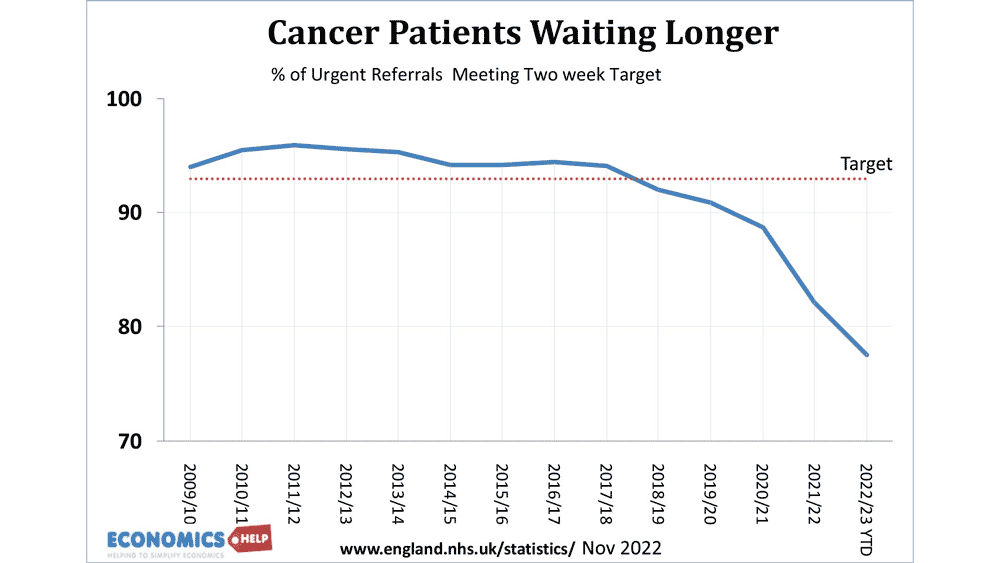
Of course, it is true, the NHS is struggling, but ironically, life expectancy is still improving despite waiting lists. In fact life expectancy is improving around the world. One of the most interesting is the rebound in US life expectancy. The US was devastated by covid and the opioid epidemic in the early 2020s, but in the past few years, has seen a marked improvement largely because the opioid epidemic is less.

And there is more good news to come. For the first time in decades, the US is starting to reverse its relentless rise in obesity. Ozempic has supercharged a decline in obesity. And this decline in obesity has the potential to unlock many knock on benefits. There are potential savings from health care to higher productivity, even lower fuel costs as airlines save weight — though I wouldn’t build a health policy around that one. Another reason for the improvement in life expectancy is that smoking rates have collapsed. (admittedly, some has been replaced by e-cigarettes) but overall the amount of toxic fumes from smoking is going down.

I remember as schoolchild, getting a train and by the end of the 20 minute journey your clothes would stink. It is one big improvement to the quality of life.

In fact overall air quality is improving, and with the arrival of electric vehicles, cities are starting to see a decline in toxic fumes, which have been linked to issues like dementia. It’s even more stark if you go back to post-war period. It’s no wonder life expectancy has improved. If we continue to move towards cleaner air, it will hopefully further help health conditions. And it could get even better – in medical sciences there are many potential breakthroughs from cancer immunotherapy, AI-guided diagnostics, even gene correction.

One of the clearest examples of perception drifting from reality is crime. Because perceptions of crime are hotly contested…Crime is a real problem, especially highly visible types like shoplifting, but when it comes to serious crime, there is a clear fall.

Note, this shows surveyed crime levels, not police statistics. You can also look at hospital stats for knife admissions, which all point to the same thing, a decline in violent crime.

The UK is nothing special, it is a trend we see across the world. Yet, we tend to be suspicious that crime is falling. One interesting point is that our perceptions are influenced by media. So for example, everyone thinks London is a war zone — except the people who actually live there, who are mostly worried about the price of a coffee.” This is a well-known phenomena we feel national crime rates are rising, but often see crime rates stable or falling where we actually live. The % of people who feel safe walking after dark has increased from 65% to 80%
Our perceptions are heavily influenced by what dominates the news and social media. In the UK, Ipsos reported that we guess the top 1% of people own 53% of the wealth, the actual figure is 21%. People estimate 26% are immigrants, the figure is actually 14%. We estimate 21% of the population is Muslim, the actual figure is 6%. The point is you don’t have to go far on social media to understand why perceptions are wrong.

But, one good trend that is very hard to dispute, the number of road deaths has fallen quite dramatically. Speed cameras, speed limits, safety belts, road design, airbags, crumple zones have all helped to bring death rates down. It’s not all good news in that the increase in size and weight of modern cars makes them more lethal for pedestrians and cyclists. But there is a concerted effort to make roads safer. Interestingly the one exception to this global decline, is the US, where road deaths are actually rising.
If this seems like too much good news, I suppose the reality of this summer is that global heating is smashing new records especially in Europe, the one consolation is that solar power is getting better every year.

The cost of panels has fallen, but much more important than this is the rapid growth of technology, we are getting to the situation where solar and battery combinations can provide closer to 24 hour power. Lithium batteries get more efficient every year, but the new sodium batteries are a potential game changer. Sodium batteries don’t catch fire, it’s made from materials you can get anywhere, they take up less space and work in sub-zero temperatures. As manufacturing scales up, sodium is projected to undercut lithium on price by 2027, without the global supply chain drama. Sodium is abundant in a way lithium isn’t. Powerful batteries will be a game changer for renewables.
But, some things are getting worse
Now, at this point it is fair to mention that one reason why things feel worse, is because some things are objectively worse. There is a real economic stagnation, with barely any increase in real wages, and if you take housing costs into account, it is even worse. The good news is you have slightly longer to live in your expensive privately rented flat. Even new technologies like AI give scope for potential productivity improvements but who benefit from the gains, how do you stop it all going to big tech? And whilst life expectancy is slowly rising health life expectancy is not keeping up and actually falling. We started with video with good news about dementia, but still over conditions like diabetes, kidney disease, mental health depression Ms, Parkinsons are still rising.
But one thing this video highlights is that our perceptions are very much informed by how news reaches us. The modern algorithm is kind of rewarding more divisive, polarising content, often content which is misleading but pushes people’s buttons. This is one of the more dystopian aspects of social media. But the good news is that it isn’t always as bad as initial perceptions make it out to be. Be careful what you see on YouTube. In terms of technology, there are really exciting possibilities for greater abundance, if we can share the benefits. And a final thing is that with climate under threat, there are two goods thing to hold onto. The Montreal Protocol was fairly effective in closing ozone layer showing co-ordinated action is possible. And scientists are developing more drought resistant crops. So has this article changed your mind in any way? Do let me know what you think and do subscribe.
Tomorrow, why the oil market is set to explode
Sources
Health
- Dementia incidence – Wolters et al., “Twenty-seven-year time trends in dementia incidence in Europe and the United States”, Neurology 95 (2020), Alzheimer Cohorts Consortium. Age-adjusted incidence falling ~13% per decade.
- Cancer survival – Rachet et al., “Trends over 48 years in cancer survival, England and Wales (1971–2018)”, Lancet Regional Health – Europe (2025); Cancer Research UK cancer statistics.
- Obesity (measured) – CDC / NCHS Health E-Stat 111, Obesity prevalence among adults (NHANES).
- Obesity (recent decline) – Gallup National Health and Well-Being Index (2025).
- Smoking – ONS, Adult smoking habits in the UK; ASH, Smoking Statistics fact sheet.
Crime
Transport and energy
Perceptions
- Is the world getting better or worse? – YouGov.
- Misperceptions of wealth, immigration and religion – Ipsos, Perils of Perception.
A note on the data
- Dementia figures refer to age-adjusted incidence — individual risk is falling, while total cases continue to rise as populations age. The chart shown is modelled from the pooled −13% per decade estimate, not a measured annual series.
- Obesity figures come from two different series: NHANES is physically measured, Gallup is self-reported. They are shown separately and are not directly comparable.
- Sodium-ion battery costs are currently close to parity with cheap lithium-iron-phosphate cells, with the projected crossover around 2027.
About The Author
