Nike (NKE 1.17%) has been struggling for years, and those challenges continued in the first half of the year, pushing the stock lower.
Nike told investors that its hoped-for turnaround would take longer than expected; revenue continued to be flat; its CFO said it was stepping down, and tariff-related expenses torched its profits.
As a result, the stock lost 36% over the first half of the year, according to S&P Global Market Intelligence.
As you can see from the chart below, the stock’s declines came primarily in March and April, and it fell sharply following its third-quarter earnings report at the end of March.
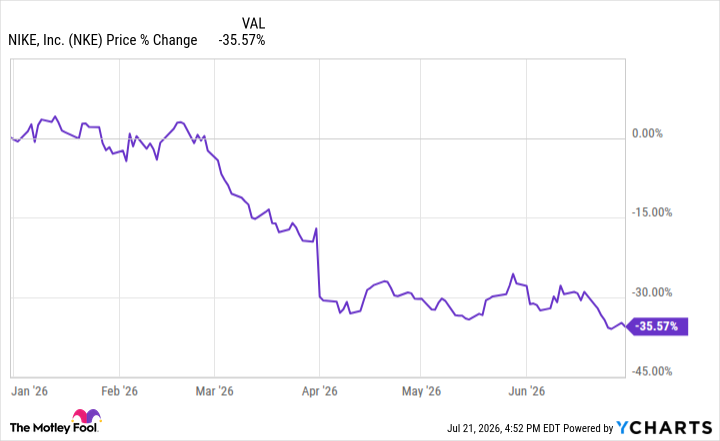
Nike’s slide continues
Nike’s issues in the first half of the year will be familiar to anyone who has followed the stock in recent years.
Investors have been hopeful that Elliott Hill, who took over as CEO nearly two years ago, could turn the business around, but that has yet to materialize.
In the first half of the calendar year, tariffs hit the company’s profits sharply. In its third-quarter earnings report, revenue was flat at $11.3 billion, and gross margin fell 130 basis points to 40.2%.
The stock fell 15.5% on April 1 after the report came out, its worst day of the year. However, investors seemed to be more concerned about its forecast of declining revenue in the fourth quarter and comments on the earnings call that it didn’t expect gross margin to return to growth until the second quarter of fiscal 2027, which ends this November. Investors were hopeful that it would get back to margin expansion sooner than that.
Additionally, the stock sank in March as the war in Iran weighed on stocks broadly, especially consumer discretionary names like Nike. Nike is sensitive to inflation, which can impact consumer spending, and the war also has the potential to disrupt supply chains.

Image source: Getty Images.
What’s next for Nike
Nike stock initially plunged on its fourth-quarter earnings report, released on June 30, falling double-digits in the after-hours session. However, the stock finished up 5% the following day, a sign that investors may believe that Nike is bottoming out.
The results were again mostly underwhelming, with revenue down 1%, but investors seem convinced that the new fiscal year would bring a return to margin expansion, which it continues to expect in the second quarter.
Nike’s turnaround is showing results in some categories as it’s now growing and gaining market share in running, but there’s still a lot of work to be done. At this point, it’s hard to call the stock cheap even as it’s fallen more than 75% from its peak, but there’s certainly upside potential if it can return to growth on the top and bottom lines.