Retail prices make poor targets for excise taxAn excise tax is a tax imposed on a specific good or activity. Excise taxes are commonly levied on cigarettes, alcoholic beverages, soda, gasoline, insurance premiums, amusement activities, and betting, and typically make up a relatively small and volatile portion of state and local and, to a lesser extent, federal tax collections. policy, often reflecting factors that have little to do with the underlying reasons for which an excise taxA tax is a mandatory payment or charge collected by local, state, and national governments from individuals or businesses to cover the costs of general government services, goods, and activities. is levied in the first place. Unfortunately, the World Health Organization (WHO) has a growing preference for using tax share of retail price (tax incidenceTax incidence is a measure of who bears the legal or economic burden of a tax. Legal incidence identifies who is responsible for paying a tax while economic incidence identifies who bears the cost of tax—in the form of higher prices for consumers, lower wages for workers, or lower returns for shareholders.) as a primary policy target. For tobacco, the WHO recommends that taxes account for at least 75 percent of the final retail price.
The problem is that price shares are a poor measure of efficient or effective tax policy. A tax accounting for 75 percent of the price of a €2 product is economically very different from one accounting for 75 percent of a €20 product. Consumers experience the tax burden in absolute terms, governments collect revenue in absolute terms, and behavioral responses depend on those burdens—not on arbitrary percentages embedded in retail prices.
Good tax policy should be designed around the tax revenue growth policymakers are seeking to achieve, as well as the behaviors they are trying to influence. Price-based incidence targets do neither.
75 Percent Tax Incidence Reflects a Flawed Ideology
The first problem with the WHO’s tax incidence target is that its definition lacks clarity and consistency. For example, according to the WHO’s Technical Manual, the 75 percent target includes all taxes, including import duties, excise taxes, and value-added taxes (also known as goods and services taxes). However, their inclusion depends on whether cigarettes are domestically manufactured or imported. Other times, it appears that the WHO suggests fiscal policymakers target excise duties only. This shifting guidance makes the WHO’s target problematic.
The second serious drawback is practical: many countries would have to make significant changes to conform. The WHO’s own data reveal that out of the 178 countries for which it collects and reports data, only 39 (22 percent) meet the WHO’s recommended 75 percent tax incidence rate.
Of the 39 countries that meet the target, 25 are classified as high-income countries by the World Bank. And of these, 20 are within the EU. This all suggests that the benchmark is not globally representative. A policy that works well in high-income countries doesn’t necessarily work well in less-developed countries.
However, there are reasons to question whether it is an appropriate policy target at all.
Higher cigarette taxes decrease disposable income for people already struggling with rising costs for housing, groceries, fuel, and everyday essentials. By layering another steep increase on a product disproportionately purchased by lower‑income residents, lawmakers risk deepening financial strain at a time when meeting basic needs is a challenge for many.
Further, policymakers should recognize that tax incidence and tax burden are separate measures. Broad tax bases and low tax rates can generate more revenue than high tax rates applied on narrow bases. It is quite possible to have a high tax incidence and a low tax burden (e.g., Bangladesh) and a low tax incidence and a high tax burden (e.g., Germany).
The reason for this is clear. Tax incidence is calculated by dividing total taxes by the retail price of the product in question. Government policy can affect tax policy—the only item in the numerator in this equation. But the denominator in our tax incidence equation is comprised of taxes plus pre-tax prices, made up of manufacturing and distribution costs over which the authorities have no control and which will vary substantially geographically based on differences in costs, the economic conditions by country, the nature of retail competition across markets, and so on.
The right level of taxation will be profoundly different from one country to the next, and will depend on many factors, including the level of economic development, public policy objectives, enforcement capabilities, and any number of other factors.
Instead of targeting a measure they don’t have full control over, like retail prices, tax policy is better aimed at a target they do have control over, like a specific tax rate. An ad quantum tax defined in euros, dollars, or local currency is a far better policy target.
Basic economics tells us that higher prices of a specific product will decrease legal sales. If you look at the WHO’s own published data, it is abundantly clear that there is a strong positive correlation between the retail price of cigarettes and the tax yield in currency terms. So, if the policy goal is raising the price of legal cigarettes, then it makes more sense to target an ad quantum rate than the tax share of final retail prices. And, similarly, tax revenues depend not on the tax incidence, but on tax rates in currency terms.
Tax Revenue Increases Aren’t Guaranteed Everywhere
Consumer responses vary substantially across products, income groups, and markets. As taxes rise, substitution, avoidance, cross-border purchases, and illicit activity can all affect collections. Therefore, the relationship between higher tax rates and higher revenue is neither linear nor universal.
For instance, higher tax rates incentivize tax evasion and illicit activity. As tax rates increase, consumers and suppliers search for ways around these costs. In cigarette markets, for example, consumers tend to shop across borders where the tax rates are lower, and illicit market entrepreneurs develop black and gray markets to sell illegally to consumers, paying little or no tax at all. Not surprisingly, higher tax rates are linked with higher levels of smuggling.
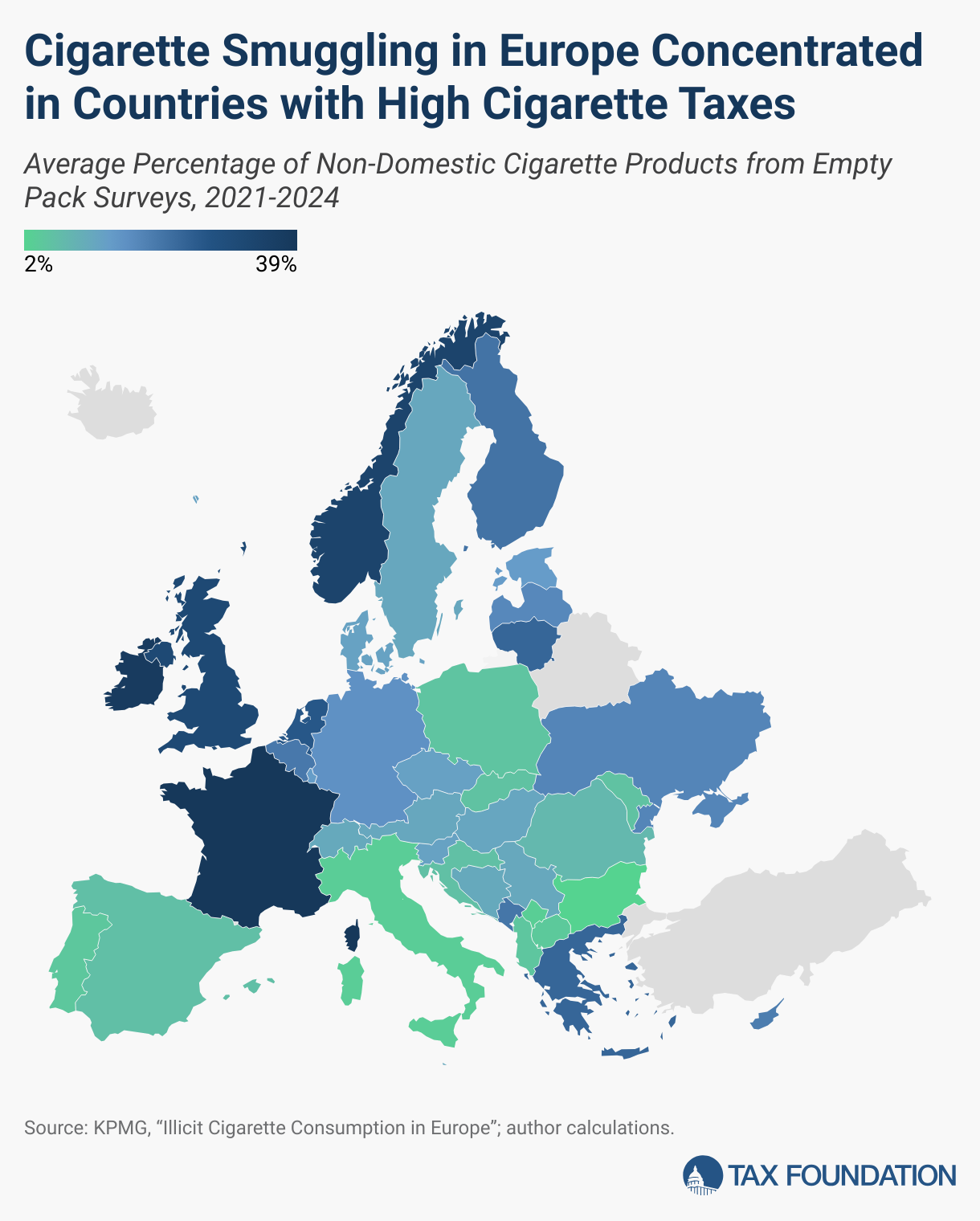
In 2025, more than 10 percent of cigarettes consumed in the EU were counterfeit or contraband. These nearly 42 billion cigarettes avoided approximately €16.7 billion in taxes for Member States.
Not surprisingly, smuggling is most heavily concentrated in countries where tax rates are greatest. More than a third of cigarettes consumed in Ireland and France are not legally purchased in those countries. Across the EU, one additional euro tax per pack of 20 cigarettes increases smuggling by roughly 7 percent.
This kind of tax avoidance helps explain why so many EU countries that relied on taxes to decrease smoking have failed to achieve their targeted goals. Ireland, for example, levies the highest cigarette tax in the EU at €10.71 ($12.58). Despite its high tax rates, smoking rates remain persistently high. The country’s goal to decrease smoking rates to less than 5 percent by 2025 was missed by a factor of more than three, as smoking rates stayed at roughly 17 percent. In these jurisdictions, achieving the WHO’s target has not been successful from the perspective of the public purse nor in terms of reducing tobacco consumption.
A drastic increase in tax rates threatens to exacerbate existing problems in well-established illicit cigarette markets and to spur the development of other illicit markets for newly high-tax products.
Illicit consumption obviously undermines revenue goals, but it also undermines public health goals. Products that avoid tax regimes also avoid regulatory regimes meant to protect consumers and any accountability in court systems for injuries caused.
By targeting tax incidence, the WHO mistakes higher prices for better public health and tax revenue outcomes. A universal tax incidence target ignores differences in existing tax systems, consumer behavior, and the products being taxed, while risking greater tax evasion and illicit trade. Rather than pursuing arbitrary price benchmarks, policymakers should focus on evidence-based reforms that directly target harmful consumption, improve tax design, and encourage lower-risk alternatives where appropriate.
Taxes make more sense with us in your inbox.
Subscribe to our newsletter for tax insights that cut through the noise—and make sense of it.
Share this article