In the resource-strained for-purpose sector, AI tools may help teams work faster, reduce manual effort, and recover time for higher-value work. However, individual productivity gains do not automatically translate into organisational value, and in some cases may divert attention from important work. Effective adoption focuses less on how much AI can produce, and more on how it can support mission-critical outcomes.
Use is growing fast, but is the sector ready?
AI tools are now widely accessible, and individuals across the sector are experimenting with these tools and already seeing practical benefits.
AI has the potential to positively reshape our sector, not by replacing human connection, but by strengthening it. It can help us extend our reach, support more clients, and improve service consistency, while still preserving the empathy, trust and judgement that sit at the heart of our work.
Marc Haynes, Chief Operations Officer, Justice Support Centre (a Sydney-based organisation providing domestic and family violence support)
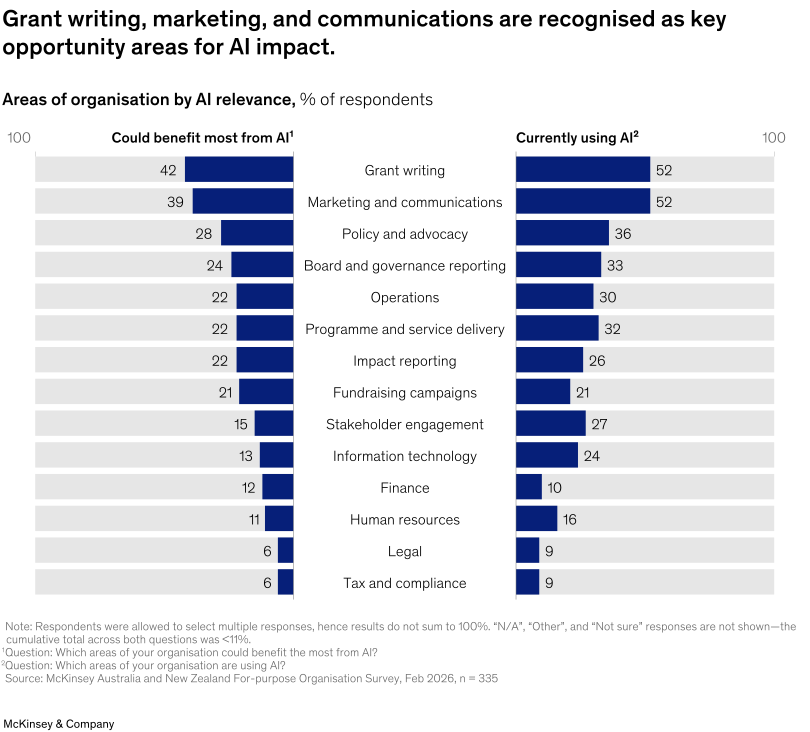
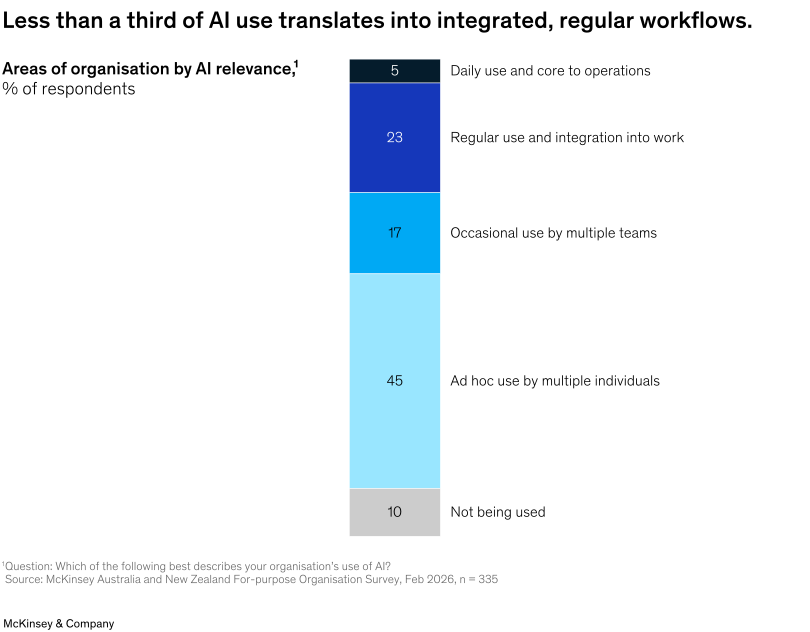
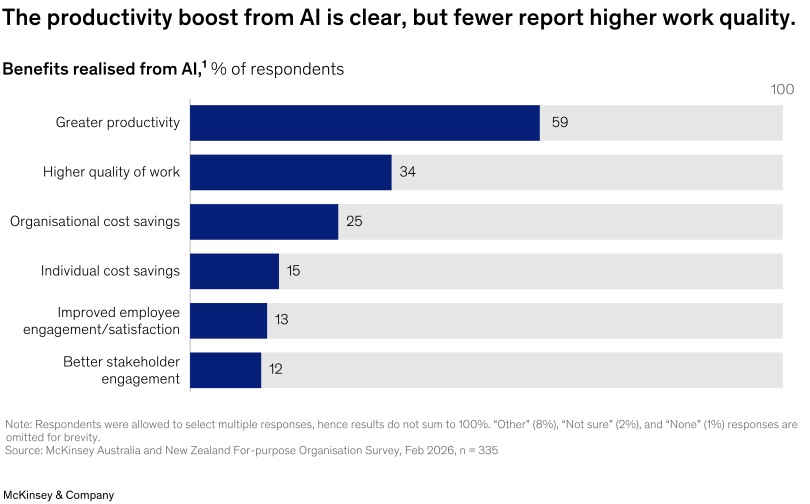
In McKinsey’s recent survey of for-purpose organisations in Australia and New Zealand (see sidebar “Our AI survey methodology”), 59 percent of respondents said they used AI on a regular or daily basis. A similar share reported increased productivity from AI use. Respondents also saw clear opportunities for AI to create future value, particularly in grant writing, and marketing and communications (Exhibit 1).
With AI, some tasks may be completed faster and potentially to a higher standard. However, the survey suggests that many benefits remain concentrated at the individual level, rather than translating into more integrated organisational change (Exhibit 2).
Frequently, AI is layered over existing ways of working rather than used as a prompt to reassess processes. Applying AI to inefficient workflows might make tasks faster, but it does not automatically improve how the task is done. Often this means any time saved is absorbed by routine tasks rather than redirected to higher-value work. This friction helps explain why only 34 percent of survey respondents reported that AI supported higher quality of work (Exhibit 3) and suggests a gap between AI adoption and organisational impact—a finding also reflected in McKinsey’s cross-sector AI research.
The survey also indicates that governance remains underdeveloped. Forty-one percent of respondents reported that their organisations lack policies or guidelines for ethical AI use, while only 21 percent reported having formalised them.
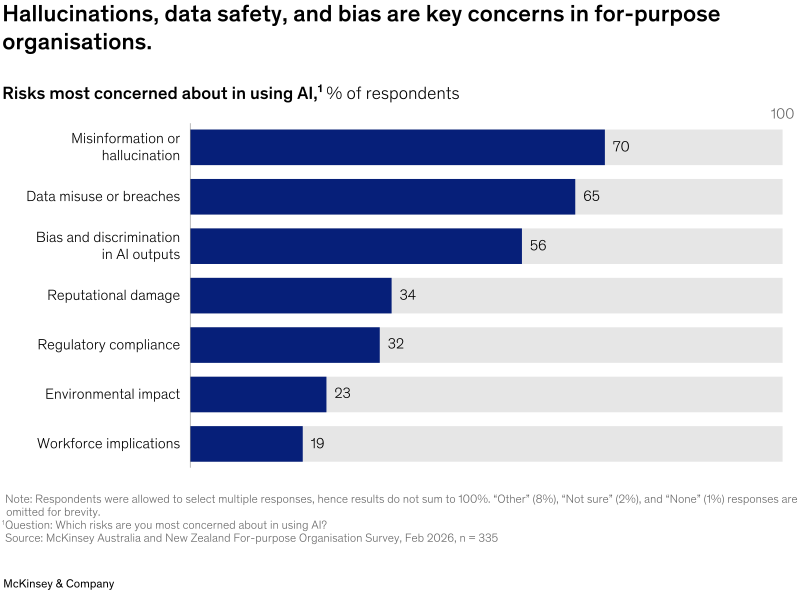
This lack of guidance can contribute to uncertainty for leaders and teams who are being asked to make decisions about rapidly developing technologies they are still learning to use. Without policy-driven guardrails like human validation and strict data protocols, it can become difficult to manage the risks that respondents are most concerned about, including misinformation, hallucinations, and data security (Exhibit 4). These concerns are understandable: For organisations where currency is trust, a single high-profile AI failure could affect funder or community confidence.
Protecting the time and space to think
Critical activities in the for-purpose sector, including grant decisions, client assessments, and advocacy, depend on the quality of human judgement. Protecting this cognitive space matters more than increasing throughput. Yet this can be challenging in high-demand environments where leaders and teams are often operating with limited capacity.
Earlier McKinsey research found that 88 percent of Australian for-purpose leaders are at risk of, or experiencing, burnout, often over extended periods. In these contexts, AI adoption may not automatically reduce pressure. If introduced without sufficient support, clear guidelines, or workflow redesign, AI can create additional demands for leaders and teams, including the need to assess outputs, manage risks, and decide where use is appropriate.
The existing burden can also influence how AI is adopted and used in the organisation. When leaders and teams feel under pressure, they may have less capacity to make thoughtful decisions about where AI should be used, how outputs should be reviewed, and when critical human judgement is necessary.
Under sustained pressure, several factors can make it harder to evaluate AI outputs and risks:
- impaired judgement: Sustained stress can affect the ability to think flexibly and apply sound judgement.
- inaccurate assessment: Neuroimaging research indicates that people may be able to detect when AI-generated content feels inconsistent or “off.” For example, AI-generated voices can activate brain regions associated with error detection. When resourcing feels constrained, staff may not have the time or cognitive capacity to investigate these signals, potentially increasing the risk of AI outputs being accepted without sufficient scrutiny.
- stress-driven responses: Under pressure, leaders may be more likely to default to avoidance (“we’ll deal with AI later”), over-control (“nothing gets used without approval”), false certainty (“AI can handle that”) or unchecked use (“it looks fine to me”). Each response may limit an organisation’s ability to adopt AI effectively.
The pressure … to adapt to AI is immense, [in] an already demanding environment shaped by years of external disruption. A growth mindset is essential, but that doesn’t diminish the reality of the uncertainty.
Tracie Olcha, CEO, Australian Jewish Funders
Aligning AI use with mission outcomes
The priority for leaders is to create the conditions in which AI can be applied safely and systematically, focusing on what matters most to the organisation. This means aligning adoption with outcomes while also considering staff well-being and capability at every level.
Through McKinsey’s for-purpose partnerships, we support organisations to build the conditions for this alignment (see sidebar “Australian Jewish Funders: Engaging AI with rigour”). To begin an effective AI adoption process, leaders may wish to consider five practical steps:
- Treat AI as a significant organisational investment. Avoid reactive adoption by first examining whether workflows are fit for purpose and whether AI would genuinely advance the mission. New tools should be introduced with the same rigour as any significant organisational investment.
- Identify what should remain human-led. Be explicit about which skills, tasks, and relationships should not be automated. These may include complex case discussions, in-person learning opportunities for junior staff, or sensitive client interactions.
- Create space for honest discussion. Leaders can acknowledge that technology is moving quickly and that many people are still building their understanding of AI’s uses and limitations. Inviting staff to share their concerns, hopes, and red lines can help surface issues early, before they appear as resistance, workarounds, or quiet disengagement.
- Set concrete policy boundaries. Define categories of information or activities that should remain outside AI-enabled workflows, such as personal data and sensitive correspondence. Put those decisions into a written policy that your team can refer to. Vague or unwritten boundaries leave teams guessing about what is permitted.
- Select pilots with care. A high-value, low-risk use case may provide a useful starting point. Map the existing workflow, pain points and stakeholders, and ground the pilot in a real problem. Policy, guardrails and technology can then be tested simultaneously.
AI may increase speed and output, but these gains alone are unlikely to improve outcomes. Its value will depend on whether organisations can develop the capacity to rethink how work is done and direct effort toward their most important priorities.