New York City’s traffic is legendary. In 2024, congestion in the city was the worst in the United States, with delays per driver reaching 102 hours.
In the same year, the Metropolitan Transportation Authority (MTA), the operator of New York’s subways and commuter rail, saw a deficit of $8.3 billion. The combination of the two factors led to a vicious cycle. As the MTA struggled to maintain its service quality, commuters turned to driving. This lowered MTA revenue while increasing delays for drivers.
To remedy this, New York City implemented a congestion pricing program in January 2025. This initiative, modeled after similar systems in cities such as Singapore, Milan, and London, charges drivers a fee of $9 a day for driving in the city’s most congested areas. The goals: raise revenue to support the MTA while pushing people onto alternative transportation, decreasing congestion.
So far, it’s worked. NYC’s congestion tolling has reduced congestion, raised money for the MTA, and sped up vehicles in the city. Its success has inspired proposals for congestion tolling in other major US cities, like Los Angeles and Washington, DC.
Why Implement Congestion Pricing?
Traffic is economically inefficient. Delays increase exponentially with respect to the number of drivers on roads. But while each driver loses time to delays, there isn’t an inherent mechanism that charges drivers for the marginal congestion that they create.
Congestion pricing has two separate functions. First, like other road use charges, the toll acts as a user feeA user fee is a charge imposed by the government for the primary purpose of covering the cost of providing a service, directly raising funds from the people who benefit from the particular public good or service being provided. A user fee is not a tax, though some taxes may be labeled as user fees or closely resemble them.. Entering the city causes wear and tear on road infrastructure, which can be partially offset by revenues from the scheme. The toll also serves as a Pigouvian tax. Driving in congested areas creates harm to others in the form of traffic and pollution. Charging drivers a fee for these external harms forces drivers to incorporate those added costs into their decision-making and ultimately reduces congestion.
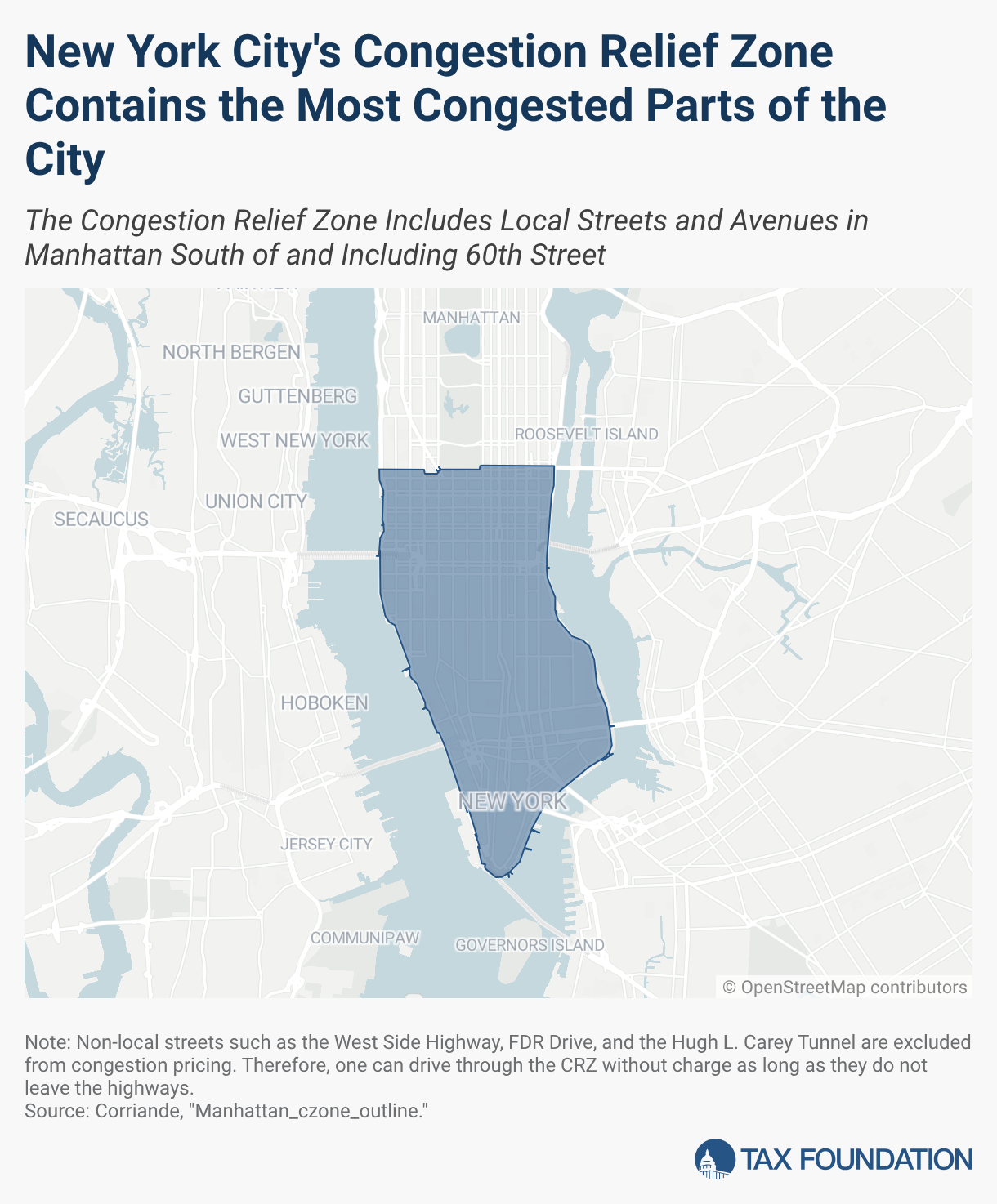
The MTA designed the Congestion Tolling program to be as non-disruptive as possible. Entries to the CRZ are tracked by E-ZPass, an electronic toll collection system, as well as a network of over 1,400 license plate scanners. This minimizes the disruption of traffic while automating compliance.
Fees differ based on vehicle type. Large trucks and sightseeing buses are charged the most, at $21.60 per entrance, while motorcycles pay $4.50. For most vehicles, the fees apply a maximum of one time per day, though taxis and rideshare vehicles are charged per entrance at a lower price of $.75 for taxis and $1.50 for rideshare vehicles.
Fees also differ based on the time of day. During the peak period, which lasts from 5 a.m. to 9 p.m. on weekdays and 9 a.m. to 9 p.m. on weekends, drivers are charged the full toll, while off-peak there is a 75 percent discount.
Congestion Pricing Decreased CRZ Traffic in 2025
According to the MTA’s First Evaluation Report, congestion pricing raised revenue, decreased CRZ congestion, and increased public transit ridership. Comparing 2024 and 2025, the report found that vehicle entries into the CRZ decreased by 11 percent, with a corresponding increase in transit ridership of 9 percent. This has caused average vehicle speeds within the CRZ to increase by 4.6 percent and speeds on crossings into Manhattan to increase by an impressive 23 percent.
Decreasing congestion also decreased emergency medical service (EMS) response times by an estimated 5-6 percent (63 to 70 seconds). When “time is tissue,” improved EMS performance saves lives.
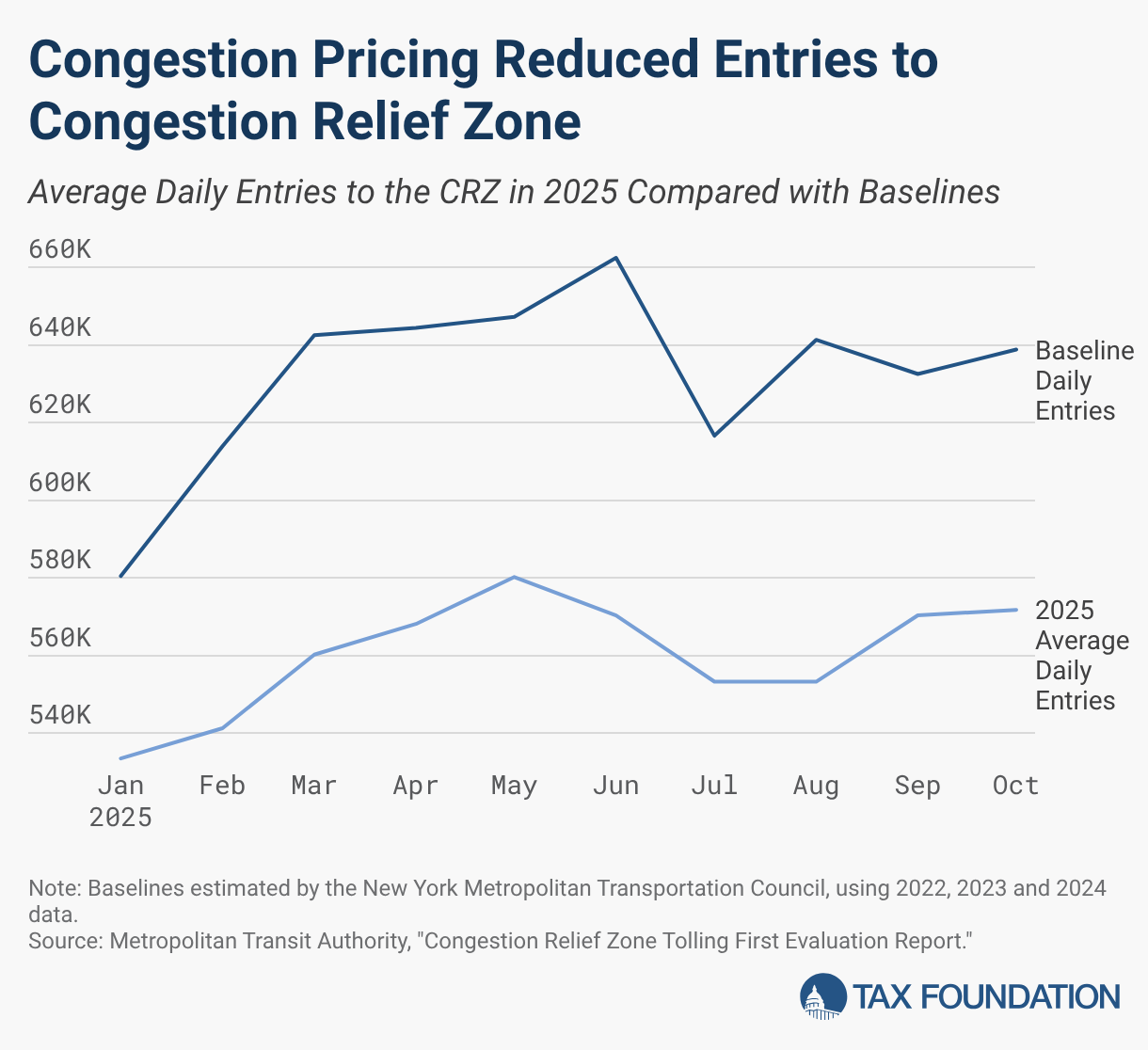
Congestion pricing has also reallocated traffic to less congested times of day. The hours immediately before and immediately after the maximum toll price are the only hours that have seen an increase in vehicle travel in 2025 compared to 2024.
During this first year of operation, the Congestion Relief Zone Tolling recorded an average monthly revenue of $55 million. This has allowed the bonding of $15 billion for the MTA’s capital plan.
NYC’s congestion pricing wasn’t a perfectly smooth ride. Shortly after the tolling scheme began, it faced federal legal challenges. In February of 2025, Secretary of Transportation Sean Duffy attempted to withdraw federal approval and funding, culminating in a lawsuit where he alleged that the program had violated federal restrictions. The case is ongoing, though the court has issued an order rejecting the federal attempts to stop the program. As of now, the case is waiting to be heard by the 2nd Circuit Court of Appeals.
Overall, congestion pricing is an economically efficient taxA tax is a mandatory payment or charge collected by local, state, and national governments from individuals or businesses to cover the costs of general government services, goods, and activities. that reduces traffic while raising revenue. However, questions remain about its role in the US. This early congestion pricing policy appears to work in NYC, but the Big Apple is unique among American cities. NYC has the nation’s largest population, faces serious traffic congestion, operates a sprawling mass transit system, and contains one of the densest concentrations of jobs in the world in Lower and Midtown Manhattan.
No other American city matches this profile. In fact, many are struggling to attract business back into their downtowns in the work-from-home era, so following New York’s example could be harmful. Nevertheless, New York’s positive experience with congestion pricing could prove to be a vital data point for the expansion of congestion pricing traffic policies.
Taxes make more sense with us in your inbox.
Subscribe to our newsletter for tax insights that cut through the noise—and make sense of it.
Share this article