Ottawa continues to constrain provincial health-care policy options
beng
EST. READ TIME 3 MIN.
Canada’s provincial health-care systems have long suffered from a policy-driven confluence of high spending and poor performance. While some provinces have attempted minor reforms, most (with the notable recent exception of Alberta) have largely remained committed to the status quo of monopolistic health care dominated by government. This lack of provincial policy innovation is at least partly driven by the federal government’s involvement in provincial policymaking through the Canada Health Act (CHA) and the cash transfers tied to provincial compliance.
Put simply, health care is constitutionally a provincial responsibility, and provinces are able to choose their own health policies. But Ottawa influences provincial decisions substantially through cash transfers, which are tied to the federal template for health care outlined in the CHA alongside various federal interpretations of the CHA made over the years. Provinces found to violate Ottawa’s requirements risk potential reductions or even total withdrawal of their cash transfers for health care. The CHA and past interpretations largelyfavour a government-dominated model of health-care insurance, explicitly disallowing and discouraging a number of policy approaches commonly found in other often higher-performing universal health-care countries.
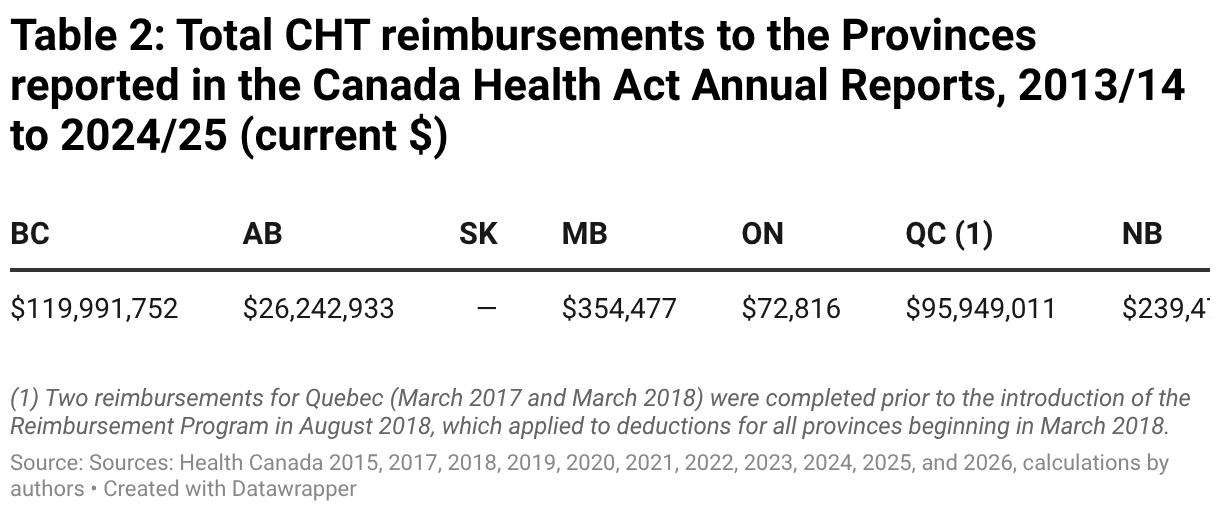
This federal constraint is not just theoretical. A recent review of federal actions between 2014 and 2024 revealed Ottawa levied a total of $267 million in deductions for provincial non-compliance. Health Canada reimbursed $195 million (of the $267 million) to provinces that fell back into line with federal requirements.
An examination of the latestCanada Health Act Annual Report reveals Ottawa continues to actively penalize provincial policy approaches that fall outside federal preferences.

In 2024/25, eight of Canada’s provinces were fined a total of $62.2 million for CHA infractions, with fines ranging from $35.2 million in Quebec to $3,787 for Newfoundland and Labrador. Yukon was also fined $50 for non-compliance in 2024/25, after a physician was found to have charged a patient for services over and above the amount billed to the province (a disallowed practice defined as extra-billing in the CHA).
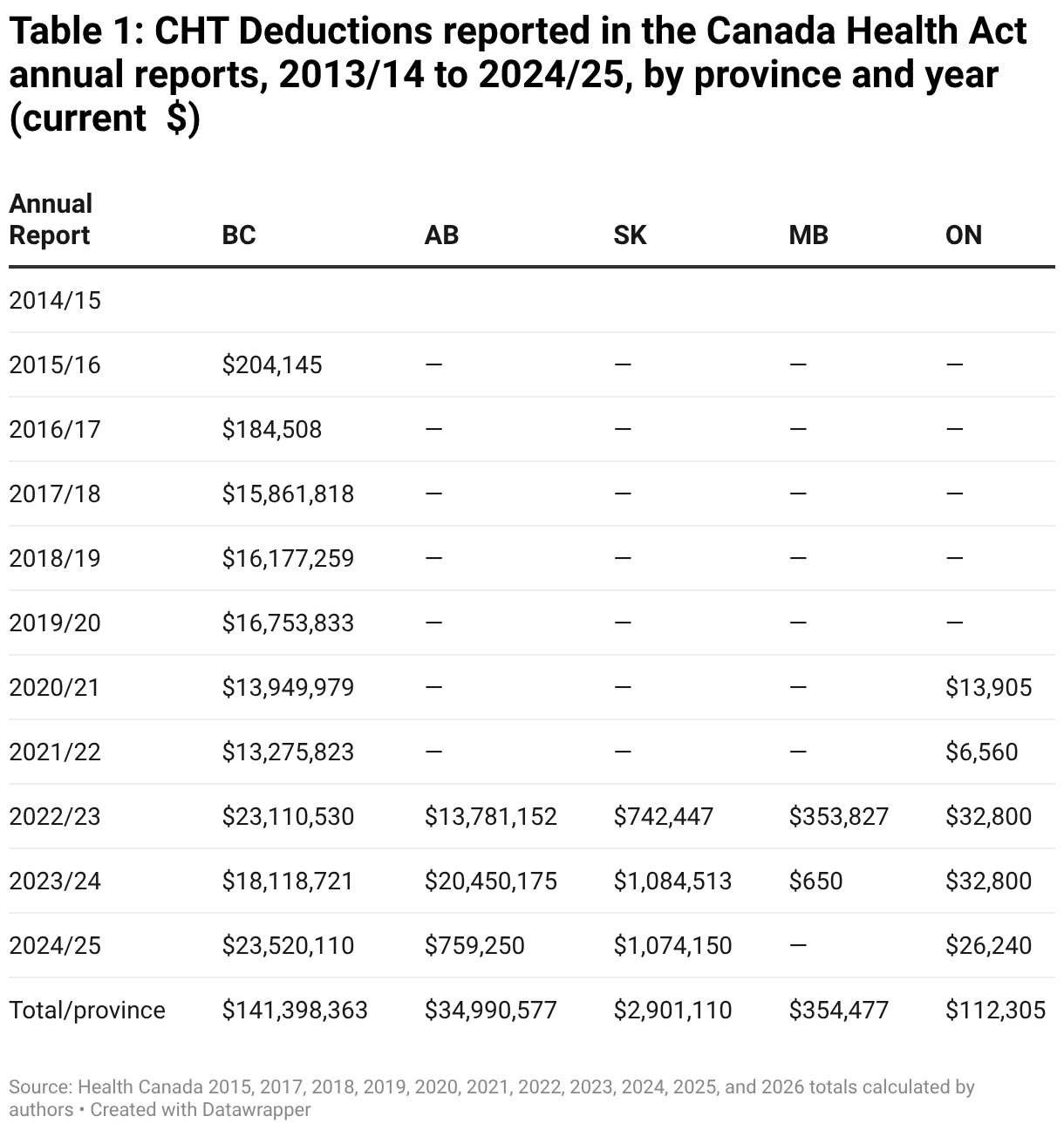
Provinces also continued to work towards compliance with the federal government’s policy preferences in 2024/25, being reimbursed a total of $51.9 million in 2024/25 for resolving or working towards resolving the conditions under which their penalty arose in the first place.
In total, provinces have faced CHA non-compliance penalties of $329 million since 2014/15. Of that amount, $247 million has been paid back to Quebec first and later to other provinces under the “Reimbursement Policy” introduced in 2018.
While the dollar amounts deducted from provincial transfers are small—the $62.2 million in penalties in 2024/25 comprised only 0.12 per cent of the $52.1 billion Ottawa transferred to the provinces that year—no province has yet dared enact any large-scale reforms (e.g. a Swiss- or Dutch-style approach that allows citizens to choose between insurance companies and even personalize their coverage within the universal scheme, or introducing patient cost-sharing/user fees) that clearly run afoul of the CHA. Only Alberta has recently pushed to allow patients to purchase non-urgent health-care services privately from doctors who also work in the public system. While this approach does not clearly violate the CHA, the federal government has repeatedly and again recently suggested it may not comply with its reading of the CHA. Just as importantly, the provinces (including Alberta) have largely worked with the federal government towards reimbursement and resolution of past CHA violations and deductions.
The withholding of transfers and the spectre of much larger penalties, combined with the potential political consequences of being branded a violator of the CHA, clearly creates a powerful disincentive for provincial governments to innovate and reform. This is true even when those reforms have value and are commonly found in other universal health-care countries that routinely outperform Canada on many key indicators including wait times.
Ottawa’s involvement in provincial health-care policy, which holds the provinces back from positive reforms under the threat of financial penalty and political fallout, is unhelpful. Ottawa should stop resisting reforms to the failed status quo and allow the provinces to fix their health-care systems.

By: , and