Strong earnings and excitement around the artificial intelligence (AI) boom have made U.S. growth stocks a great way to invest over the past 10 to 15 years. One low-cost exchange-traded fund (ETF) that makes it easy to invest in a targeted portfolio of America’s largest, fastest-growing companies is the Schwab U.S. Large-Cap Growth ETF (SCHG -0.34%).
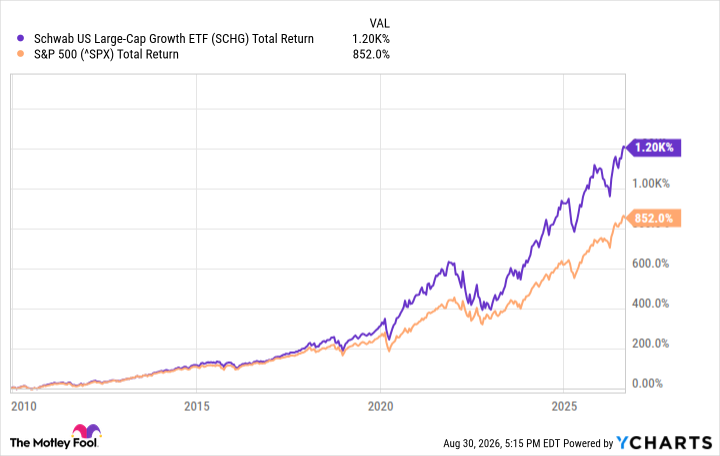
This Schwab fund launched in December 2009 and has a strong track record of performance. SCHG delivered average annual returns (by net asset value) of 16.4% since the fund’s inception. It has strongly outperformed the S&P 500 index (^GSPC -0.33%):
Data by YCharts.
What if the Schwab U.S. Large-Cap Growth ETF can keep growing strong for the next 15 years and beyond? Let’s see how your money could grow with this low-cost growth stock ETF.

Image source: Getty Images.
Schwab U.S. Large-Cap Growth ETF (SCHG): 10 years of 18.2% annualized returns
The Schwab U.S. Large-Cap Growth ETF is not a broadly diversified total stock market index fund. Instead, it offers a more targeted portfolio of 196 large-cap stocks expected to exhibit strong growth-style characteristics. SCHG charges an ultra-low expense ratio of 0.04%, which is lower than what many popular tech ETFs charge.
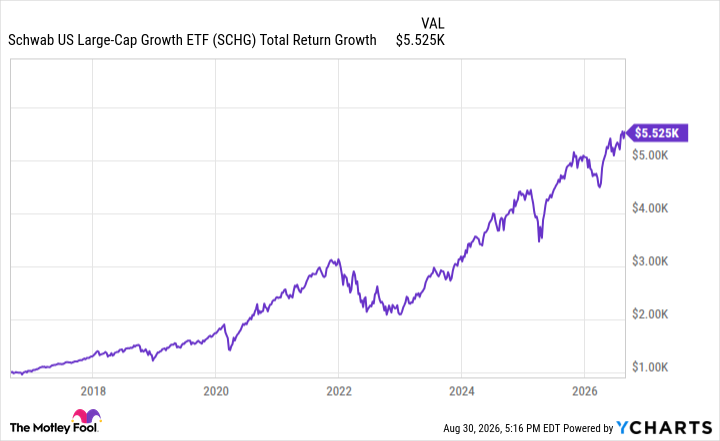
SCHG has outperformed the S&P 500 since December 2009. But the past 10 years have been even better for this growth stock fund. In the past 10 years, SCHG has delivered annualized returns of 18.2%. If you had invested $1,000 in SCHG 10 years ago, you’d have $5,525 today (with dividends reinvested).
Data by YCharts.
How $1,000 invested in SCHG could grow
There’s no guarantee that any fund or stock will deliver the same high returns forever. But let’s assume you invest $1,000 into SCHG today, and leave that money alone to grow, with dividends reinvested. And let’s assume SCHG can keep earning 18.2% average annual returns along the way.
After 10 years, you would have $5,319.
After 15 years, you would have $12,266.
And after 20 years, your initial $1,000 investment would grow to $28,289.
Ben Gran has no position in any of the stocks mentioned. The Motley Fool has no position in any of the stocks mentioned. The Motley Fool has a disclosure policy.