Sandisk Is Up 429% This Year — Its $15.5 Billion Stock Buyback Suggests Management Thinks Shares Are Still Cheap
Sandisk (SNDK +2.68%) is a leading innovator in flash memory and advanced data storage solutions. The company supplies high-capacity NAND products essential for accelerated computing. In the artificial intelligence (AI) infrastructure era, Sandisk’s enterprise solid-state drives (SSDs) and related technologies form a critical layer in hyperscale chip stacks — providing massive data storage, retrieval, and low-latency access for inference workloads and next-generation agentic systems.
The AI data center build-out boom has transformed Sandisk’s business, and its shares have gained ground accordingly. Since its return to the market as an independent public company in February 2025, the stock has risen by more than 3,400%. And even though the shares have surged more than 400% so far in 2026 alone, I think further gains appear almost certain as the company converts secular demand into durable revenue acceleration and earnings power.
Image source: The Motley Fool.
Looking at Sandisk’s share buyback history
Sandisk’s approach to returning capital has accelerated since the company was spun off by Western Digital (which acquired it in 2016). In its fiscal 2026 third quarter (which ended April 3), the company’s board of directors authorized a $6 billion share repurchase program.
Management moved swiftly, deploying roughly $4.5 billion during the fiscal fourth quarter alone to retire shares. With only $1.5 billion remaining under the prior authorization, the board approved an additional $14 billion buyback program, lifting the company’s total remaining authorization to $15.5 billion. Its market cap is currently in the neighborhood of $186 billion.
This stepped-up commitment reflects both the scale of the company’s cash flow generation and its clear intention to continue shrinking the company’s share count at a meaningful pace.

Today’s Change
(2.68%) $33.13
Current Price
$1,271.05
Key Data Points
Market Cap
Day’s Range
$1242.06 – $1287.04
52wk Range
$42.82 – $2354.39
Volume
259.1K
Avg Vol
13.4M
Gross Margin
71.47%
Why do companies buy back their own stock?
Share buybacks serve as a unique form of capital allocation. By reducing the number of shares outstanding, companies increase earnings per share (EPS) and the ownership stakes of their remaining investors.
Generally speaking, management teams authorize stock buybacks only when they believe shares are trading below their intrinsic value or when the excess cash they have available exceeds their reinvestment needs. Sandisk’s decision signals confidence: Leadership is effectively showcasing that the best use of its capital is to invest in the company’s own equity rather than paying dividends, making acquisitions, or letting cash sit idle on the balance sheet.
Sustained buyback programs often coincide with periods when the underlying business is achieving robust cash generation and has an optimistic growth outlook, reinforcing the view that future earnings will justify the stock’s current valuation.

Image source: Getty Images.
Why Sandisk stock remains a reasonable buy
Despite its parabolic rise, Sandisk stock still screens as reasonably valued based on forward valuation metrics. Analysts’ consensus estimates are for EPS of $212 for its fiscal 2027 (which just started last month). At its current share price, that gives it a forward price-to-earnings (P/E) ratio of roughly 6. This is quite modest compared to other leading semiconductor stocks in the AI chip value chain.
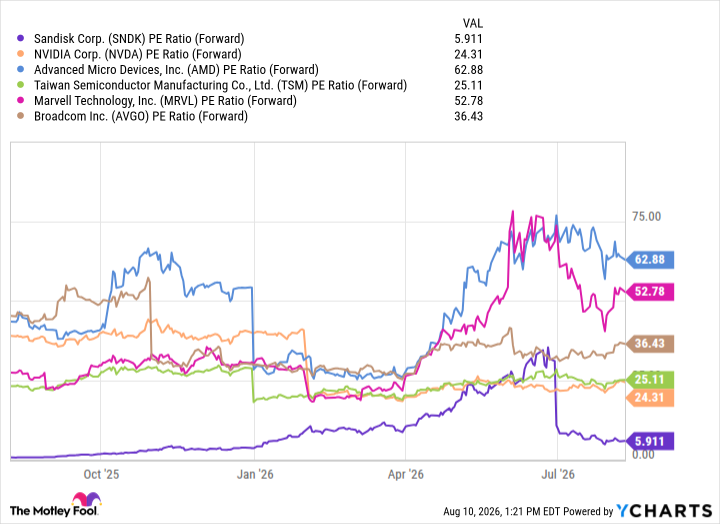
SNDK PE Ratio (Forward) data by YCharts.
Meanwhile, Sandisk’s revenue rose by 175% to $20.3 billion in fiscal 2026 (which ended July 3). Sales during the fourth quarter alone hit $8.9 billion, up 372% from the prior-year period, and up 51% sequentially. Revenue from its data center segment more than doubled sequentially and rose 437% year over year.
Another important detail smart investors are not overlooking is Sandisk’s ability to lock in future revenue through what it calls its “new business model” agreements — long-term deals with large buyers of memory. The company has secured eight multiyear supply contracts that establish a minimum contracted revenue floor of $93.9 billion, supported by $16.5 billion in prepayments.
Its remaining performance obligations stand at roughly $60 billion and rise to more than $90 billion when accounting for recently signed customer expansions. These contract arrangements provide the company with a level of revenue visibility and pricing protection that prior memory cycles did not afford.
Combined with consistent free-cash-flow conversion and gross margins that have expanded to nearly 85%, the foundation for sustained revenue acceleration and compounding profitability is firmly in place. As this positions it for consistently higher earnings, I think valuation expansion becomes almost inevitable for Sandisk. Investors who are able to buy Sandisk stock at today’s modest price point may want to consider scooping up shares with the intention to hold onto them over the next couple of years as the AI capex cycle unfolds.