The job nobody prepares you for: are ministers set up to fail in government?

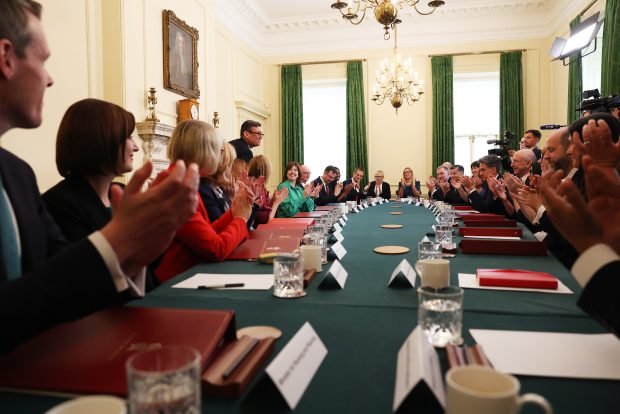
Photo by Lauren Hurley / No 10 Downing Street via Flickr
The work of ministers is crucial in governments around the world – but politicians take up these roles with limited preparation or specific skills. Professor Nada Kakabadse of Henley Business School explores how governments can make the relationship between ministers and permanent secretaries work better from the beginning
Every major profession demands preparation before people take charge. Medicine, law and the military all do it. But government remains a striking exception, and repeated failures show why this needs to change.
Think about the times a government programme failed expensively and in plain view of the public. In the UK, the A-level grading algorithm disadvantaged many state-school pupils; the 2022 mini-Budget sent sterling tumbling; the evacuation from Afghanistan was widely criticised as too slow, and it unfolded while the then foreign secretary remained on holiday.
The post-mortem often reaches for familiar explanations: civil service failure, institutional dysfunction or just bad luck.
But a harder question is rarely asked. What kind of leader was in charge? What preparation had they received? And what would it have taken for those around them to say, clearly and early enough to matter: ‘This is all going wrong’?
The civil service attracts much of the blame when government fails. Some criticism may be justified, but it is incomplete. Research conducted by the late Professor Andrew Kakabadse and colleagues at Henley Business School, based on confidential interviews across government, found that both sides of this crucial relationship can be set up to fail from the outset.
Ministers arrive with little preparation for the job. Officials can be loyal to the point where voicing an uncomfortable truth becomes genuinely difficult. Meanwhile, no one has deliberately designed the relationship between them to work.
This isn’t a counsel of despair; it’s a design problem, and design problems can be solved.
As the Institute for Government observed: “It is hard to think of another profession or career where an individual could rise to the very top, and assume a position of heavy responsibility, having had no previous acquaintance with that line of work.”
The arithmetic of inexperience
Since 1997, the average Cabinet minister in the UK has spent less than two years in any one post. Developing a genuine working knowledge of a complex department can take between one and two years.
Government is therefore often led by ministers who are still getting to grips with their brief, or who are moved just as their knowledge becomes useful.
Over one six-year period, the Department for Work and Pensions had eight different secretaries of state. Our research suggests that a new executive can take about 10-18 months to become fully productive. A minister may therefore have only a short effective period in which to lead a department spending billions and serving millions.
The debate around civil service capability tends to miss the corresponding obligation. Ministers should be prepared for the role they are about to assume. The officials supporting them should also be developed not simply to serve, but to lead, including when leadership means saying something unwelcome.
Why chemistry matters
The central finding from the Henley research is that the working chemistry between a secretary of state and their permanent secretary has a powerful bearing on whether policy is delivered.
When the relationship works, departments perform more effectively. When it breaks down, the machinery slows or even stops. Research interviewees estimated that between 10% and 53% of these relationships included a level of dysfunction capable of derailing policy.
This range reflects different views about how fragile the relationship is. And yet even the lowest estimate means that one in ten partnerships running the British government may be seriously dysfunctional. Despite such a risk, there is no consistent framework to help either side understand what the other needs.
The research further found that civil servants are deeply devoted to ministers, sometimes to the point that the relationship resembled a one-sided love affair. Officials may go to extraordinary lengths to support a secretary of state, often without the minister recognising it.
Permanent secretaries work hard to match a minister’s wavelength. They may read different newspapers to understand the political context, adjust a department’s pace to match the minister’s urgency, and absorb political pressure. This skilled work happens mostly out of sight.
Danny Alexander, chief secretary to the Treasury from 2010 to 2015, put the lesson in simple terms: “Most of the officials who are working for you are educated, committed people who are trying their best. And you’ll get the best out of them if you treat them properly. I wish someone had told me that on day one.”
Global Government Forum research has revealed the key characteristics needed in a modern public service, with priorities ranging across leadership, digital service delivery, workforce development, cross-departmental integration, and citizen trust.
The Making Government Work: Five pillars of a modern, effective civil service report is the result of interviews with 12 senior civil service leaders from around the world.
The research was undertaken to identify how public services are responding to unprecedented challenges.
It found that relationships between civil servants and ministers are becoming increasingly strained, with populist politics often making it difficult to speak truth to power. Officials find themselves torn between serving the requests of ministers seeking quick political solutions and upholding their ‘stewardship’ function as public servants working in the nation’s long-term interest. Meanwhile, global pressures – such as conflicts, ageing populations, the transition to net zero and post-Covid economic recovery – are placing huge strain on public services.
Drawing on these interviews with government leaders – as well as an extensive body of wider Global Government Forum work – the research identifies five pillars that are key to making government work.
• Strong leadership with mutual respect and alignment between ministers and senior officials
• Building a highly skilled, inclusive and thriving public sector workforce
• Fostering an agile, digital, and risk-taking culture focused on delivery
• Implementing working structures that transcend organisational silos
• Cultivating a service trusted by its users and the public
Read more: Exclusive Global Government Forum research reveals five pillars of a modern civil service
Four ministerial styles and risks
The Henley research maps ministerial behaviour against two qualities: confidence and logic. It also identifies four recurring patterns, each of which creates different conditions for officials and carries its own potential for failure:
- The confident rationalist actively welcomes challenge. When an official arrives with bad news, this minister leans into it. Officials want to brief them because they know their advice will be heard. This pattern tends to produce the best outcomes, but ministerial preparation does little to develop it.
- The driven visionary brings urgency and strong political goals to the table. This minister can galvanise a department. The danger comes when officials find that raising a problem creates more difficulty than it resolves. Warnings then dry up. The drive that originally made the minister effective becomes a blind spot.
- The low-confidence sensitive deflects when things go wrong. Officials begin to filter their advice, removing information that’s likely to provoke an uncomfortable reaction. The minister stops hearing what they need to know the most. The pattern is especially dangerous because the individual may not recognise it in themselves.
- The transactional manager sees the civil service as a resource to direct. This can work when the problem is clear, and the answer is already known. But it leaves the minister exposed when the issue requires expertise they don’t possess, and officials are too cautious to volunteer it.
These are not fixed character types, but rather patterns which are often intensified by pressure. Understanding how you behave under pressure, and how it affects those you lead, is a basic requirement of senior leadership. Ministers, however, receive little help to do it.
Lessons bought at a high price
Recent history offers examples of what happens when challenge, risk and preparation are neglected.
Gavin Williamson was education secretary during the 2020 A-level crisis. Concerns were raised about the grading arrangements, but the system went ahead and was then abandoned. It showed the cost of failing to interrogate risk and ensure that uncomfortable evidence reaches the decision-maker. These skills can be taught.
The 2022 mini-Budget exemplifies a larger-scale failure. The Office for Budget Responsibility was not asked to publish a forecast alongside it. Sterling fell sharply, and the Bank of England intervened. A leader committed to testing assumptions would seek out the uncomfortable scenario and demand an independent assessment before proceeding.
Lord Digby Jones resigned as trade minister after 14 months and spoke of the cultural divide between Whitehall and business. He had entered a role requiring parliamentary accountability, collective responsibility and leadership through institutional process, rather than by direct authority. These were learnable demands and what looked like a personality mismatch also exposed a preparation gap.
As one permanent secretary told the Kakabadse research: “The department’s job is to support the secretary of state to deliver their objectives. But there are moments when only the permanent secretary can say: I’m sorry, but this won’t do.”
Read more: Rewiring Whitehall: what 170 years of reform say about the civil service’s next chapter
Why officials can’t always save ministers
Behind a ministerial failure there may be an official who recognised the danger but could not make the warning count.
That is not necessarily cowardice. Speaking truth to power requires a relationship that’s strong enough to survive the conversation. Bringing difficult news to a minister after three weeks carries a different risk from doing so after six months, when trust and working practices have developed. And yet we expect that trust to emerge without support.
One official interviewed described civil service culture as “unbelievably polite”. It is indirect by design. Officials are trained to be useful, but usefulness and directness are not always the same.
When ministers deflect challenge, officials adapt. Advice is filtered, and uncomfortable scenarios softened. A decision can lead to a crisis, while the person responsible never knows what was withheld.
This is not just about courage. The minister-permanent secretary relationship is the channel through which difficult truths reach those with the power to act. When it fails, responsibility lies on both sides.
Three practical changes
The government’s decision to establish a new National School of Government and Public Services, bringing much of the training of civil servants back in-house, is welcome. It has since confirmed that the school will also provide structured training and support for ministers. Special advisers should be included too if government is to avoid repeating familiar mistakes.
The first step is to bring a new secretary of state and permanent secretary together before the first formal policy briefing. The purpose should be to understand each other’s working style, pressures and the circumstances in which either will need the other to push back.
Three months after a new appointment, the research found, both parties can still be feeling their way. This costly delay could be deliberately shortened.
Secondly, give every new minister a ‘mirror’. A structured half-day before taking office could show ministers their patterns under pressure, and how colleagues experience it. This is not therapy or a hidden test; it involves improving self-awareness and is routinely offered to senior executives.
Thirdly, develop officials for the relationship, not just the role. Permanent secretaries need to give difficult advice to ministers who may not want it and adapt to their successive leadership styles. Too much still depends on experience and luck.
The next failure can still be prevented
The civil service will continue to attract blame. It is a large, anonymous institution that cannot easily answer back.
Somewhere in Whitehall, a minister might not understand the kind of leader they become under pressure. An official may already have decided that a piece of bad news can wait. A relationship that should drive policy delivery could be running on courtesy and goodwill alone, neither of which is enough in a genuine crisis.
We know much more than we admit about what causes these failures. We also understand how to reduce the risk. The question arising is whether those with the power to act will do so before another avoidable crisis makes the case for them.
Professor Nada Kakabadse is Professor of Policy, Governance and Ethics at Henley Business School, University of Reading. The research cited draws on work by the late Professor Andrew Kakabadse and colleagues, based on confidential interviews with ministers and senior officials across successive governments.