What Type Of Spider Web Is In My Home And Yard?
The experience many of us have with spider webs is the sudden, sticky impact of walking through one. It’s a feeling that can be hard to shake off, especially if you’re not a fan of the arachnids who create them. Yet, however creepy you may find them, webs can tell you a lot about the types of spiders you have crawling around your property.
While not all spiders build webs, many of the most common types of spiders lurking around your home and yard do construct webs for hunting and shelter from fibers produced in their bodies. There are six distinct web shapes: spiral orb, tangle, funnel, tubular, triangle, and sheet. These shapes provide a framework for web structures, which are shared between different spider species. Still, there are distinctive features present in each type of web that can help you hone in on who is living in it. Cellar spiders, for example, construct large, messy webs in basement corners, while garden orb spiders make the signature spirals we all think of as spider webs.
While web identification isn’t the most precise way to identify spiders, it can still provide you with an idea of what spiders are dangerous or not. The majority of spiders won’t bite unless they feel threatened, but there are others who, if you come across one of their webs, you will want to get rid of immediately.
Cobwebs of American house spiders
With their bulbous abdomen and angular, spindly legs, the American, or common, house spider (Paraseatoda tepidariorum) is the kind of spider everyone thinks about when the critters are mentioned. Most of the time, you might not know you’ve got a lot in your house because of their preferences to live in attics, forgotten windowsills, or basement spaces where they can hide and hunt for prey. Their webs are part of the tangle shape family, which are also known as cobwebs. These webs are messy and don’t really have any specific shape, but are still able to trap prey and provide shelter.
Tangled black widow webs
While you’re most likely to identify a black widow spider (Latrodectus mactans) by the blood red hourglass marking on their abdomen, you can also check out their unique webs to see if you might have one around. Another tangle web species, the black widow web can appear uneven and tangled, but their multiple layers of angled, intertwining silk are such that they maximize the potential for prey to get trapped. While they tend to stay away from people, you still want to be careful if you spot these spiders’ webs as their painful, venomous bites could be dangerous.
The beautiful webs of orb weaver spiders
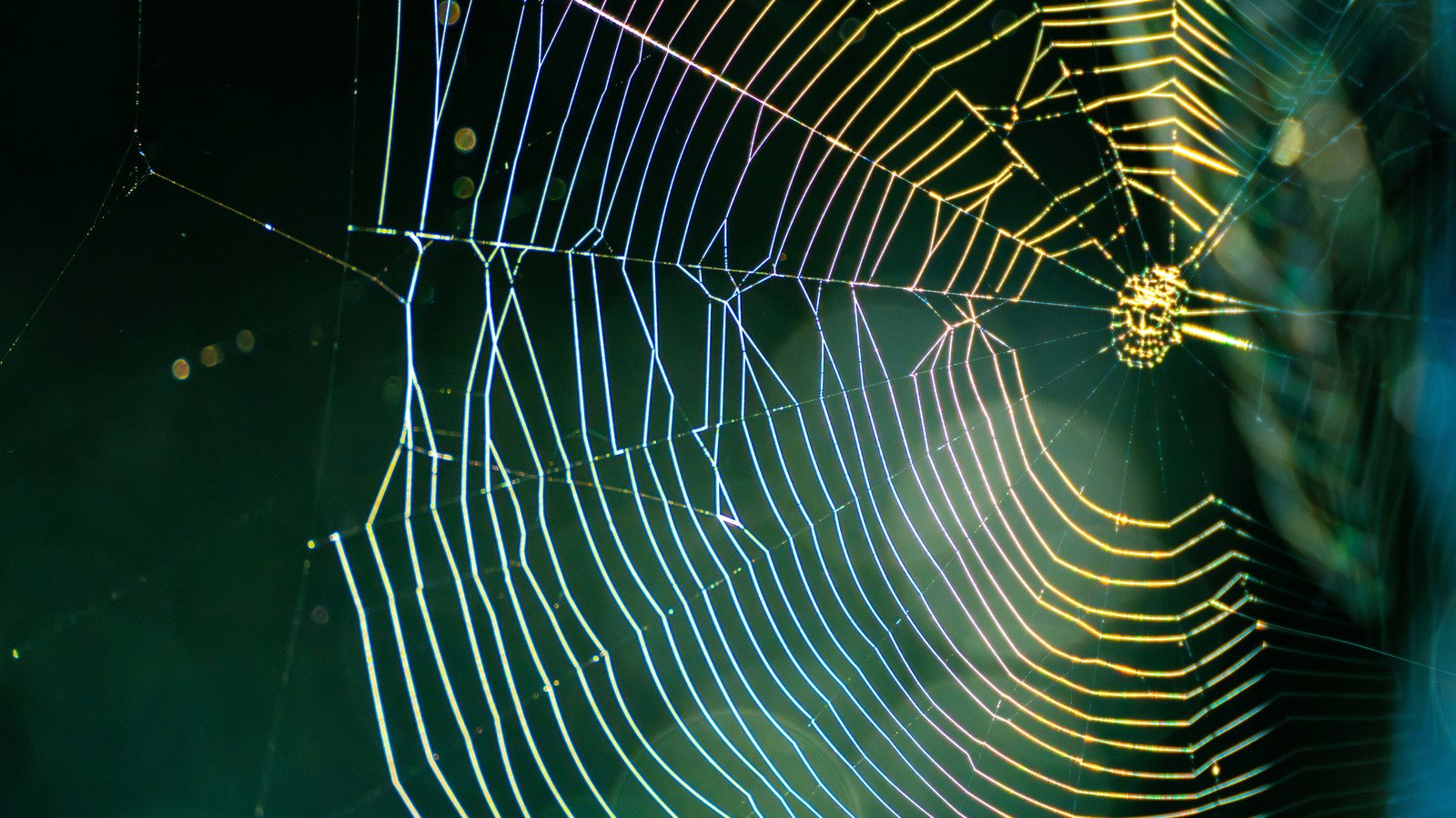
Spiral orb webs are primarily produced by a spider family known as orb weavers (Araneidae), which included the garden orb weaver (Neoscona crucifera) and the golden orb weaver (Nephila clavipes). The spiral orb shape is the most immediately recognizable web type. The massive, sticky spirals fan out from a central point, providing the optimal square footage for the spiders to capture insects or small mammals. These types of spiders are almost exclusively sighted outdoors, and their webs can be found in fields, forests, wetland, and gardens.
Venusta orchard spiders weave horizontal webs
The orchard spider (Leucauge venusta) is a small spider with unique underbelly patterns that range in color from bright greens to dappled reds and construct their webs in bushes, small trees, and other low vegetation. While their webs do bear a resemblance to the spiral orb web, what makes the orchard weaver’s different is that it is spun horizontally or at an angle as opposed to vertically. The spider then waits underneath the web for prey to land. These webs are incredibly effective at catching small insects.
Check your basement corners for cellar spider webs
Though you might know them better as ‘daddy long-legs’, cellar spiders (Pholcus phalangioides) are highly common spiders who prefer the low-light environments of basements. This is where you are likely to find their messy, sometimes enormous, tangle style webs. These cobwebs don’t have a specific structure like those of the orchard or orb weaver spiders, but they do serve a purpose as shelter and a hunting aid. Usually constructed in corners where the wall and ceiling meet, these webs usually aren’t noticed until they’ve been abandoned and started collecting dust.
Grass spiders weave delicate sheets over lawns
Grass spiders are members of the Agelenopsis genus with one of the web structures of any type of spider. The web is a combination of both sheet and funnel structures. The outside of the web is a delicate sheet that acts as a roof. On the outer edge of the sheet is a small, funnel shaped tube that descends down into the cover of the dense vegetation it prefers to hide under. Despite the spider’s relatively small size, the sheets can sometimes be up to three feet long.
The funnel webs of hobo spiders
The hobo spider (Eratigena agrestis) are a common spider in the Pacific Northwest and down into parts of Utah. One way to tell if you have hobo spiders on your property is by their funnel-shaped webs. They construct tunnels in log piles, under vegetation, and even inside of a house. The purpose is to detect prey through the vibrations made on the web walls. While not listed as dangerous to people, finding one in your garden is shocking enough to make you want to test out some beautiful plants that double as spider repellents.
Tube webs at the base of trees are likely purseweb spiders
Tubular spider webs are not to be confused with funnel webs, though they can look remarkably similar. The chief difference between the two is the fact that these tubular webs are constructed almost exclusively at the base of trees. Purseweb spiders (Sphodros spp.) construct this type of webs, which in some cases can reach up to nearly a foot in length. Also unlike funnel webs, these tube webs are used exclusively as camouflage where the purseweb spider can lie in wait for prey to pass by.
Brown recluse spiders build webs to hide in
The brown recluse spider (Loxosceles reclusa) has a much different looking web than any of the other spiders on this list, and uses it for different purposes. The web of a brown recluse spider has no discernible shape, and therefore cannot be associated with any of the aforementioned web structures. Instead, these spiders create small, irregularly shaped daytime ‘retreats’ in which to hide and lay eggs. They do not use their webs to attract or capture prey. Instead, they wait until cover of night to leave their retreats and scavenge for food.
Triangle weaver spiders make three-sided webs
We’re going to end things with one of the most unique spiders in North America: The triangle weaver (Hyptiotes cavatus). This spider completely redefines what a spider web means. As their name implies, they construct three-sided webs to capture prey. However, what makes this spider truly special is that two sides of the web are stationed in place, while the third remains attached to the spider. When prey arrives, it fires the web like a spring-loaded dart, trapping its prey with lightning-like speed. This silk has the highest elasticity of any spider. Fascinating, isn’t it? We definitely think so.