Lamps Aren’t Just Lighting the Room. These Fixtures Are Becoming Part of the Design

Lighting once had a clear set of forms: chandeliers above dining tables, pendants above kitchen islands, floor lamps beside seating, and sconces attached to walls. These interiors keep those functions but change what the fixtures contribute when the lights are on or off.

Brass branches stretch across a kitchen ceiling, wire cages hang above a dining table, glass globes rise from metal frames, and illuminated rings cover a wall like an installation. Some fixtures remove the shade, while others use glass, metal rods, circles, or LED frames to create the form.
What connects them is the amount of space the lighting occupies within each composition. Instead of disappearing after providing light, the fixture becomes another object to design around.
Brass Branches Spread Across the Kitchen Ceiling

A brass chandelier extends across the kitchen island through a network of tubular branches. Hexagonal sections connect at the center, while arms continue toward the outer edges and support vertical white light tubes.
The wide format follows the length of the counter rather than concentrating the fixture above one point. Brass also repeats in the bowl on the island and other small details, while black recessed lights handle additional ceiling illumination without competing with the larger structure.
Open Brass Rings Replace Pendant Shades

Three brass rings hang at separate heights in front of a tall gray wall. Each circle ends in a short horizontal light source at its base, leaving the rest of the fixture open.
Without solid shades, the circles remain visible against the wall while taking up little visual mass. Their placement also creates a second composition after the lights turn on: shadows from the rings land on the wall beside them and repeat their shape.
Wire Cages Give Three Exposed Bulbs Different Forms

Three black wire pendants hang above a long dining table, each built from narrow metal rods surrounding an exposed bulb. The cages differ in width and profile, so the group avoids the repeated row of identical pendants often used above rectangular tables.
Open construction leaves the bulbs visible and allows the wall behind them to show through. Against the burgundy geometric section of wall, the dark wire outlines remain part of the dining area even without large opaque shades.
Shelf Lights and a Task Lamp Share the Office Wall

Lighting is split across the furniture in this workspace. LED strips run beneath two floating shelves and across the recessed wall section, while a compact white task lamp sits at the far end of the desk.
Each source handles a different part of the setup. Shelf lighting traces the horizontal lines of the dark wood panel, and the small lamp directs light toward the work surface without adding a large fixture above the chair.
One White Globe Gives the Floor Lamp Its Shape

A large white globe sits on a thin brass stem that transitions to black near the floor. There is no broad shade or heavy lamp body, leaving the sphere as the dominant part of the fixture.
Its height places the globe against the dark wood wall rather than among the objects on the console. Brass connects the lamp to the small metal pieces on the shelf, while the round globe breaks from the long horizontal lines behind it.
Smoked and Amber Glass Turn Exposed Bulbs Into Floor Lamps

Three lamps use rounded glass enclosures held inside thin black frames. One tall smoked-glass shade rises behind two lower lamps, with amber and white glass creating changes in size and transparency across the group.
The bulbs remain visible through the glass, but each enclosure changes how the light appears. The metal stands keep the glass above the floor and expose the structure beneath it, making the support frame part of each lamp rather than something hidden below a shade.
Glass Pieces Form a Ring Above the Dining Table

A cluster of clear glass pieces forms a broad circle above the rectangular dining table. Thin rods descend from the ceiling and spread outward, suspending the illuminated elements around the perimeter.
The chandelier mirrors the table’s role as the center of the dining area without copying its rectangular shape. Clear glass allows the fixture to occupy a wide span while keeping views open toward the cabinets, mirror, artwork, and wall behind it.
One Room Pairs an Industrial Spotlight With a Glowing Wall Ring

Two different approaches to lighting appear within the same seating area. A tall floor lamp resembles a studio or stage spotlight, with a metal cage, visible hardware, and tripod-like support. Across from it, a compact circular wall fixture creates a ring of light against the concrete surface.
One exposes its mechanical parts while the other reduces the fixture to a small disc and halo. The contrast allows both lights to function as distinct objects rather than matching pieces from one lighting collection.
Interlocking LED Frames Build a Chandelier Without Shades

Bent illuminated frames overlap above the round dining table, forming a large suspended grid. Light comes from the edges of the structure itself, removing the need for separate bulbs surrounded by shades.
The fixture takes up substantial volume above the table but remains open through the center and sides. Its repeated angular lines also contrast with the circular stone tabletop and woven pedestal below.
Two Exposed Bulbs Become a Table Lamp

Two globe bulbs sit at the ends of a U-shaped black support beside the sofa. A narrow stem connects the curved top to the base, reducing the lamp to bulbs and a few sections of metal.
The compact form works beside a table that already provides storage for books and magazines. Instead of adding another shaded lamp with a wide base, the twin bulbs rise above the tabletop and become the most visible part of the fixture.
Bedside Pendants Stack Globes and Metal Forms

Two pendant lights descend beside the bed, combining white globes with dark rounded sections. One hangs lower than the other, creating a staggered pair against the wood-paneled wall.
Suspending the lights leaves the small bedside table open for objects while bringing the bulbs close to bed height. Their rounded shapes also stand apart from the rectangular brass grid, upholstered headboard, and straight wall panels behind them.
Wall Lights Spread Across the Room Like an Installation

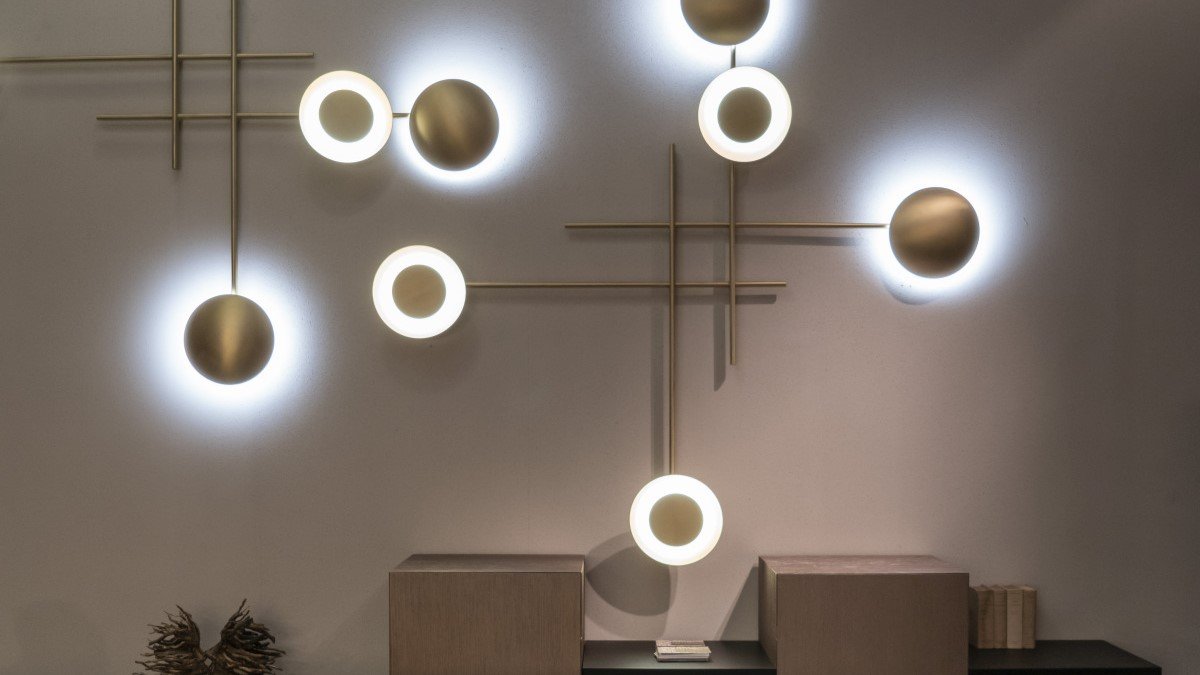
Glowing rings and solid brass discs spread across the wall above a long low cabinet. Thin metal rods connect parts of the arrangement, with some circles attached to vertical stems and others positioned around intersecting horizontal lines
Backlighting creates halos around the solid discs, while the open rings emit light from their edges. Rather than placing two matching sconces at fixed points, the lighting occupies much of the wall and fills the space that might otherwise hold artwork.